In brief
North of Abusir, King Niuserre had a temple dedicated to the sun god Ra built at Abu Ghurab during the 5th Dynasty. It is not his funerary pyramid, which lies further south at Abusir. The sun temple stands out for its vast open court, an alabaster altar and the base of a great stone monument whose elevation has now disappeared, often described as a massive obelisk.
What you discover
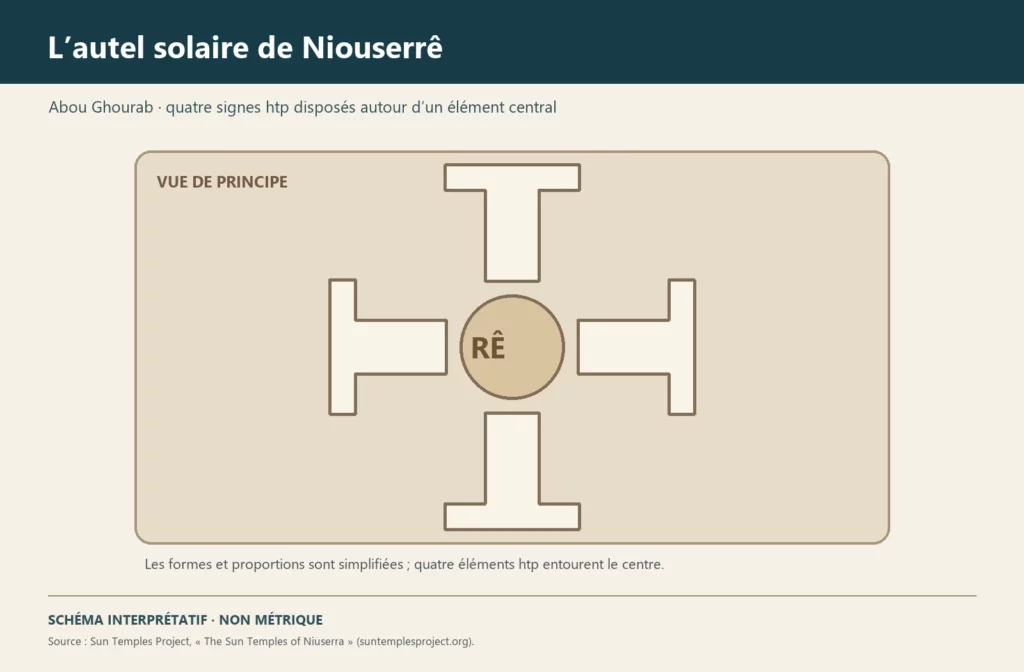
In the upper court, the alabaster altar forms a composition of offering signs around a central disc. Further west, a platform once carried the great solar monument. Its top does not survive: images of a complete obelisk are reconstructions. A decorated corridor led to this platform. Many relief fragments, now dispersed among collections, show among other things the royal Sed festival and scenes of the seasons. A causeway linked the upper temple to a valley temple. Recent excavations have provided new data on this lower part of the site.
Its history
Ludwig Borchardt and Heinrich Schäfer excavated the temple at the end of the 19th and the beginning of the 20th century. Their plans long served as the reference. Since 2010, an Italian mission has resumed research, in cooperation with other teams. In December 2025, it announced the uncovering of new remains of the valley temple, which had already been partly explored in the past. Studies of the reliefs also point out that the scenes of the royal jubilee do not give the complete, assured sequence of a ceremony: their order and interpretation are still debated.
Why this place matters
This place sheds light on the role of the sun in the kingship of the 5th Dynasty. The altar, the open court and the great stone base organise a ritual space different from a pyramid tomb. The relief fragments link the king to the cycle of the seasons and to ceremonies of renewal. The site invites us to distinguish what survives on the spot, the blocks kept in museums and the parts reconstructed by hypothesis.