In brief
At Abusir, south of Giza, Sahure had a funerary complex built during the 5th Dynasty. His pyramid is now badly ruined, but the remains of its temples and their decoration make it a major site. A causeway linked the temple next to the pyramid to a valley temple. This route helps us understand that the royal tomb was surrounded by places of ritual and of images.
What you discover
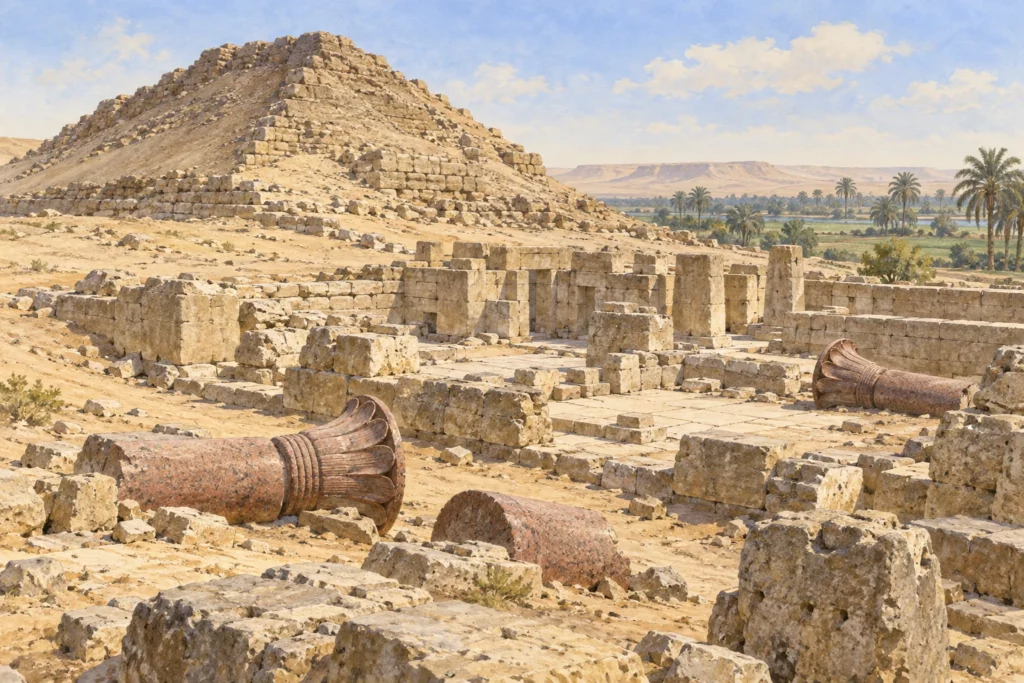
The mortuary temple stood against the east side of the pyramid. An open court was once lined with sixteen granite columns crowned with a capital imitating palm fronds. The columns are now dispersed or moved; one is kept in the Metropolitan Museum in New York. The walls were covered with coloured reliefs: the sovereign facing the gods, defeated enemies, offering bearers. The causeway ran down to the valley temple, at the edge of the cultivated land. On site, the walls are fragmentary and the pyramid has lost its casing; images of intact buildings are reconstructions.
Its history
Sahure, the second king of the 5th Dynasty, developed at Abusir a complex that served as a model for later ones. Ludwig Borchardt excavated the temple at the beginning of the 20th century and published its reliefs and architecture. Recent research has resumed the study of the causeway and of the interior of the pyramid. In 2019–2022, the team led by Mohamed Ismail Khaled documented decorated blocks, storerooms and parts of the substructure while consolidating threatened areas. These discoveries show that the early plans did not tell the whole history of the monument.
Why this place matters
The site shows a shift of emphasis in royal building: the pyramid is less imposing than at Giza, but the temples and their reliefs tell more broadly of the sovereign’s cult. The palm columns, the route of the causeway and the carved scenes link materials, architecture and political message. The ruined state of the place nevertheless calls for a distinction between the blocks observed and the halls reconstructed by researchers.