Identification and location
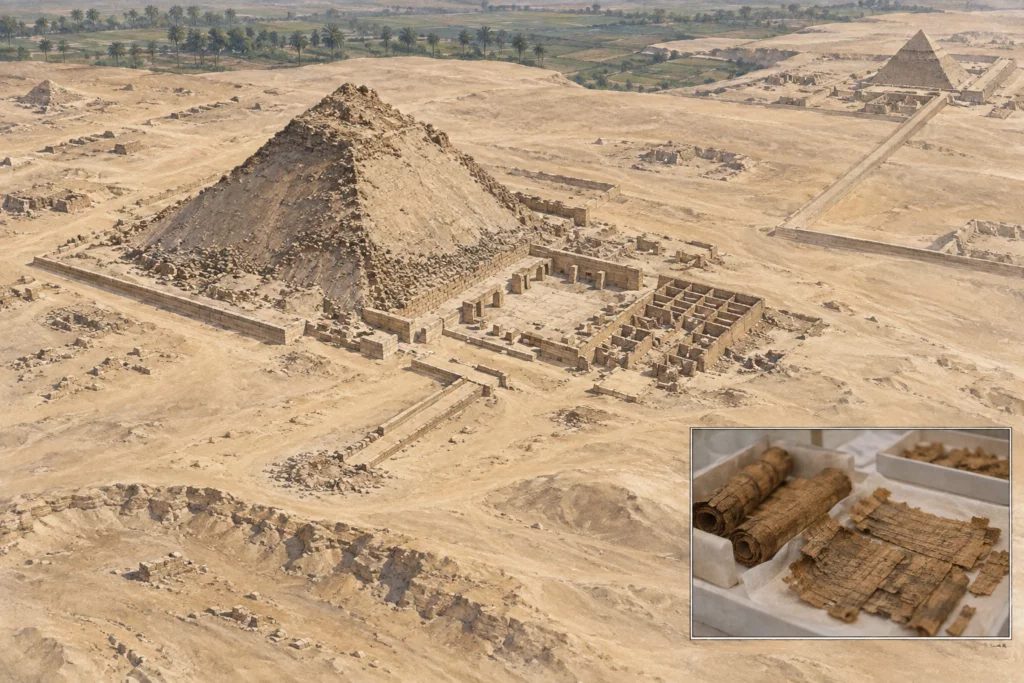
The pyramid of Neferirkare Kakai belongs to the royal necropolis of Abusir, between Giza and Saqqara. The king reigned during the 5th Dynasty, after Sahure. The complex comprises the pyramid and an eastern mortuary temple whose history is marked by partial completion and adaptations. The Czech Institute of Egyptology states that a valley temple is missing and that the unfinished causeway was taken over when the complex of Niuserre was built. The pyramid and its temple are also the place of origin of an important group of administrative archives on papyrus.
General presentation
This site stands out because its built remains can be compared with documents produced by the cult’s officials. The temple was not just a setting for royal ceremonies: it was also a place of storage, of the circulation of goods, of the presence of priests and of administrative control. The pyramid had dynastic importance in the landscape of Abusir, but its ruined state should not hide the continuity of these activities. The data in the papyri concern the running of the cult and are not equivalent to a detailed architectural plan.
Monuments and remains
The pyramid retains a very eroded core and has lost most of its casing. The mortuary temple to the east combines stone parts with sectors built in mudbrick. The storeroom and service areas are essential for understanding the archives. Remains of the priests’ settlement in the temple are reported by the Czech Institute. The causeway planned for the complex was never brought to a valley temple of Neferirkare’s own. One should therefore not automatically attribute to it the complete, finished arrangement of the other pyramid complexes. The pyramid of Khentkaus II and other neighbouring monuments belong to distinct programmes, which must be placed without merging them with the royal monument.
Chronology and building phases
Construction began under Neferirkare; it probably did not achieve all of its original aims before his death. Additions in mudbrick made it possible to bring the mortuary temple into service. The unfinished causeway and the absence of a completed valley temple bear witness to changes of programme. Niuserre reused part of this infrastructure for his own complex, which long complicated the reading of the relationships between the sites. The temple of Neferirkare then had a cult life documented by the papyri. The phases of construction, service and reuse must not be reduced to a single date.
The pyramids of Abusir seen from Saqqara
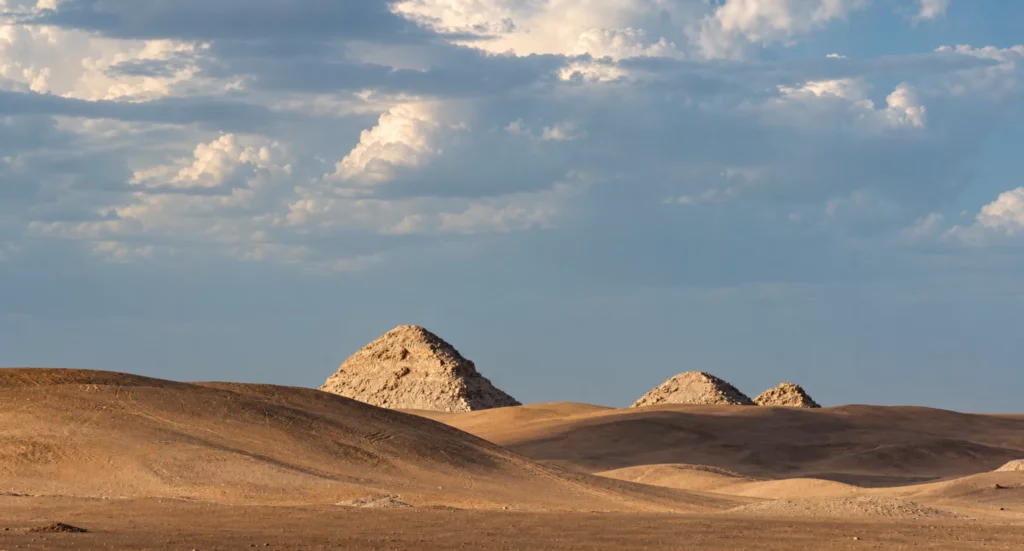
From the area of the Serapeum at Saqqara, looking north, the eye meets the three great pyramids of Abusir. Beyond the undulations of the desert, their silhouettes can be read from the nearest to the farthest:
- The pyramid of Neferirkare Kakai, on the left, dominates the foreground. It is the largest pyramid in the Abusir necropolis.
- The pyramid of Niuserre Ini appears behind it, offset to the right. Smaller, it occupies the space between the complexes of Neferirkare and Sahure.
- The pyramid of Sahure, the farthest away, can be made out in the far distance on the right. It was the first royal pyramid built at Abusir.
The order of the landscape therefore does not follow that of the reigns: Sahure opens the history of the royal necropolis, followed by Neferirkare and, later, Niuserre.
History and functions
The pyramid was intended for the royal burial, while the temple housed the rites and offerings made to the dead king. The Abusir papyri provide information on the rotation of staff, inventories, deliveries and the administration of the cult. They take the study from monumental architecture to an institution functioning day after day. Their fragmentary preservation calls for cautious reading: a missing document does not prove that an activity was absent. The monument thus illustrates a pragmatic adaptation of an incomplete building site and the persistence of a religious service over time.
Excavations and the history of research
Fragments of Neferirkare’s archives entered European collections at the end of the 19th century, before their context had been fully studied. Later excavations and publications made it possible to attribute the documents and the remains of the temple more securely. The Czech Institute of Egyptology, active at Abusir, provides an overview of the royal monuments and their relationship with the archives. University College London points out that the papyri come from the administrative papers of Neferirkare’s cult. Sheets kept in the British Museum materially document this group. Paule Posener-Kriéger’s foundational study of the archives remains a reference, to be compared with more recent research on the neighbouring complexes.
State of preservation and research questions
The erosion of the pyramid’s core and the fragility of the brick masonry limit the reading of heights and circulation. The papyri are dispersed and fragmentary, which means that documentary series must be reconstructed rather than a continuous file read. The phrase ‘unfinished pyramid’ describes one aspect of the project, but should not suggest that no cult was practised there. The relationship of the causeway with Niuserre and the extent of the alterations to the temple are questions of phasing and topography.
Sources
Main sources: Czech Institute of Egyptology, ‘Central Abusir (Royal)’, https://cegu.ff.cuni.cz/en/research/projects/field-projects/abusir/list-of-structures-in-abusir/central-abusir-royal/; Czech Institute, ‘Abusir in the Third Millennium BC’, https://cegu2.ff.cuni.cz/en/research/projects/field-projects/abusir/abusir-in-the-third-millennium-bc/; University College London, Digital Egypt, ‘Abusir’, https://www.ucl.ac.uk/museums-static/digitalegypt/abughurab/abusir.html; British Museum, record of a sheet of the Abusir Papyri, https://www.britishmuseum.org/collection/object/Y_EA10735-17; Paule Posener-Kriéger, Les Archives du temple funéraire de Néferirkarê-Kakaï, Cairo, 1976 (online sources consulted on 27 September 2026).