Identification and location
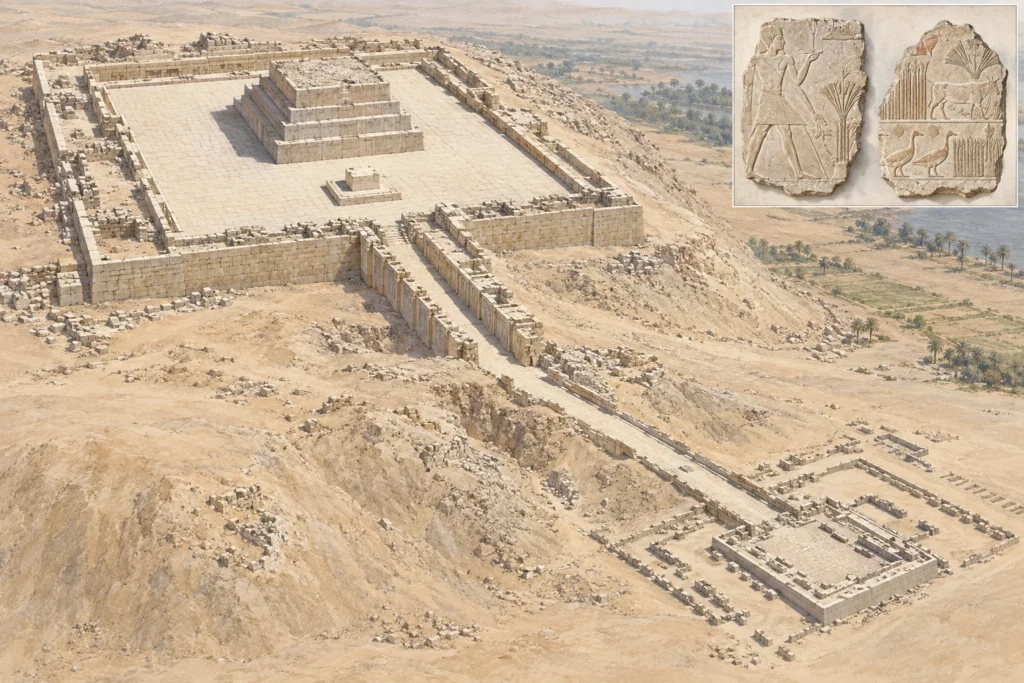
The sun temple of Niuserre lies at Abu Ghurab, north of the royal necropolis of Abusir. It belongs to the 5th Dynasty and is distinct from the same king’s funerary pyramid, built at Abusir. The solar complex comprises an upper temple on a rise, a causeway and a valley temple. Its ancient name, Shesep-ib-Ra, appears in the documentation of the site. The organisation of the space around an open court, an altar and an obelisk-shaped stone monument served the cult of Ra, but the exact rituals must be reconstructed with caution.
General presentation
The temple is one of the few sun sanctuaries of the 5th Dynasty identified on the ground, and one of the easiest to read. The centre of the court preserves an alabaster altar made up of four large elements evoking the Egyptian sign for offering and a circular central piece. To the west lies the massive base of a stone monument whose elevation has disappeared. Drawings of a complete obelisk visualise a hypothetical reconstruction, not a state still standing. The reliefs discovered in the passages and halls add exceptional documentation on the royal jubilee and the cycles of the natural world.
Monuments and remains
The upper temple combined an open-air court, an altar, decorated corridors and the platform of the solar monument. The relief fragments from the corridor towards the obelisk and from a neighbouring chapel depict episodes of the Sed festival; the ‘Chamber of the Seasons’ bore scenes of nature and human activity. The finds are fragmentary: University College London stresses that a large part of the reliefs has been lost. The causeway ran down to the valley temple. The latter, long less well known because of the excavation conditions, is the subject of new research. The remains of the sanctuary of Userkaf, another sun temple at Abu Ghurab, belong to a distinct monument and must not be merged with that of Niuserre.
Chronology and building phases
The construction dates from the reign of Niuserre during the 5th Dynasty. The early work of Ludwig Borchardt and Heinrich Schäfer produced the first detailed plans, but recent observations are re-examining certain sectors. Since 2010, a mission from the University of Naples L’Orientale, together with other institutions, has resumed investigations. The Sun Temples Project reports that remains of the valley temple were announced in December 2025 after recent seasons. This discovery does not create a new, separate temple: it clarifies a part of the complex known from earlier documentation and raises questions about its approaches and phases. The identification of older masonry beneath the upper sanctuary remains to be interpreted and must not be presented as a certain attribution to another king.
History and functions
The altar and the open court placed the offerings in a setting associated with Ra and with sunlight. The reliefs of the Sed festival present episodes of the renewal of kingship; those of the seasons evoke the ordered life of the world. Their meaning must be studied in connection with the routes and places of worship, without assuming that they document every act actually performed by Niuserre. UCL points out that no surviving text gives a complete description of the order of the Sed festival. The titles of priests known from contemporary tombs show, moreover, that staff served the sanctuary. The sun temple and the king’s pyramid both contributed to his representation, but they occupied different places and had distinct programmes.
Excavations and the history of research
The site was excavated in 1898–1901 by Borchardt and Schäfer for the Berlin museums, according to UCL’s Digital Egypt. Publications of the early 20th century circulated the plans and reliefs. Some of the fragments are kept in the Petrie Museum and in other collections, which means that the displaced objects must be linked back to their original context. The Sun Temples Project has resumed the archaeology of the upper temple and its surroundings since 2010; its work on the altar, the platform and the valley temple is reassessing the old reconstructions. The announcement of December 2025 about the lower temple illustrates the value of the new excavations, but the detailed conclusions will have to be assessed as the scientific reports appear.
State of preservation and research questions
The upper walls and the elevation of the great monument have disappeared, while the altar and several foundations remain identifiable. The reliefs are incomplete and dispersed. The reconstructions of the height of the monument, of some corridors and of the order of the decorative programme involve different degrees of uncertainty. The new data on the valley temple do not yet justify a definitive plan of all its spaces.
Sources
Main sources: University College London, Digital Egypt, ‘Abu Ghurab’, https://www.ucl.ac.uk/museums-static/digitalegypt/abughurab/index.html; UCL, ‘Plan of the Sun Temple of king Neuserre’, https://www.ucl.ac.uk/museums-static/digitalegypt/abughurab/plan.html; UCL, ‘Background information on the reliefs’, https://www.ucl.ac.uk/museums-static/digitalegypt/abughurab/info.html; Sun Temples Project, ‘The Sun Temples of Niuserra’, https://www.suntemplesproject.org/the-sun-temples-of-niuserra/; Sun Temples Project, announcement of 12 December 2025, https://www.suntemplesproject.org/news/; Czech Institute of Egyptology, ‘The Rise and Development of the Solar Cult’, https://cegu.ff.cuni.cz/en/research/grants/the-rise-of-solar-cult/ (online sources consulted on 27 September 2026).