Identification and location
The funerary complex of Djedefre, also called Radjedef, occupies a high plateau at Abu Rawash, about eight kilometres north-west of Giza. Its ancient name is translated as ‘The firmament of Djedefre’. The ruler, a son of Cheops, belongs to the 4th Dynasty; the chronology of this list places his reign c. 2566–2558 BC, while the exact length of the reign is debated. The monument must not be confused with the older necropolises or the private mastabas of Abu Rawash. The attribution to the king is secured by inscribed statue fragments discovered in the complex. Its present, very low form reflects heavy destruction and does not necessarily represent a pyramid abandoned during construction.
General presentation
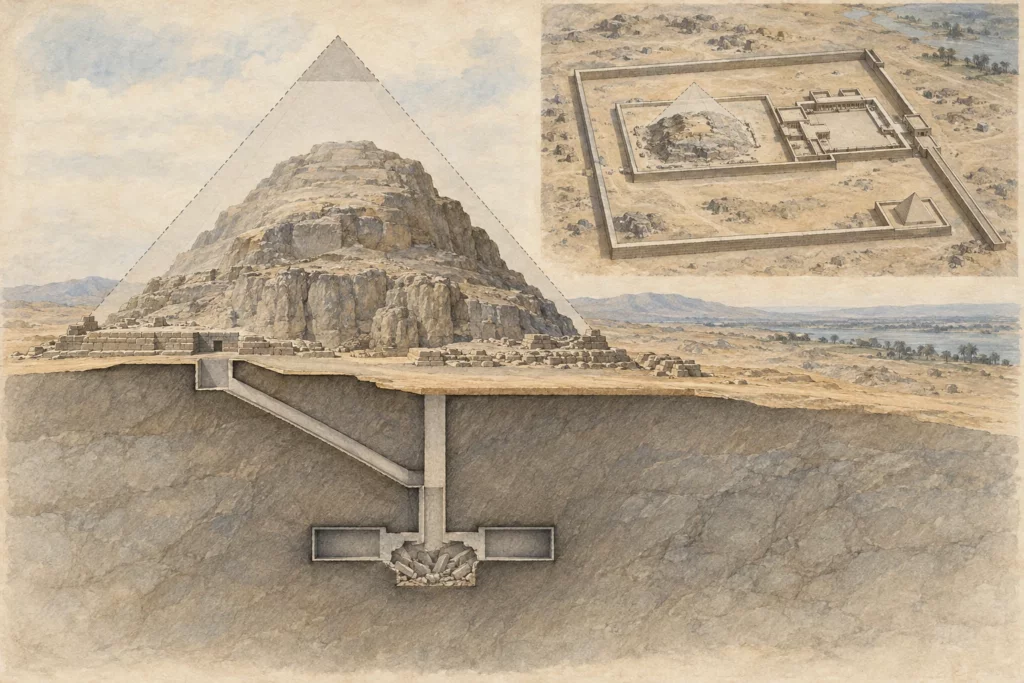
The pyramid was built by incorporating a natural rocky outcrop into its core. Around it lay enclosures, a mortuary temple, an ascending causeway, a reception sector and a satellite pyramid. Research by the Institut français d’archéologie orientale (IFAO, French Institute of Oriental Archaeology) and the University of Geneva has renewed the interpretation of the site: ancient dismantling may have made a building that was probably finished look like an unfinished project. The discovery of organised cult components supports this reading. The investigation does not, however, restore all the lost surfaces and elevations. Abu Rawash therefore offers a case study in the construction of a pyramid that made use of the rock, in the life of a royal complex and in the effects of later quarrying.
Monuments and remains
The IFAO estimates the base of the project at about 106 metres a side and a reconstructed height of close to 67 metres; these are reconstruction values, not the dimensions of the present ruin. A large part of the internal mass rested on the natural inselberg. The pyramid retains a descending passage and a T-shaped central arrangement including a shaft intended for the royal burial chamber; the burial chamber itself was almost entirely destroyed. Two enclosure walls, with monumental gateways, structured the complex. To the east were buildings linked to the temple, courts, storerooms and living or service spaces; an ascending causeway linked the plateau sectors with the approach. A boat-shaped cavity was observed in one of the buildings of the complex, though not all its details should be equated with an intact boat pit. A small satellite pyramid to the south-east underwent, according to the excavations, a change of function and was reused for the burial of a woman.
Chronology and building phases
Djedefre’s building work followed that of Cheops, but the exact progress of the works is not dated year by year. The inscribed fragments and the cult buildings firmly attach the programme to the king’s reign. Recent excavations have called into question the tradition of a simply unfinished pyramid, by showing the scale of the stone robbing. According to the IFAO, the demolition of the funerary sector continued notably in the Roman period, and quarrying profoundly transformed the superstructure and the internal spaces. The enclosures, the temple and the causeway lend weight to the hypothesis of a completed, functioning complex. The satellite pyramid itself has a history in several phases, first for the cult and then probably linked to the burial of a queen. A distinction must therefore be made between the initial project, the ancient uses, the reuse and the late destruction.
History and functions
The complex fulfilled the usual royal funerary function of the 4th Dynasty, with a central pyramid and spaces for the cult of the sovereign. The courts, chapels and statues provided a setting for the representation of the king and his family. The storerooms and service spaces show that the running of the cult involved staff and resources. The satellite pyramid adds a ritual dimension, and then a funerary one if the interpretation of its reuse is accepted. The mastabas of the neighbouring necropolis F, studied separately by the IFAO, bear witness to the elite of the reign. Their presence contradicts the simplistic idea of a ruler entirely isolated or erased from the memory of the court. The precise functions of each room cannot all be read directly from the surviving foundations, however.
Excavations and the history of research
Nineteenth-century travellers, among them John Shae Perring and Karl Richard Lepsius, described the site. Flinders Petrie had a trial trench dug between 1880 and 1882. The IFAO’s excavations on the eastern side, carried out under Émile Chassinat in 1901–1902, yielded fragments of quartzite statues, some inscribed with the name of Djedefre. Pierre Lacau resumed research in 1912–1913. From the mid-1990s, a joint mission of the IFAO and the University of Geneva, directed by Michel Valloggia, re-examined the pyramid, its substructures, the enclosures and the buildings of the complex. The seasons up to 2007 led to a reassessment of how far the pyramid had been completed and of the scale of the demolition. Studies of the private necropolis F have completed the social and chronological picture of the reign.
State of preservation and research questions
The exploitation of the limestone, erosion and the destruction of the internal spaces severely limit the reading of the pyramid. The rock core and the descending passage are material facts; the complete height, the final silhouette and some details of the temples remain reconstructions. The IFAO considers the completion of the pyramid likely, but the degree of certainty must be preserved in the wording. Roman quarrying explains a large part of the ruin, though not every missing block can be attributed to a specific episode. Current conservation issues include urban growth and the exploitation of limestone around Abu Rawash. The discovery illustration provided separately evokes the ruined site.
Sources
Main sources: Institut français d’archéologie orientale, ‘Abou Rawach’, overview of the mission (in French), https://www.ifao.egnet.net/uploads/docs/sites/IFAO-abou-roach_2012.pdf; IFAO, report on the first seasons of the Valloggia mission, BIFAO 96 (in French), https://www.ifao.egnet.net/bifao/096/12; UCL Digital Egypt, ‘King Djedefre’, https://www.ucl.ac.uk/museums-static/digitalegypt/chronology/kingdjedefre.html; Griffith Institute, Topographical Bibliography III/1, section ‘Abû Rawâsh’, https://www.griffith.ox.ac.uk/topbib/pdf/pm3-1.pdf.