Identification and location
Cemetery M lies at Abu Rawash, about eight kilometres north-west of the Giza plateau. It occupies a small rocky spur about twenty-five metres above the plain to the north-west. The site has yielded twenty-five mudbrick tombs dated to Naqada IIIC2, corresponding to the middle of the 1st Dynasty, mainly the reign of Den according to the mission’s pottery study. The letter M recalls Pierre Montet, who excavated the sector in 1913–1914. This necropolis is distinct from the pyramid complex of Djedefre, a ruler of the 4th Dynasty: several centuries of history separate them. It must also be distinguished from other cemeteries on the same site, notably those of the Old Kingdom.
General presentation
The discovery of the M tombs was important because it revealed, in Lower Egypt, 1st Dynasty buildings comparable in some respects to the monuments known further south. Their architecture and grave goods shed light on the role of a local elite in the integration of the Memphite region into the emerging royal power. The mastabas are large, but nothing justifies making them royal tombs: the kings of the 1st Dynasty have their necropolis at Abydos. The seal impressions bearing the name of Den help to date and contextualise certain deposits. They are not funerary ownership inscriptions attributing each monument to the king. Above all, the cemetery makes it possible to compare the ways tombs of the same chronological horizon were built, closed and equipped.
Monuments and remains
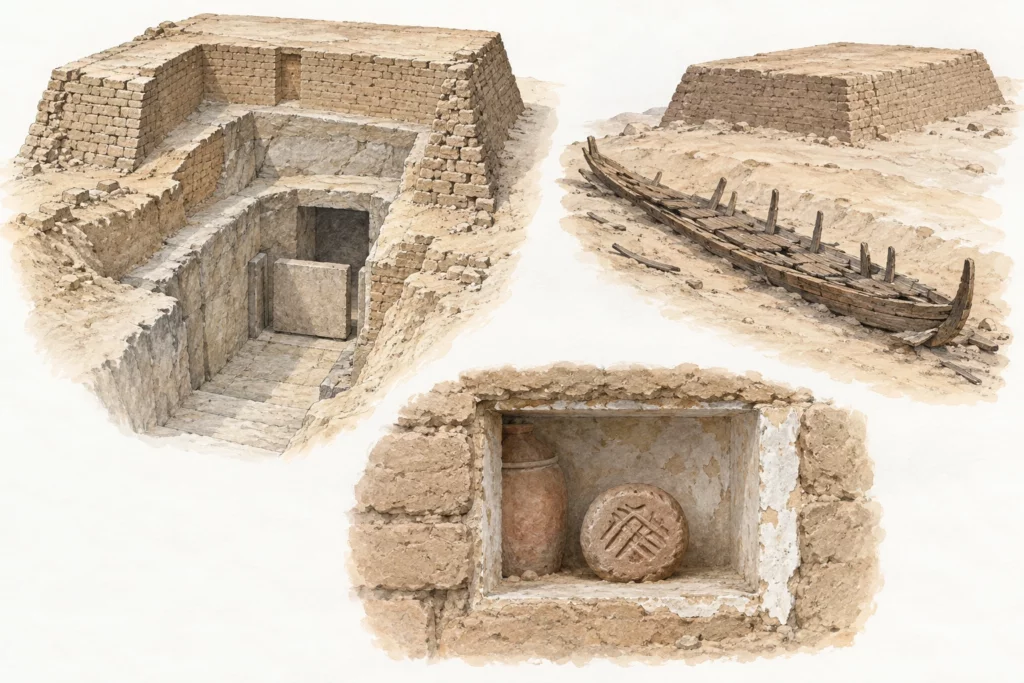
The large monuments combine a mudbrick mass, external niches or recesses and a burial chamber cut into the rock. Recent excavations have documented how the walls were built and bonded, traces of plaster on the outer faces, levelling layers and deposits placed beneath the foundations, including pottery, shells and cattle horns. At mastaba M02, a stone portcullis slab was still in place at the entrance to the chamber. Subsidiary tombs accompany some mastabas and sometimes retain their grave goods. The case of mastaba M06 stands out for the discovery of the remains of a wooden funerary boat nearby. This boat is not part of the equipment of M02: these examples belong to different monuments. The degraded state of the superstructures makes it necessary to distinguish the excavated elements from their supposed elevation.
Chronology and building phases
The whole belongs to the Naqada IIIC2 phase and, according to the pottery studied, is concentrated in the reign of Den, in the middle of the 1st Dynasty. This relative chronology is reinforced by several radiocarbon dates obtained from varied materials, including bricks, wood and remains of the boat. The measurements and their calibration must be read together with the archaeological contexts, not as an identical date for all the tombs. The twenty-five known burials were not necessarily built in a single campaign. The pyramid of Djedefre, visible in the later history of Abu Rawash, belongs to the 4th Dynasty, towards the middle of the 3rd millennium. Its building site and the necropolis that depends on it do not explain the construction of Cemetery M, which is much older.
History and functions
The tombs show a community able to mobilise brickmakers, rock-cutters, carpenters and makers of objects. The closing devices protect the chambers, while the niches and foundation deposits give the monument a visible or ritual dimension. The funerary boats associated with several mastabas attest to an important practice of this horizon; their exact symbolic interpretation calls for caution. The anthropological examination of the subsidiary tombs revealed individuals of varied ages and sexes, with no trace of violence identified on the skeletons studied. The excavators regard these data as contradicting the hypothesis of people sacrificed to accompany the occupants of the large mastabas. This conclusion concerns the contexts studied at Abu Rawash and should not automatically be extended to all the necropolises of the first dynasties.
Excavations and the history of research
Pierre Montet began excavating Cemetery M in 1913–1914; Adolf Klasens and a team from Leiden continued the study in 1957–1959. From 2009 to 2014, the Institut français d’archéologie orientale (IFAO, French Institute of Oriental Archaeology) re-examined the monuments under the direction of Yann Tristant. Fifteen mastabas were completely re-excavated, together with subsidiary tombs, some of them intact. The researchers drew new plans, recorded the construction details and studied the objects kept in several collections, including those of the Louvre and the University of Strasbourg. Jane Smythe worked on the pottery; the radiocarbon dates complement the typological comparisons. The study of the M06 boat was the subject of a dedicated publication. This return to the archives and to the field corrects the gaps in the early excavations while making the place of Cemetery M in the Memphite region easier to read.
State of preservation and research questions
The monuments have been badly damaged, which limits the reconstruction of their height and of some features. The data from the early excavations are not always as precise as recent surveys. Most of the grave goods must be put back into their find context before any social interpretation. The impressions bearing the name of Den are chronological and administrative evidence, not proof of a royal burial on the spot. The anthropological conclusions about the absence of sacrifice rest on the skeletons actually examined. Finally, the images supplied separately are an evocation and a non-metric plate: they bring together attested types of remains, without reproducing the exact plan of a mastaba or confusing M02 and M06. The history of Cemetery M must not be mixed up with that of the pyramid of Djedefre.
Sources
Institut français d’archéologie orientale, ‘Abou Rawach : une nécropole protodynastique au nord-ouest de Gîza’ (in French). https://www.ifao.egnet.net/archeologie/abou-roach/ (consulted on 26 September 2026).
Tristant, Yann, ‘Les tombes des premières dynasties à Abou Roach’, Bulletin de l’Institut français d’archéologie orientale 108, 2008, pp. 325–370 (in French). https://www.ifao.egnet.net/bifao/108/15/ (consulted on 26 September 2026).
Tristant, Yann, et al., ‘Barques sur le Nil… Le mastaba M06 d’Abou Rawach et sa barque funéraire’, BIFAO 114/2, 2014, pp. 563–588 (in French). https://www.ifao.egnet.net/bifao/114/22/ (consulted on 26 September 2026).
University of Strasbourg, ‘Étude du matériel d’Abou Rawach’ (in French). https://egypte.unistra.fr/la-collection-de-linstitut-degyptologie/travaux-sur-la-collection/accueil-de-chercheurs-et-de-visiteurs/operation-etude-du-materiel-dabou-rawach/ (consulted on 26 September 2026).