Identification and location
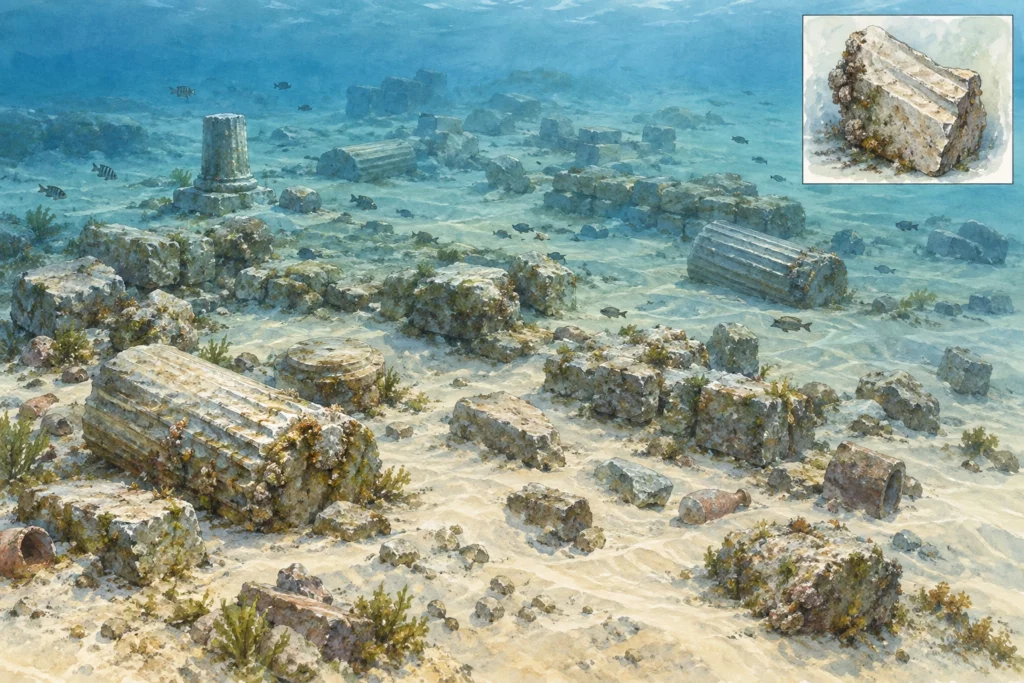
Thonis (the Egyptian name) and Heracleion (the Greek name) refer to one and the same city, at the former mouth of the Canopic branch of the Nile, in the western part of Aboukir Bay, about thirty kilometres north-east of Alexandria. Its remains lie at a depth of about ten metres, some 6.5 kilometres from the present shore; the area surveyed by the IEASM in the bay measures 11 kilometres by 15. The equivalence of the two names, long debated, was established by the stela of the decree of Sais found in 2000; the Canopus decree (238 BC) also mentions Amun-Gereb as the main deity of Heracleion.
A customs port of the Late Period
The city was probably founded around the 8th century BC; coins and pottery place its peak between the 6th and the 4th century BC. Before the foundation of Alexandria, it was the compulsory port of entry and the customs post of Egypt for Mediterranean traffic. Herodotus mentions a great temple of Heracles there; Strabo (Geography, XVII, 1, 18) still mentions, after Canopus, the Heracleion with its temple of Heracles, then the Canopic mouth, the main emporion of the Delta. The temple of Amun-Gereb was destroyed around the middle of the 2nd century BC in a catastrophic event; struck by successive natural disasters, the city sank entirely in the 8th century AD.
The domain of Amun-Gereb on the central island
The sanctuary of Amun and his son Khonsu was built between 450 and 380 BC, when settlement shifted towards the central island. Its domain exceeded three hectares; the enclosure was made of limestone blocks. The monolithic pink granite naos (1.74 m high, 0.93 m wide, 1 m deep) bears three epithets of the god, including ‘he who presides over the mekes’. The texts of the lintel and jambs are almost illegible. RTI imaging did not make it possible to identify the dedicating sovereign. Three pink granite colossi more than five metres high represented a royal couple and Hapy, the latter 5.4 metres high. A canal ran along the south face of the temple: a Ptolemaic galley moored at a landing stage was pinned to its bottom by the fall of the blocks. Silver ritual instruments, gold jewellery and alabaster perfume vases complete the finds.
The stela of the decree of Sais
A black granodiorite stela 1.99 metres high, dated to year 1 of Nectanebo I (around 380 BC). The decree assigns to the temple of Neith at Sais a share of the customs duties collected at Thonis and of the taxes on Greek trade at Naucratis. It reproduces almost word for word the stela of Naucratis, found in 1899, from which it differs only in the instruction to set it up ‘at the mouth of the Sea of the Greeks’, in a city named Thonis. The stela had been deliberately buried face down, its hieroglyphs coated with clay. Anne-Sophie von Bomhard has published its palaeographic study (IFAO, 2025), which reveals a previously unknown Egyptian place name, Hone of Sais.
Basins, anchors and wrecks
The port had many large basins. More than 700 anchors have been recorded. The number of wrecks grows with each season: the Oxford Centre for Maritime Archaeology published at least 64, the IEASM now counts 125, dated from the 6th to the 2nd century BC. Several of them (ships 11, 17 and 43) are the subject of monographs.
A city still largely buried
The IEASM, directed by Franck Goddio, has worked in Aboukir Bay since 1996 with the Egyptian antiquities authorities; the University of Oxford joined the excavations in 2011. The IEASM estimates that it has uncovered only about 5% of the city. Open questions concern the topography of the islands and channels, the conditions in which the wrecks were deposited, the exact causes and chronology of the submersion, and the links between Thonis-Heracleion, Canopus and Naucratis.
Sources
Main sources (consulted on 30 September 2026): Sunken Civilizations: Thonis-Heracleion, Franck Goddio / European Institute for Underwater Archaeology; Temple of Amun-Gereb, Franck Goddio / IEASM; Oxford Centre for Maritime Archaeology, School of Archaeology, University of Oxford.