Identification and location
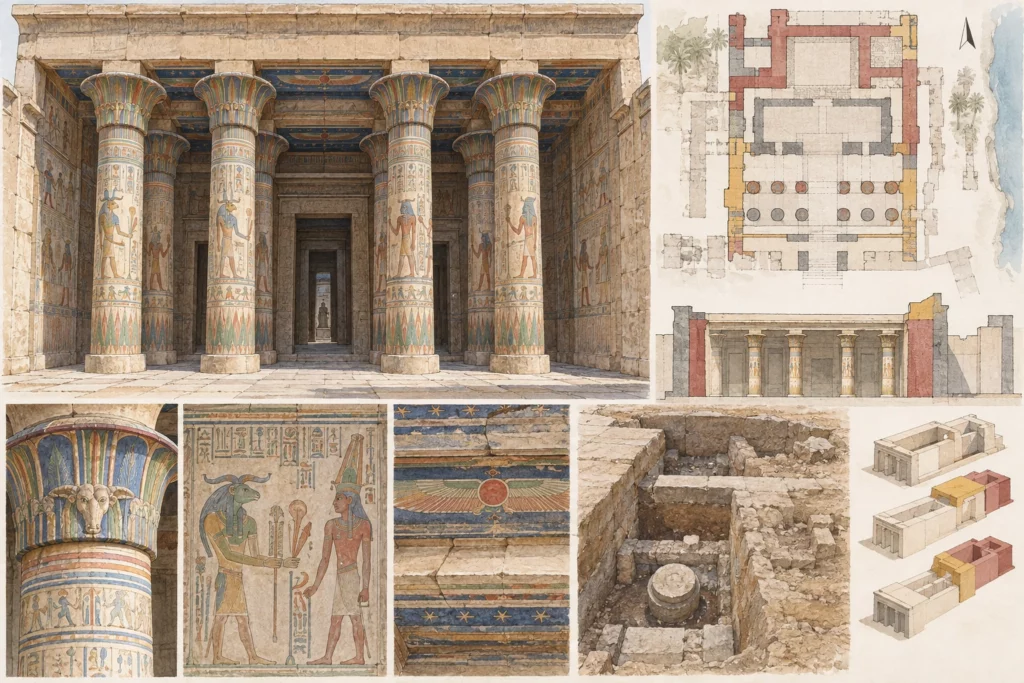
The temple of Khnum at Esna, ancient Latopolis, stands at the heart of the modern town, on the west bank of the Nile, about fifty kilometres south of Luxor. Only its hypostyle hall, the pronaos, survives; it lies about 9 m below the level of the modern streets, built up by centuries of occupation.
Architecture and decoration
The pronaos is a hall of 24 columns with varied floral capitals, beneath an astronomical ceiling. The walls and columns are covered with inscriptions: hymns, festival calendars and theological texts. Khnum is celebrated there as a creator god, shaping beings on his potter’s wheel; the goddess Neith also plays a major role in the creation accounts.
Chronology and building phases
The pronaos was added in the Roman period, in front of a Ptolemaic temple that has since disappeared. Its decoration extends over the first two centuries AD and beyond; the name of the emperor Decius, in the middle of the 3rd century, is among the last royal mentions in hieroglyphs.
History and functions
Esna was a centre of the cult of Khnum and Neith. The texts of the pronaos, published by Serge Sauneron for the Institut français d’archéologie orientale (IFAO, French Institute for Oriental Archaeology), are an essential source for the theology of late ancient Egypt.
Recent restoration
An Egyptian-German mission, associated with the University of Tübingen, has cleaned the columns and ceilings blackened by soot and deposits. The work has revealed bright colours and many details, presented in the exhibition The Colours of the Cosmos. The Egyptian ministry notes in particular new details of the royal and divine costumes, and a scene of priests carrying the sacred barque of Khnum.
State of preservation and research questions
The position of the temple, below the level of the town, raises problems of humidity and drainage. Research focuses on the texts, on the polychromy revealed by the cleaning and on the vanished parts of the temple.
Sources
Main sources (consulted on 28 September 2026): Egyptian ministry, new details of the decoration of the temple of Esna; University of Tübingen, exhibition The Colours of the Cosmos (temple of Esna).