Identification and location
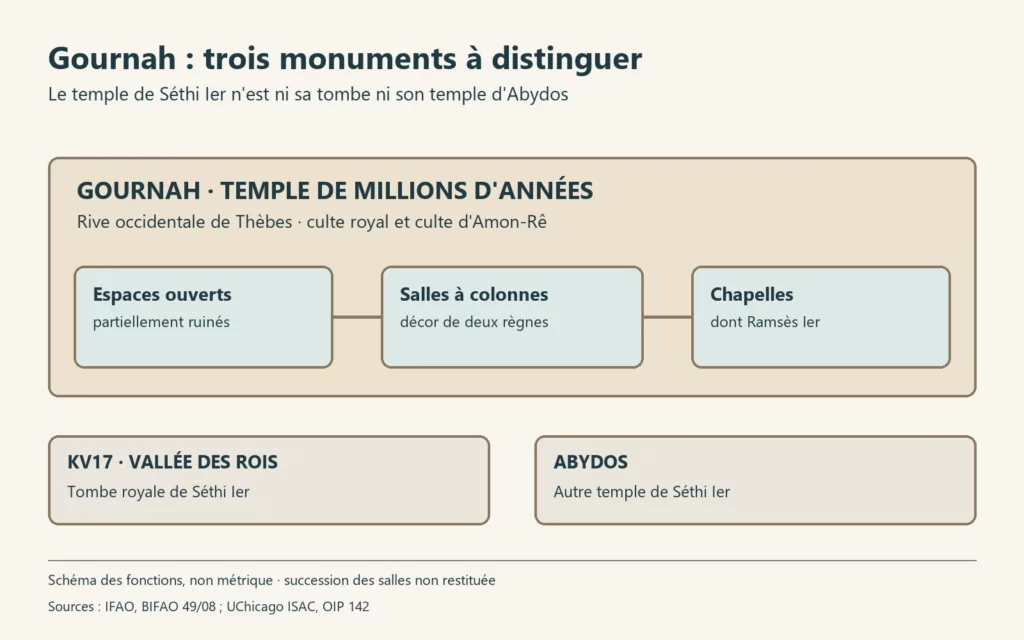
The temple of millions of years of Seti I stands at Qurna, on the west bank at Thebes, among the monuments of the Theban necropolis. It belongs to the landscape of the temples of royal cult, on the edge of the cultivated land, while KV17, the king’s tomb, is cut into the Valley of the Kings. His temple at Abydos responds to another religious context. A photograph or plan of the three places cannot be interchangeable.
General presentation
The site preserves open spaces, a hypostyle hall and cult rooms whose study depends on the inscriptions and the remains. The eastern areas and the elevations are fragmentary: drawing all their façades would be a hypothetical reconstruction. Room V, studied in the Bulletin of the Institut français d’archéologie orientale (IFAO, French Institute of Oriental Archaeology), illustrates the need to read the rooms in detail rather than to assign them a function by analogy with the Ramesseum. The whole combines the cult of Amun and that of the rulers.
Monuments and remains
The scenes of the hypostyle hall and the neighbouring rooms show Seti I before the gods. A suite of chapels is linked to Ramses I, father of Seti, and the reliefs of Ramses II (Ramesses II) show the two preceding generations deified. In the monument, an image of the king does not automatically give the date of the wall that bears it: it may be posthumous. The texts and carving techniques must be read together with the position of the scenes.
Chronology and building phases
Seti I had the temple begun during his reign. Part of the programme remained unfinished at his death; Ramses II executed scenes in which his father now appears as a dead king. The study published by the Epigraphic Survey distinguishes these posthumous representations from any decoration carved during the lifetime of Seti I. Later transformations and losses of masonry add further phases. The succession of building works must not be flattened under the single attribution ‘temple of Seti I’.
History and functions
The temple maintained a cult sustained by offerings and rites on behalf of Amun-Ra and the kings. The memory of Ramses I held a particular place there, in a space associated with his son. The tomb KV17 fulfilled a distinct burial function: the cult scenes of the temple do not describe the arrangement of the royal sarcophagus. The representations of Ramses II beside his predecessors express the dynastic continuity of the 19th Dynasty.
Excavations and the history of research
Room studies and epigraphic surveys provide a firmer grip than an overall image of ruins. The IFAO published the analysis of room V and keeps old photographs of the temple. The Epigraphic Survey of Chicago studied the reworkings of the decoration of Seti I and the posthumous scenes added under Ramses II. Researchers compare the inscriptions, the style and the position of the reliefs before attributing a scene to a reign. Early documents are also useful where blocks have disappeared or been moved.
State of preservation and research questions
The monument is fragmentary, and the development of Qurna has altered its surroundings. Preserved walls, consolidations and graphic reconstructions must be distinguished.
Sources
Main sources (consulted on 28 September 2026): https://www.persee.fr/doc/bifao_0255-0962_1950_num_49_1_2074 (in French); https://isac.uchicago.edu/sites/default/files/uploads/shared/docs/Publications/OIP/oip142-2.pdf; https://egittologia.cfs.unipi.it/en/research/concluded-excavations/thebes/.