Identification and location
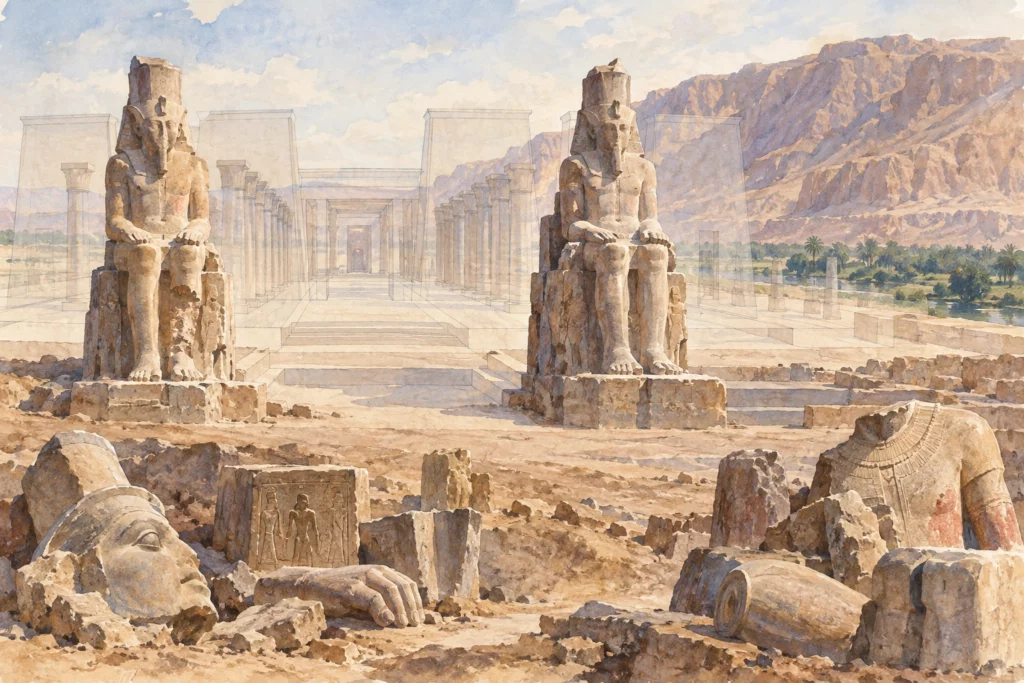
Kom el-Hettan lies on the west bank at Thebes. Amenhotep III had his mortuary temple built there, called a ‘temple of millions of years’, near the land of the Nile plain. The two colossal statues that marked the entrance are known by the modern name of the Colossi of Memnon. Their fame should not make us forget that the building extended far beyond them. Recent excavations and restorations concern a vast site of courts, pylons, colonnades, sculptures and remains of walls, not two isolated statues.
General presentation
The monumental façade of the temple was announced by the two seated colossi of Amenhotep III. Further back followed other gateways, courts and columned spaces. Much of the elevation has disappeared; the bases, blocks and statues found make it possible to study their distribution, but the height of each sector cannot be reconstructed freely. The Egyptian-German mission documents certain fragments and puts them back in their context. The monument visible today combines preserved ancient remains, pieces taken out of the ground and conservation work: this distinction must remain clear in the description and in the images.
Monuments and remains
Besides the entrance colossi, the discoveries include statues of the king, of Queen Tiye and of deities. The Egyptian ministry reports several figures of Sekhmet, pieces of royal sphinxes and a fragment of a black granite statue of Horus found in the columned hall. Blocks and column bases provide information on the extent of this hall. Reliefs of the Sed festival have also been identified. The various statues did not necessarily stand in a single alignment: their position must be deduced from the foundations and the find spots. The materials vary from one work to another, which rules out colouring all the sculptures uniformly in a reconstruction.
Chronology and building phases
The main programme belongs to the reign of Amenhotep III, in the 14th century BC. The scenes linked to the royal jubilee belong to this history, but a block found out of context is not enough to date a whole space. The temple was later badly damaged and its stones were reused at various periods. The ministry refers to an ancient earthquake among the causes of destruction; erosion, floods and the removal of materials have also affected the reading of the site. The modern excavations and re-erections form a final phase, which must be distinguished from the ancient layout when looking at the colossi and the walls today.
History and functions
The temple maintained the cult of the king after his death and staged his relationship with the gods. The great statues at the entrance made royal power visible; the figures of Sekhmet and other deities belonged to the ritual programme of the whole. The representations of Sed festivals linked the monument to the renewal of the power of Amenhotep III. The site was not a residence: it must be distinguished from the palace of Malkata, very close in Theban geography but devoted to other activities. The disappearance of many halls makes it impossible to reconstruct with certainty all the processional routes and all the internal functions.
Excavations and the history of research
Since 1998, the Colossi of Memnon and Amenhotep III Temple Conservation Project, directed by Hourig Sourouzian under Egyptian authority with the assistance of the German Archaeological Institute, has been excavating, recording and restoring the site. Successive discoveries have broadened the image of a monument long known mainly through its two entrance statues. The teams have identified fragments of colossi, divine statues, decorated blocks and column bases. Each piece is cleaned and studied before any resetting; sculptures moved for restoration should not be taken for in situ finds when they are put on display.
State of preservation and research questions
The colossi still dominate the landscape, but the temple behind them survives mainly as foundations and fragmentary elements. The conditions of the Nile plain, collapses and the reuse of stones complicate reconstruction. Research seeks to determine the layout of the courts, the original position of the statues and the extent of the great columned hall. Some hypotheses change with each new campaign; an overall image must show its uncertainties instead of presenting invented elevations as excavated. The conservation of the remaining stones and the documentation of the fragments matter as much as the visual reconstruction of the monument.
Sources
Main sources: Egyptian Ministry of Tourism and Antiquities, ‘New archaeological discoveries in the project to restore the Colossi of Memnon and the temple of King Amenhotep III’ and ‘Large Fragment of a Monumental Statue of Horus Discovered in the Mortuary Temple of Amenhotep III’, consulted on 28 September 2026: https://egymonuments.gov.eg/news/new-archaeological-discoveries-in-the-project-to-restore-the-colossi-of-memnon-and-the-temple-of-king-amenhotep-iii/; https://egymonuments.gov.eg/news/a-large-part-of-the-monumental-statue-of-god-horus-was-revealed-at-the-temple-of-millions-of-years-in-luxor/.