Identification and location
The complex of Nebhepetre Mentuhotep II occupies a bay of the Theban west bank at Deir el-Bahri. The 11th Dynasty ruler reunited Egypt after the First Intermediate Period and is generally placed at the beginning of the Middle Kingdom. The Egyptian ministry places his reign c. 2055–2004 BC; the dates proposed vary between chronologies. His temple precedes by several centuries that of Hatshepsut, built in the same area. The two buildings have distinct histories and plans, even if the site has created a strong visual continuity.
General presentation
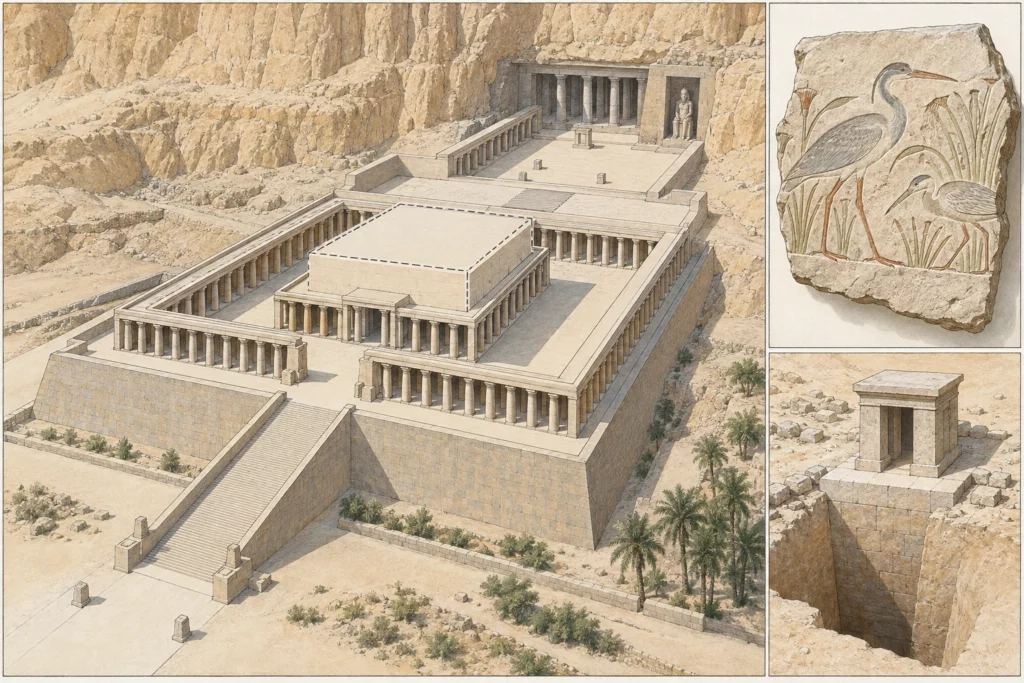
The monument stands out for the integration of terraces, porticoes and rock-cut spaces into a cliff landscape. According to the Metropolitan Museum, it had several functions: tomb and place of cult of the king, burials of women of his family, commemoration of his achievements and sanctuary of Montu. Later phases also hosted the cult of Amun-Ra. The form of the mass in the centre of the terrace remains debated; some reconstructions make it a pyramid, others do not. This debate must be kept in any graphic presentation of the monument.
Monuments and remains
The monumental approach led to a ramp and two levels of colonnaded terraces. A cubic central mass was surrounded by columned halls. Further west followed a court, a hypostyle hall cut against the cliff and a sanctuary with a niche for a statue of the king. Limestone reliefs covered the porticoes and halls around the centre; other reliefs, in sandstone, belonged to the rear part. Beneath the paving of the inner court lay several tombs of royal women, associated with small chapels. This summary description should not be read as an exhaustive plan of a single building phase.
Chronology and building phases
The temple developed during the reign of Mentuhotep II and underwent cult adaptations. Stone robbing at the end of the Ramesside period removed much of the decorated walls. Modern excavations therefore worked from remains and thousands of fragments. The Metropolitan Museum recalls the explorations of Lord Dufferin in 1859–1860, then the excavations of Édouard Naville for the Egypt Exploration Fund between 1903 and 1907. Objects were later kept in various museums, and their provenance must be linked to the precise archaeological position where it is known.
History and functions
The rites of the temple sustained the funerary cult of the ruler. The axial layout, the cliff landscape and the route towards the western part organised a progression towards the most restricted spaces. The chapels of the royal women show that the complex combined several cults and burials. The Metropolitan Museum describes a fragment of the shrine of Queen Henhenet, now in New York, and a relief of marsh birds from the temple. These objects document different parts; it would be unjustified to put them back in the same hall without proof.
Excavations and the history of research
The fragment with birds illustrates the quality of the decoration, but its precise position in the original composition remains proposed rather than certain. The study of the materials distinguishes limestone and sandstone reliefs, as well as later interventions. The Metropolitan Museum records document the provenance and conservation history of some fragments. The Egyptian ministry’s presentation sets the context of Deir el-Bahri and notes the uncertainty about the top of the central mass. The fragments kept in museums do not replace the architectural surveys of the monument on site.
State of preservation and research questions
Reuse and ancient extraction have created large gaps. Scientific restoration must separate ancient masonry, reset blocks and supposed volumes.
Sources
Main sources: Metropolitan Museum of Art, ‘Relief with Birds in the Papyrus Thicket’, https://www.metmuseum.org/art/collection/search/545290; ‘Part of the shrine of Queen Henhenet’, https://www.metmuseum.org/art/collection/search/544208; Egyptian Ministry of Tourism and Antiquities, ‘Deir el-Bahri’, https://egymonuments.gov.eg/archaeological-sites/deir-al-bahari/; University College London, ‘Mentuhotep II’, https://www.ucl.ac.uk/museums-static/digitalegypt/chronology/mentuhotepII.html; UCL, ‘Fragments from the temple of Mentuhotep II’, https://www.ucl.ac.uk/museums-static/digitalegypt/thebes/temple/mentuhotepii.html (consulted on 27 September 2026).