Identification and location
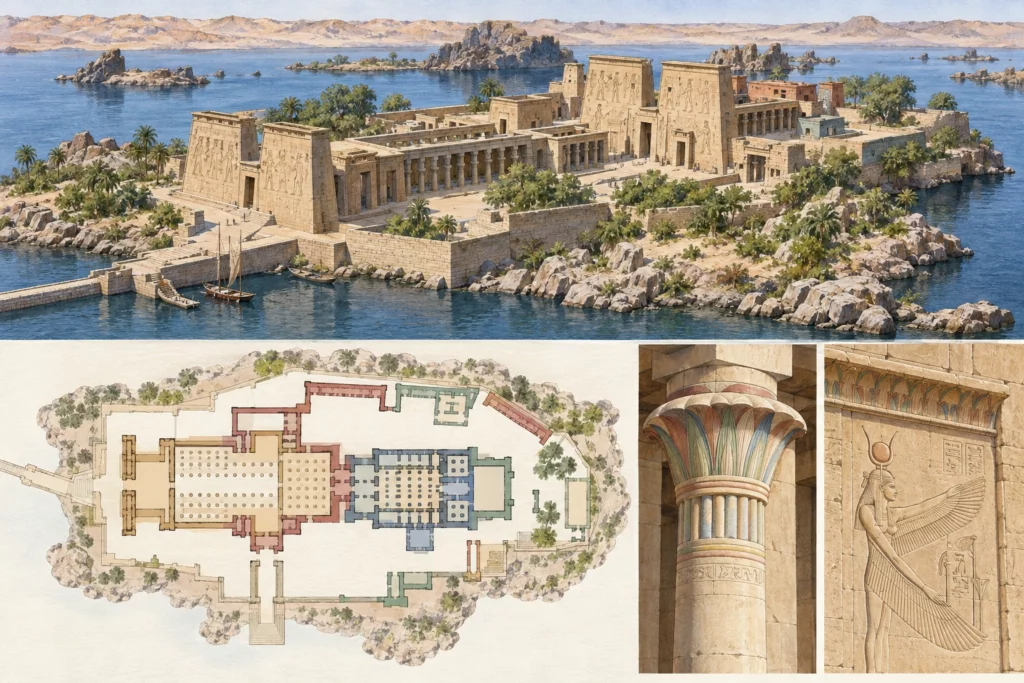
The temple of Isis at Philae stood on a small island in the Nile, upstream of the First Cataract, south of Aswan. It is part of the property Nubian Monuments from Abu Simbel to Philae, inscribed on the World Heritage List in 1979. The monuments of the island were dismantled and rebuilt between 1972 and 1980 on the neighbouring island of Agilkia, landscaped to reproduce the original topography.
Architecture and decoration
The main temple opens with a first pylon, followed by a court containing the mammisi, the ‘birth house’ devoted to the divine birth of Horus. A second pylon leads to a hypostyle hall, then to the inner rooms and the sanctuary. The island also holds a temple of Hathor, built under Ptolemy VI and Augustus, the kiosk of Trajan and the gate of Hadrian.
The reliefs show the sovereigns, Ptolemaic and then Roman, making offerings to Isis, Osiris and Horus. Several scenes depict Isis suckling Horus in the marshes.
Chronology and building phases
The oldest surviving building goes back to the 30th Dynasty, with a kiosk of Nectanebo I. The great temple of Isis was begun by Ptolemy II Philadelphus (285–246 BC) and enlarged by his successors, then decorated in the Roman period. The cult lasted longer than in any other Egyptian temple: the priest Esmet-Akhom carved there in AD 394 the last known dated hieroglyphic inscription, and the last priests attested by graffiti date from AD 456–457. The traditional date of a closure under Justinian, around 535–537, should be handled with caution: UNESCO states only that the sanctuary was turned into a church around AD 540.
History and functions
Philae was a great centre of pilgrimage, frequented by Egyptians and by Nubian populations, who maintained the cult of Isis there after the Christianisation of Egypt. When traditional worship ceased, part of the building was turned into a church; carved crosses bear witness to this.
The rescue
The building of the first Aswan Dam, at the beginning of the 20th century, submerged the island for part of the year. The High Dam threatened to swallow it for good. As part of the UNESCO campaign, the monuments were surrounded by a cofferdam, dismantled into thousands of blocks and rebuilt on Agilkia. The orientation and general layout were respected, but the setting is now that of another island.
State of preservation and research questions
The hieroglyphic, Demotic and Greek inscriptions of Philae document the end of the Egyptian cults and the relations between Roman Egypt and the Nubian peoples. Photographs taken before the floods make it possible to compare the state of the surfaces before and after the long periods of submersion.
Sources
Main sources (consulted on 28 September 2026): Egyptian ministry, Philae; UNESCO, Nubian Monuments from Abu Simbel to Philae; UNESCO, International Campaign to Save the Monuments of Nubia.