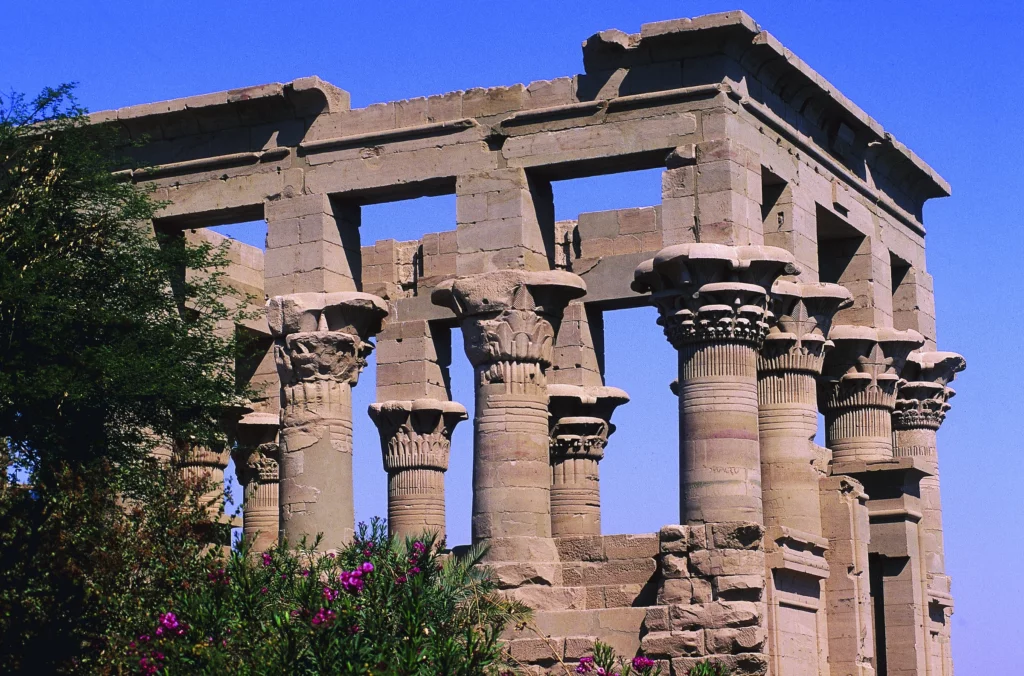
A pavilion on the east bank
The kiosk of Trajan occupies the eastern edge of Philae, south of the temple of Hathor. It is now rebuilt on Agilkia. Its rectangular plan and fourteen columns form a widely open space, bordered by screen walls. The roof has disappeared; any reconstruction of it remains hypothetical.
The regularity of the columns explains the monument’s place in images of Philae. It does not, however, tell us the exact date of the main structure or the details of the ceremonies held there.
What the name of Trajan dates
The two scenes on the southern walls show Trajan making offerings to the gods. His reign, from AD 98 to 117, provides a reference point for this decoration. The traditional name of the kiosk comes from these reliefs and is not enough to attribute the whole construction to the same sovereign.
A construction as early as Augustus has been proposed. This hypothesis, reported by Holger Kockelmann, requires us to distinguish the architectural project, the assembly of the blocks and the campaign of sculpture. Caution remains necessary as long as the precise sequence of interventions has not been established.
A decoration left incomplete
The carved scenes occupy a small part of the available surfaces. The undecorated walls and the reserves of uncarved stone on some elements show that the pavilion did not receive the whole planned programme. The work was done on a building already assembled, which allowed a scene to extend over several courses.
In the finished reliefs, the emperor takes on the role of the Egyptian sovereign before Isis, Osiris and Horus. Roman rule thus did not mean abandoning the pictorial language of the temples. The rites depicted and the names carved place the sovereign within the traditional relations between kingship and the gods.
A probable processional function
Its position near the river and its form have led to the kiosk being interpreted as a processional resting place. This proposal is plausible, but no surviving inscription explicitly states its function. The hypothesis should not be turned into a certain description of a landing or a ceremony.
The route to the Abaton of Osiris, on Biggeh, belongs to another area of the sanctuary: the gate of Hadrian, west of the temple of Isis. Distinguishing the two buildings makes the religious organisation of the island easier to read.
The pavilion after its move
The kiosk followed the rescue of the monuments of Philae begun in 1972. On Agilkia, the columns, the walls and their reliefs remain ancient; the foundations and the joints of the reconstruction bear witness to modern conservation. Comparisons with old views must take this change of island into account.
Sources
- Holger Kockelmann, ‘Philae’, UCLA Encyclopedia of Egyptology, 2012, historical and archaeological study, especially pp. 4–8.
- Egyptian Ministry of Tourism and Antiquities, Philae.
- UNESCO, World Heritage Centre, Nubian Monuments from Abu Simbel to Philae, for the rescue, the inscription and the authenticity of the relocated monuments.
References consulted on 20 November 2026.