In brief
In the New Kingdom, Abydos was one of the great centres of the cult of Osiris. Seti I, the second king of the 19th Dynasty, had a temple built there of limestone, with occasional use of sandstone, on an unusual L-shaped plan. The building combined the cult of several gods with that of the king and his ancestors. Unfinished at the death of Seti I, it was completed by his son Ramses II (Ramesses II). Behind the temple lies the Osireion, a separate semi-subterranean structure linked to the underworld of Osiris.
What you discover
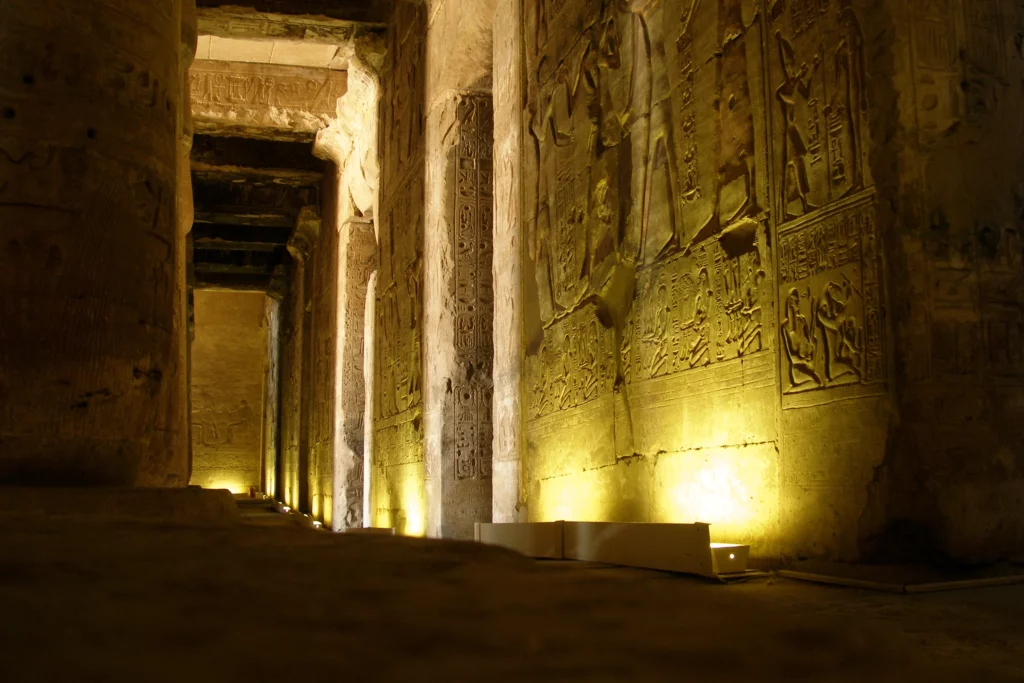
The entrance was to the north-east, through a great pylon now lost, followed by a badly damaged first court. The present façade is a pillared portico pierced by seven doorways; Ramses II had all of them walled up except the central one. Next come two hypostyle halls: the first has twelve pairs of sandstone papyriform columns with closed capitals, the second thirty-six columns of the same type. At the back, seven chapels in a row are dedicated to the deified Seti I, Ptah, Ra-Horakhty, Amun-Ra, Osiris, Isis and Horus. Behind the chapel of Osiris opens a suite reserved for the god, with two halls, two sets of chapels and a secret chamber with two pillars, accessible only to the high priests. The south wing, which gives the plan its L shape, groups together the Gallery of the Ancestors, the Hall of the Barques and the Hall of the Butchers.
What to look at
The quality of the relief is the first thing to observe. The halls decorated under Seti I bear raised relief of great delicacy, which can be distinguished from the work done afterwards under Ramses II.
The second point of interest is the famous king list, carved on the west wall of the passage leading from the second hypostyle hall to the Hall of the Butchers. Seti I, wearing the blue crown, stands on the left; in front of him, Prince Ramses, wearing the sidelock of youth, unrolls a papyrus. Two registers of 38 cartouches name 76 kings, from Menes to Seti I himself. The omissions are as telling as the names: neither the Herakleopolitan kings, nor the rulers of the Second Intermediate Period between Sobekneferu and Kamose, nor Hatshepsut, nor the Amarna kings. The list belongs to a rite of invoking the ancestors; it asserts the legitimacy of the king rather than drawing up a complete chronology.
Its history
The Osireion, built by Seti I, was reached by a long tunnel whose decoration was added under his grandson Merenptah. Henri Frankfort resumed its study after the First World War and published it in 1933. The temple reliefs were recorded, often in colour, by Amice Calverley and Myrtle Broome for the Egypt Exploration Society. From 2023 to 2025, the American Research Center in Egypt and the World Monuments Fund had the Osireion and the tunnel of Merenptah scanned in 3D. They then replaced corroded steel bars with stainless-steel anchors. The work uncovered the ramp used to transport the blocks, cut into the bedrock north of the monument, as well as seventy hieratic and Demotic ostraca.
The interpretation of the Osireion is still debated. ARCE attributes it to Seti I, despite an archaising appearance that has sometimes fuelled the idea of an older origin; its conservation requires constant monitoring.
Sources
Consulted on 30 September 2026: Temple of Seti I, Abydos, American Research Center in Egypt; The Abydos King List, American Research Center in Egypt; Rediscovering Abydos with the World Monuments Fund, American Research Center in Egypt.
Illustrations: image ‘Present-day interior of the temple of Seti I at Abydos’: Source and author · Licence CC BY 4.0.