In brief
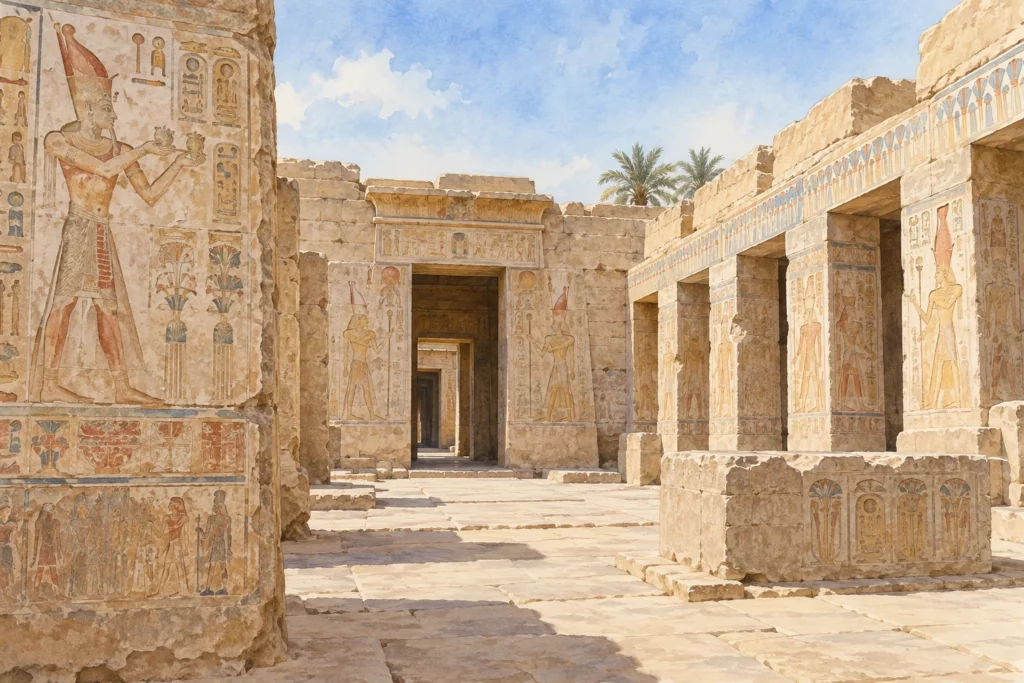
Early in his reign, Ramses II (Ramesses II) had his own temple built at Abydos, separate from the great temple of his father Seti I, which he also completed. Devoted to the cult of Osiris and to the royal cult, the building is known for its painted reliefs, including scenes of the battle of Qadesh. Foundation deposits marked with the king’s throne name, found at the south-west corner, confirm that construction was begun in his reign.
What you discover
The temple occupies a vast rectangular enclosure of about 100 by 90 metres, closed by mudbrick walls 3.25 metres thick and lined with 42 storerooms. The excavations of the New York University mission, directed by Sameh Iskander, have revealed unexpected building choices there. The first pylon, set on a footprint of 8 by 58 metres, was built entirely of mudbrick, framing a limestone gateway preserved to a height of about 2 metres: the use of brick for the pylon of a temple of Ramses II appears to be unprecedented. The first court was also paved with brick, an unusual feature in the Ramesside period. The pylon has been restored to a height of 1.50 to 2 metres.
Ten large vaulted mudbrick storerooms were attached to the temple palace. They served as granaries and stores for provisions, offerings and small cult equipment: a temple lived from a daily economy as much as from its rites.
What to look at
The foundation deposits provide the most concrete detail. They contained food offerings, plaques painted blue or green bearing the throne name of Ramses II, models of copper building tools, a vessel inscribed in hieratic and oval quartzite grindstones. Buried at the time of the foundation, these objects link the building directly to the reign of Ramses II.
The temple also had its own king list. A limestone fragment 3.70 metres long and 1.35 metres high, discovered in 1818 by William John Bankes, has been in the British Museum since 1837. It preserves parts of three rows of cartouches and 34 names: the upper rows run from the kings of the 7th–8th Dynasties to those of the 12th, while the lower row alternately repeats the two names of Ramses II. It echoes the more complete list in the temple of Seti I.
Its history
The place did not cease to be used after Ramses II. In the Ptolemaic period, twelve heads of sacrificed bulls and their bones were placed in niches in the storerooms, and a complete bull skeleton was buried beneath the floor of the temple palace. The recent excavations have also yielded a black granite head of a goddess from the reign of Thutmose III, a seated steatite statue of the 26th Dynasty, eleven stelae and Coptic and Demotic ostraca.
These finds show a site frequented before and after the construction of the temple, without Ptolemaic practices having to be projected onto the reign of Ramses II. The chronology of these successive occupations and their link with the royal cult remain to be clarified.
Sources
Consulted on 30 September 2026: New discovery of foundation deposits and the storerooms of Ramesses II’s temple in Abydos, Egyptian Ministry of Tourism and Antiquities; Excavating and conserving the temple of Ramesses II in Abydos, American Research Center in Egypt; King list from the temple of Ramses II at Abydos (EA 117), British Museum.