Identification and location
The temple of Seti I stands at Abydos, in Upper Egypt, in a sacred landscape linked to Osiris and to the first kings. Its masonry is mainly limestone and its plan is L-shaped. Behind it lies the Osireion, an underground structure of large granite and sandstone blocks. The proximity of the two monuments does not allow them to be drawn on the same ground level, nor the plan of the seven chapels to be attributed to the Osireion. The neighbouring temple of Ramses II (Ramesses II) is yet another building.
General presentation
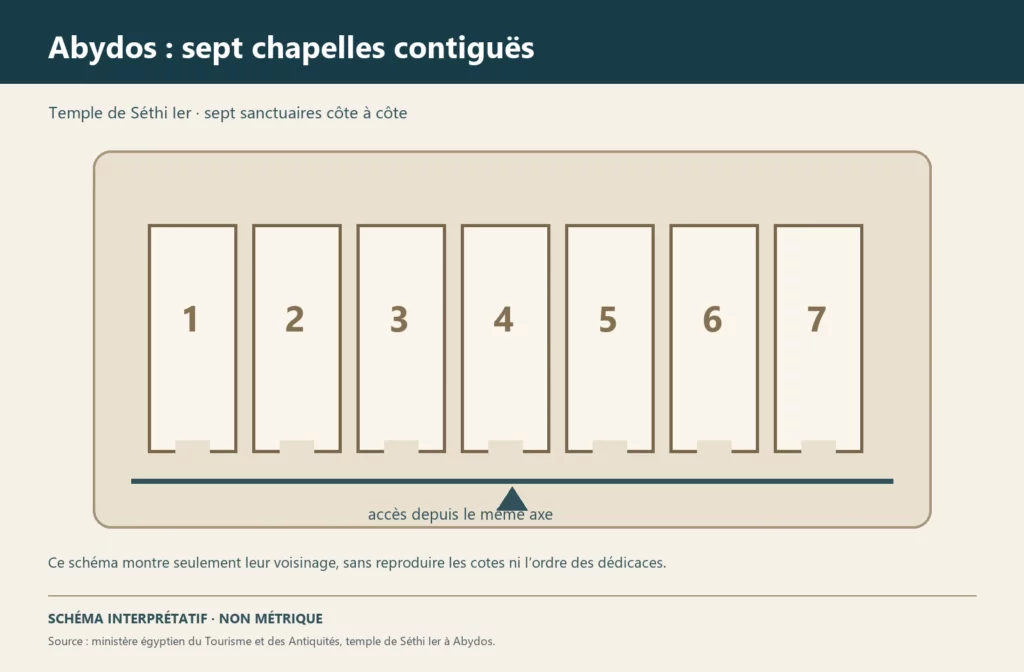
The ancient approach passed through a lost pylon, ruined courts and ramps before reaching the portico of the roofed building. Seven doorways opened onto the first hypostyle hall; six were later blocked under Ramses II. Two hypostyle halls follow one another before the seven chapels. The first has twelve pairs of papyriform columns, the second thirty-six columns. From the chapel of Osiris, a transverse suite of rooms devoted to the god could be reached. The southern wing brings together other rooms, including the Gallery of the Ancestors and the Hall of the Barques.
Monuments and remains
The seven main chapels are dedicated to the deified Seti I, Ptah, Ra-Horakhty, Amun-Ra, Osiris, Isis and Horus. Their reliefs combine royal offerings and divine responses. The Abydos list, in the passage between the second hypostyle hall and the Hall of the Butchers, shows Seti and Prince Ramses before royal cartouches. The names form part of an offering formula to the ancestors. The Qadesh scenes in the courts belong to the phase of Ramses II; they are not contemporary with his father’s finest reliefs.
Chronology and building phases
The work began under Seti I and continued after his death under Ramses II. The state of completion of the seven sanctuaries indicates that they were among the first spaces to be decorated. In the temple, the cartouches and relief techniques help to distinguish phases. The Osireion is also attributed to Seti I by ARCE, while its access tunnel bears decoration added under his grandson Merenptah. A single date for all these surfaces would hide this succession. The archaising appearance of the Osireion does not justify a prehistoric origin.
History and functions
The temple combined divine cult, royal cult and ceremonies on behalf of the dead king. In the chapels, the priests performed sequences of actions specific to the deities honoured. The king list summoned selected ancestors and supported the idea of a legitimate continuity of kingship; it leaves out in particular Hatshepsut and the Amarna kings. The Osireion evokes the underworld of Osiris. Its interpretation remains debated, and its architecture does not demonstrate the presence of a physical burial of the god.
Excavations and the history of research
The study of Abydos must keep apart the observations of the temple, those of the Osireion and the history of the texts. ARCE and the World Monuments Fund had the Osireion and the tunnel of Merenptah recorded in 3D in 2023. The models record the present state to guide conservation; they do not automatically restore the lost parts. The king list must be compared with other historical sources, since it serves first of all a cult function. The surveys of the reliefs, for their part, clarify the differences between the programmes of Seti I and Ramses II.
State of preservation and research questions
The Osireion suffers from damp and structural stresses. The ARCE-WMF project put consolidation measures in place in 2023 and is working on a site management plan. In the temple, the courts are badly damaged, while the roofed halls preserve remarkable decoration. The accompanying photograph shows an interior lit by modern fittings; it does not reproduce its ancient light.
Sources
Main sources (consulted on 28 September 2026): https://arce.org/temple-seti-i-abydos/; https://arce.org/project/rediscovering-abydos-with-the-world-monuments-fund/; https://arce.org/abydos-king-list/.