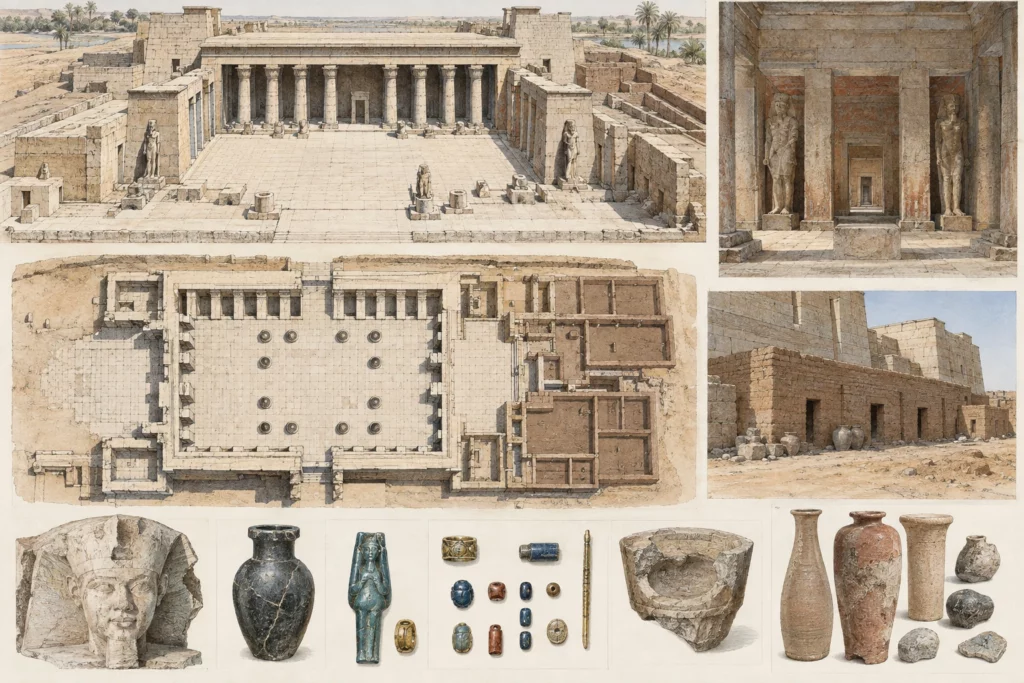
In 1818, the English traveller William John Bankes found in the ruins of the temple of Ramses II (Ramesses II) at Abydos a list of kings carved on a wall. The French consul Jean-François Mimaut had it removed and took it away. After his death, it was sold to the British Museum, in 1837. Jean-François Champollion had had a copy of it. It helped him to put the dynasties in order.
Identification and location
The temple of Ramses II at Abydos lies a few hundred metres north-west of the great temple of Seti I, on the edge of the desert. Abydos was the main centre of the cult of Osiris. Every king wanted to have his place there, near the supposed tomb of the god and near his ancestors.
Architecture and decoration
The temple is built of fine limestone, with elements of sandstone, granite and alabaster. It comprised a pylon, two courts, hypostyle halls and chapels. The walls survive only to a height of two or three metres, and the roof has gone.
What remains is of great delicacy. The reliefs are in low raised relief, and not sunk as often under Ramses II, and they keep a remarkable part of their colours: processions of offering bearers, animals, deities.
The outer walls tell the story of the battle of Qadesh, with the Egyptian camp, the chariots and the Hittite spies being beaten to make them talk. The king list, for its part, complemented that of the temple of Seti I, still in place, where the young Ramses is shown beside his father before the names of the ancestors.
Chronology and functions
The temple dates from the first years of the reign, at the beginning of the 13th century BC. It served the cult of Osiris, Isis and Horus, and of the king himself, associated with the rulers of the past.
In a long inscription carved in his father’s temple, Ramses relates that on arriving at Abydos he found Seti’s monument unfinished, the columns without a roof, the statues on the ground. He had it completed. He built his own straight afterwards. The young king thus asserted his filial piety, and his legitimacy.
Excavations and the history of research
The temple was cleared in the 19th century, after the king list had been taken away. More recent campaigns by the Egyptian Ministry of Antiquities have uncovered foundation deposits and storerooms belonging to the temple, which shed light on its organisation and economy.
State of preservation and research questions
The low height of the walls has had an unexpected effect: the lower part of the reliefs, long protected by rubble and sand, has kept its colours better than many monuments that remained standing.
Research focuses on the relationship between the royal temples of Abydos, and on the way in which the 19th Dynasty, sprung from a military family with no royal ancestry, staged its legitimacy before the ancestors.
Sources
Main sources (consulted on 28 September 2026): Egyptian ministry, foundation deposits and storerooms of the temple of Ramses II at Abydos; UCL Digital Egypt, Abydos in the New Kingdom; Kenneth A. Kitchen, Ramesside Inscriptions, Translated and Annotated, vol. II, Oxford, Blackwell, 1996.