In brief
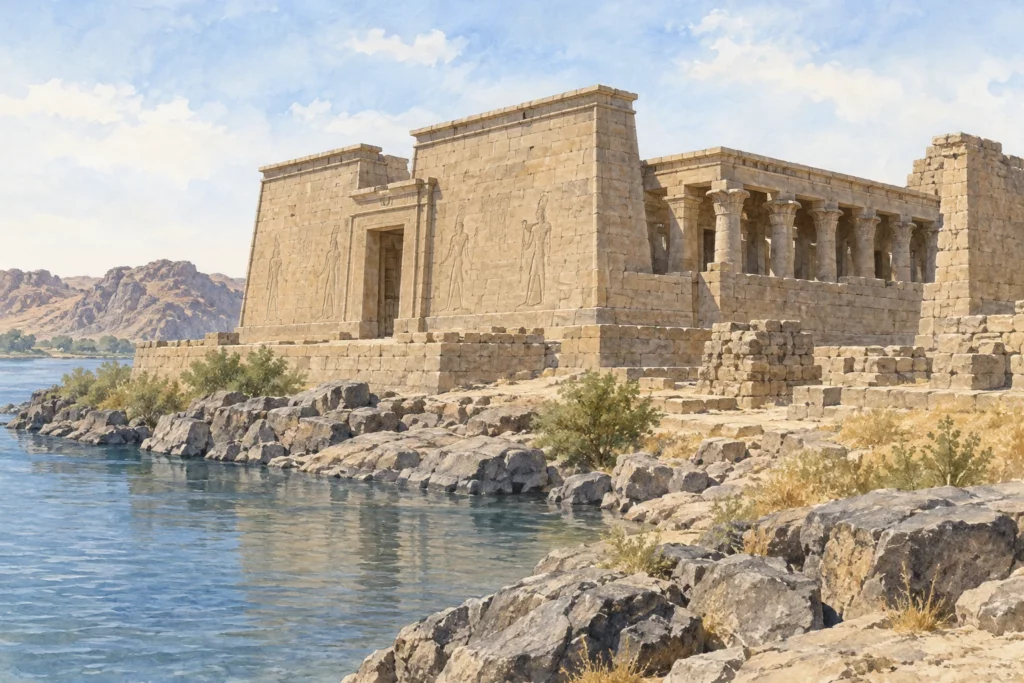
The temple of Kalabsha, which UNESCO calls the temple of Talmis, in Lower Nubia, was built in the reign of Augustus (30 BC–AD 14), the first emperor of Rome. It was dedicated above all to the Nubian god Mandulis; Isis and her husband Osiris were also worshipped there. According to the Egyptian ministry, it was moved in 1962–1963 from the island of Kalabsha to the island of New Kalabsha, to escape the rising waters caused by the Aswan High Dam. Since 1979 it has been part of the World Heritage List with the other monuments of Nubia.
What you discover
The plan follows the usual sequence of the great late temples: a monumental pylon, an open court, a hypostyle hall, two transverse offering rooms, then the sanctuary where the god’s image rested. The columns are slender and widely spaced, which the ministry interprets as an influence of the Graeco-Roman tradition. The inscriptions are written in Meroitic and Greek, two languages showing that the place was visited by people from Nubia and by speakers from the Mediterranean world. They are not enough to date each text: a wall may have been built in one period and inscribed later.
Its history
Mandulis was a Nubian deity in his own right, honoured in an Egyptian architectural setting under Roman rule; he is not a mere variant of Isis. The presence of the emperor in the ideology of the temple continues the tradition of the pharaohs, with local cults integrated into the official religion. In the Christian period, the sanctuary was used as a church: crosses carved on its walls mark this change of use and the beginnings of Christianity in the region. The move of 1962–1963, carried out as part of the UNESCO campaign conducted between 1960 and 1980, saved the masonry, but it changed the surroundings, the perceived orientation and the relationship with the river.
What to look at
South-west of the great temple, a chapel partly cut into the rock is dedicated to Dedun, another Nubian god; its location away from the main axis recalls that several cults coexisted on the same site. To the north-east, a small chapel, probably built by Ptolemy IX in the 2nd century BC, is older than the Augustan building and should not be attributed to it. On the walls of the great temple, look for the Christian crosses carved into the stone, which trace a last layer of occupation. Modern restorations and rebuilt blocks fill certain gaps, and the archives of the rescue remain necessary to distinguish what is ancient from what is modern.
Sources
Consulted on 30 September 2026: Kalabsha Temple, Egyptian Ministry of Tourism and Antiquities; Nubian Monuments from Abu Simbel to Philae, UNESCO; The Rescue of Nubian Monuments and Sites, UNESCO.