In brief
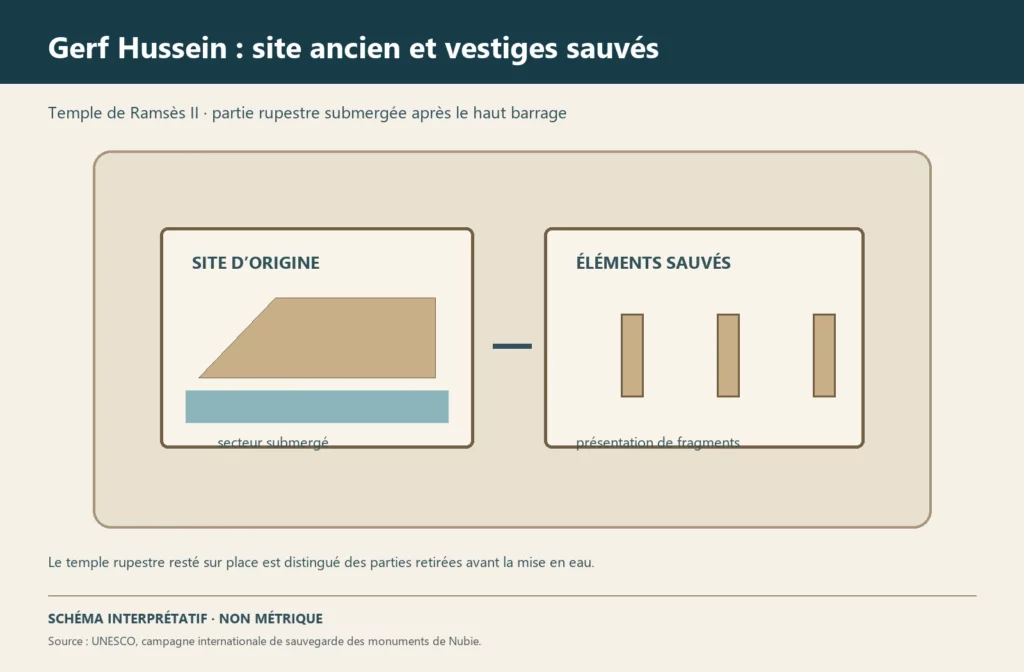
Gerf Hussein, or Gerf Husein, was a rock-cut temple of Ramses II in Lower Nubia, on the west bank of the Nile. UNESCO counts it among the monuments threatened by the rising waters caused by the Aswan High Dam. It is one of a handful of exceptions: unlike most of the temples of Nubia, it was not dismantled and rebuilt elsewhere.
What you discover
The temple was a hemispeos: a built part in front of a part cut into the cliff, a formula found in other Nubian monuments of the reign. A visit therefore does not offer the experience of a complete temple. What could be preserved does not restore the original route, from the court to the rock-cut rooms and then the sanctuary.
UNESCO specifies that, with three exceptions, the threatened monuments were dismantled, cut up and transported to another site. These exceptions are the temple of Gerf Hussein, the chapels of Qasr Ibrim and the temple of Abu Oda. The case of Gerf Hussein thus illustrates the limits of the international campaign: the monument escaped the general pattern of dismantling and reconstruction.
What to look at
The detail to remember is historical rather than visual: it is absence. UNESCO places the temple in the list of threatened monuments, then in that of the exceptions. The presence of elements of this temple at New Kalabsha, sometimes mentioned, could not be confirmed by the sources consulted, and it must be checked before any claim is made.
To judge what has disappeared, one must turn to the documentation drawn up before the flooding: surveys, plans, photographs. It is the only trace of the organisation of the rock-cut rooms.
Its history
The temple belongs to the series of foundations of Ramses II in Nubia, where the king associates the gods of the state with his own cult. Traditional presentations stress the place of Ptah there, more important than in other sanctuaries of the reign; the sources consulted here are not enough to detail the religious programme. The same caution applies to the chronology: the temple is attributed to the reign of Ramses II, without the phases of the work being known from these sources.
The fate of the monument stems from a rescue choice. The relocated temples were preserved, but at the cost of a break with their landscape. Gerf Hussein shows the other side of this record: a temple most of which could not be removed from the water, known today through its images more than its stones. Any presentation of the complete temple must distinguish what comes from early documentation from what comes from the remains still visible.
Sources
Consulted on 30 September 2026: Safeguarding the monuments of Nubia, UNESCO; Nubian Monuments from Abu Simbel to Philae, UNESCO.