In brief
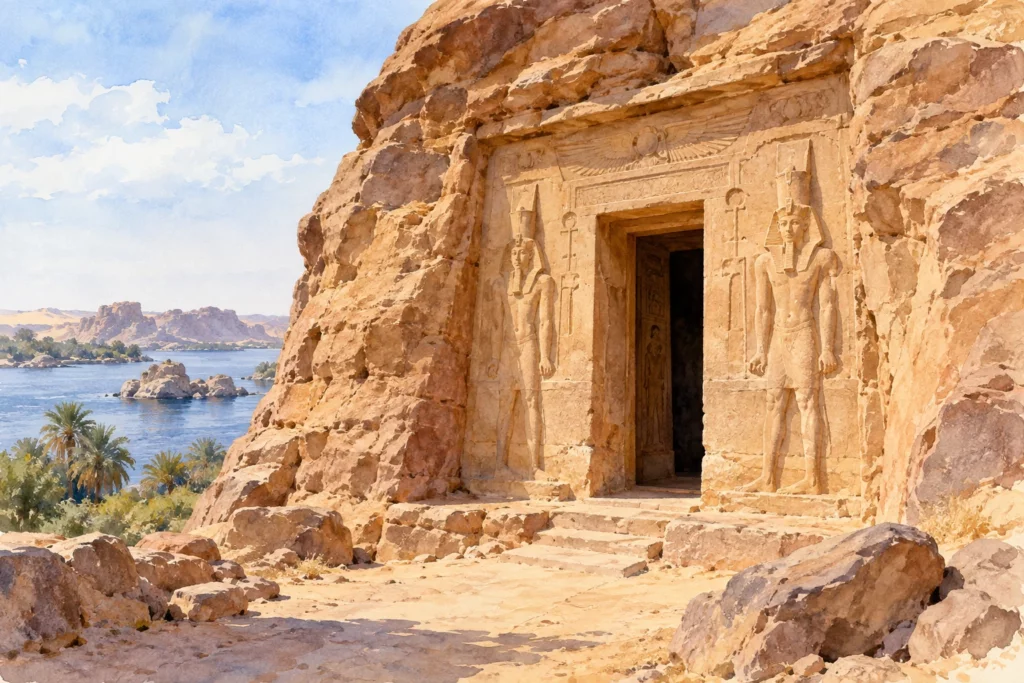
Beit el-Wali is a small rock-cut temple of Ramses II, built in Lower Nubia, in the north of the region. It was moved during the rescue campaign and rebuilt near Kalabsha, close to the Aswan High Dam. Its reputation rests on its decoration: the monument is a document on the way the Egypt of Ramses II represented Nubia.
What you discover
The plan is simple: an entrance area, a transverse hall and a sanctuary cut into the rock. Today the visitor stands in the middle of a group assembled by UNESCO: the temple of Kalabsha, built under Augustus for the local god Mandulis, the kiosk of Qertassi and Beit el-Wali were grouped near the High Dam. This proximity is modern and does not reflect the ancient organisation of the places.
The reliefs are at the centre of the visit. They show the king in scenes of domination and in rituals before the gods. Nubia appears in them as a conquered territory, which Egypt had held for about two centuries when Ramses II came to the throne, according to the descriptions of the Oriental Institute of Chicago.
What to look at
Specialists and attentive visitors can pause on a detail noted in the reference publication: overlapping cartouches in the entrance area. Edward F. Wente devoted an analysis to them in the volume published in 1967 by the Oriental Institute of Chicago, following the work of the Nubian expedition conducted between 1960 and 1964. Names carved one over another indicate that the decoration was retouched or adapted, and raise the question of successive phases of decoration.
Another useful point is the extent of the record. The book brings together an architectural section by Herbert Ricke, an epigraphic section by George R. Hughes, translations by Wente and 49 plates. This documentation, drawn up before the move, preserves the state of surfaces that the transfer may have altered.
Its history
The images of conquest and tribute reflect a court discourse. They tell us how Egypt wished to see itself and be seen, not how the peoples of Nubia lived. They complement the religious dimension of the temple, where the king makes offerings to the gods.
Several questions remain open. The precise function of the temple within the Egyptian presence in the region, its real audience and the place of the military scenes in the ritual route are not established by the sources consulted alone. Caution is needed with hypotheses that would make it a processional station or a faithful chronicle of campaigns. The monument is valuable above all as a testimony to royal ideology, studied with exemplary rigour before it was moved.
Sources
Consulted on 30 September 2026: NE 1, The Beit el-Wali Temple of Ramesses II, Institute for the Study of Ancient Cultures, University of Chicago; Safeguarding the monuments of Nubia, UNESCO; Nubia, New Kingdom, Institute for the Study of Ancient Cultures, University of Chicago.