Identification and location
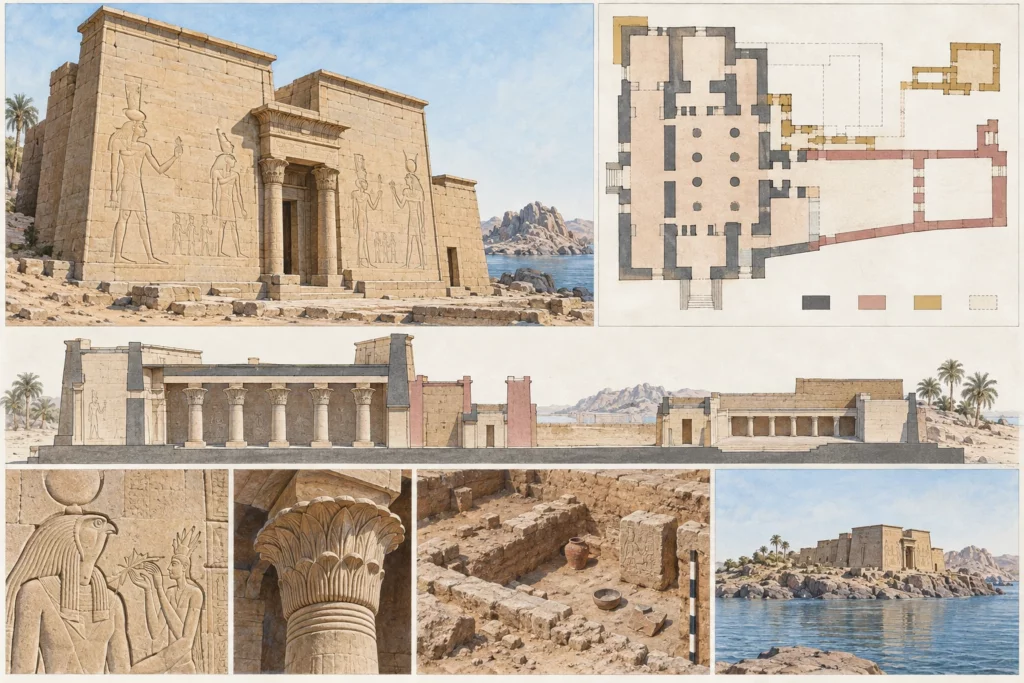
The temple of Kalabsha, ancient Talmis, is according to the Egyptian ministry the largest free-standing temple in Lower Nubia. It was dedicated to the Nubian god Mandulis, with Isis and Osiris. It stood about fifty kilometres south of Aswan; in the early 1960s it was dismantled and rebuilt on the site of New Kalabsha, near the High Dam.
Architecture and decoration
The temple follows the usual sequence of temples of the Graeco-Roman period: a pylon, a porticoed court, a hypostyle hall, transverse offering rooms and the sanctuary. The Egyptian ministry notes the Graeco-Roman influence in the slender columns and their wide spacing. A chapel to the south-west was dedicated to Dedun, another Nubian god.
The decoration, partly left unfinished, shows the emperor as pharaoh making offerings to the deities. The inscriptions are in hieroglyphs, Greek and Meroitic.
Chronology and building phases
The present temple was built under Augustus, between 30 BC and AD 14, on the site of an older sanctuary of the Ptolemaic period. A monumental gateway of this earlier building, discovered during the dismantling, was given by Egypt to the Federal Republic of Germany in thanks for its part in the rescue; it is kept in Berlin.
History and functions
Mandulis, a Nubian solar god, was honoured in an Egyptian setting, under Roman rule. Several Greek texts bear witness to the life of the temple and the region: a decree of a Roman administrator of the region, in the 3rd century, orders pigs to be kept away from the sanctuary, and a long inscription of King Silko, ruler of the Nobadae in the 5th or 6th century, celebrates his victories. The temple was later turned into a church, as the crosses carved on the walls bear witness.
State of preservation and research questions
The dismantling was entrusted to a West German team. It made it possible to save the temple, but it changed its perceived orientation and its relationship with the river. The archives of the rescue help to identify the moved blocks and the modern additions. The site of New Kalabsha now brings together other rescued monuments, including Beit el-Wali and elements of Gerf Hussein.
Sources
Main sources (consulted on 28 September 2026): Egyptian ministry, temple of Kalabsha; UNESCO, Nubian Monuments from Abu Simbel to Philae; UNESCO, International Campaign to Save the Monuments of Nubia.