Identification and location
Gerf Hussein was a temple of Ramses II (Ramesses II) on the west bank of the Nile, in Lower Nubia, about 90 km south of Aswan. It was a hemispeos: a built part in front, a part cut into the cliff behind. UNESCO classes this temple among the three monuments of Nubia that were not dismantled during the international campaign, with the chapels of Qasr Ibrim and the temple of Abu Oda. The rock-cut part was abandoned to the rise of Lake Nasser and remains submerged.
Architecture and decoration
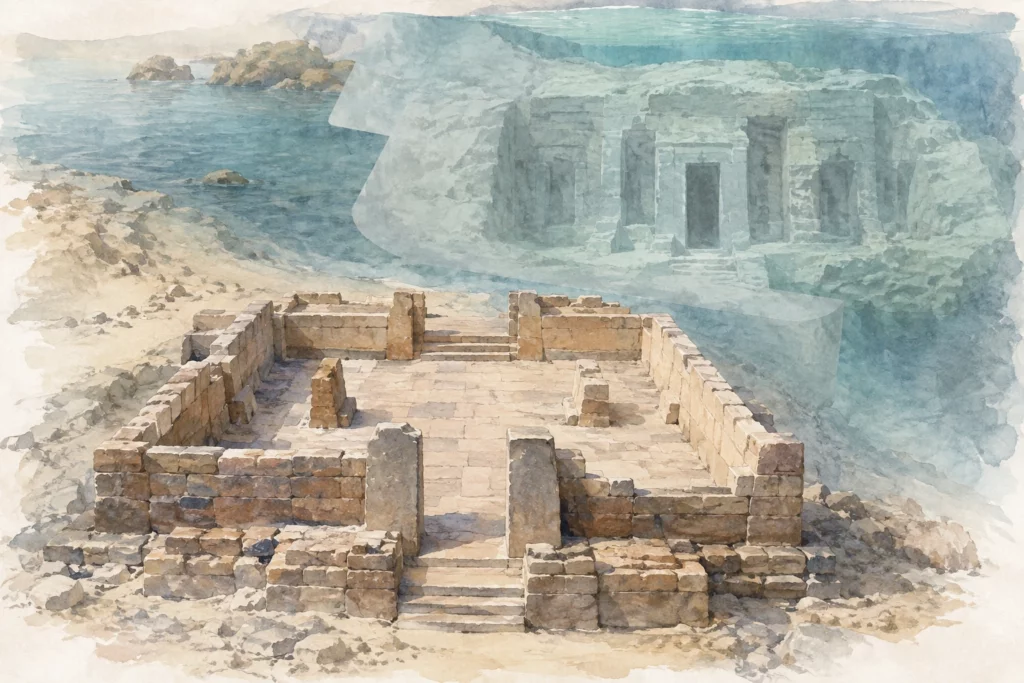
Access was by an avenue of sphinxes and a pylon, then a court surrounded by pillars in front of which stood statues of the king. The rock-cut part comprised a great hall with pillars adorned with Osiride colossi, side rooms and a sanctuary where statues of deities and of the king were carved.
The temple was mainly dedicated to Ptah, associated with Ptah-Tatenen and Hathor, with the deified Ramses II.
Chronology and functions
Like Wadi es-Sebua, the temple is attributed to the action of Setau, viceroy of Kush, under Ramses II. It belongs to the series of temples through which the king asserted his own cult and that of the great gods in Nubia. The place of Ptah is more important there than in the other Nubian temples of the reign.
The rescue
Gerf Hussein shows the limits of the rescue: unlike most of the temples of Nubia, dismantled, cut into blocks and then rebuilt on other sites, it is, according to UNESCO, one of the three exceptions of the campaign. It was therefore not transferred as a whole. The court, built in front of the cliff, was nevertheless saved and rebuilt on the site of New Kalabsha, according to the World History Encyclopedia. Separated from the part cut into the rock, it no longer allows the relationship between court and sanctuary to be perceived on the spot. The two sources do not contradict each other: UNESCO speaks of the temple, not of each of its elements. The vanished rooms are known only from the surveys and photographs made before the flooding, which are now the main memory of the monument.
State of preservation and research questions
The study of the monument rests on two categories of documents: the material elements that were rebuilt and the early documentation of the submerged part. Any presentation of the complete temple must distinguish these two sources. This hemispeos was designed as a whole in which the avenue of sphinxes, the court and the part cut into the cliff answered one another. Its study therefore rests on a documentary reconstruction rather than on a monument that can be visited. What was actually removed between 1960 and 1980 remains to be documented precisely.
Sources
Main sources (consulted on 28 September 2026): UNESCO, Nubian Monuments from Abu Simbel to Philae; Gerf Hussein Temple, Egypt, World History Encyclopedia; UNESCO, campaign to save the monuments of Nubia.