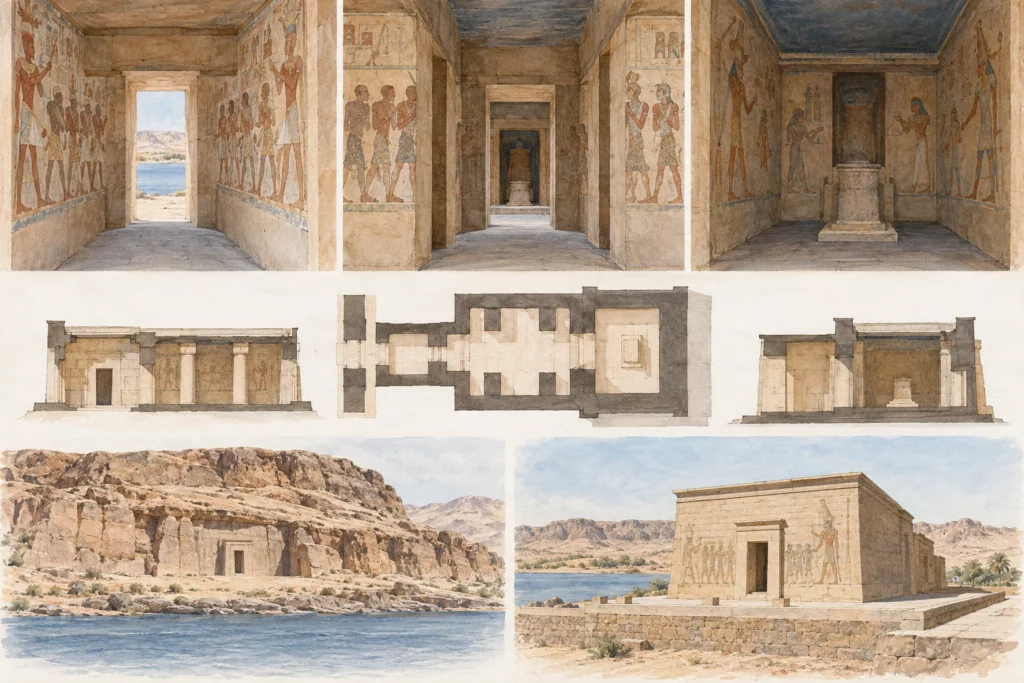
Identification and location
Beit el-Wali is a small rock-cut temple of Ramses II (Ramesses II), originally cut into the cliff on the west bank of the Nile, in Lower Nubia, not far from Kalabsha. During the rescue campaign it was cut out and rebuilt on the site of New Kalabsha, near the Aswan High Dam, beside the temple of Mandulis.
Architecture and decoration
The plan is simple: an entrance court, a transverse hall with two columns and a sanctuary, the last two parts being cut into the rock. The main interest of the monument lies in its reliefs, of high quality.
The walls of the court show the king in war scenes. On one side are campaigns against peoples of Asia and Libya; on the other, a campaign in Nubia and the arrival of a long procession of tribute: gold, ivory, skins, exotic animals and prisoners. The inner rooms present ritual scenes in which the king makes offerings to the gods, notably Amun-Ra, Khnum and Anuket.
Chronology and functions
The temple dates from the beginning of the reign of Ramses II. Some researchers link it to the period when the future king was associated with the power of his father Seti I; the study of the cartouches and of the stages of the decoration was carried out by the team of the Oriental Institute of Chicago.
The scenes of tribute and victory express royal ideology: they show Nubia as a subject and productive land. They tell us about the gaze of the Egyptian court, not about the life of the Nubian peoples. The temple served both the cult of the gods and the assertion of the king’s power in the region.
Excavations and the history of research
The reliefs were copied as early as the 19th century; painted casts made at that time are kept in the British Museum. Before the move, the Nubian expedition of the Oriental Institute of Chicago published a complete study of the monument, with plans, copies of the texts and photographic plates (Ricke, Hughes and Wente, 1967). This publication remains the reference for the parts that are now damaged.
State of preservation and research questions
The colours survive in places, but the surfaces suffered before and after the move. The exact function of the temple, its relationship with possible neighbouring settlements and the role of the military scenes in the ritual route remain debated.
Sources
Main sources (consulted on 28 September 2026): Ricke, Hughes and Wente, The Beit el-Wali Temple of Ramesses II, Oriental Institute, 1967; UNESCO, Nubian Monuments from Abu Simbel to Philae; UNESCO, International Campaign to Save the Monuments of Nubia.