Identification and location
Hierakonpolis, ancient Nekhen, lies in Upper Egypt near Edfu. The name refers to an extensive archaeological complex, not to a single monument. A mound in the cultivated zone corresponds to the town and temple area of the Dynastic periods; the localities of the low desert yield a very diverse Predynastic occupation. Geological research indicates that these zones, separate in today’s landscape, once formed parts of an evolving inhabited space. Cores attest an early presence beneath the town mound, while the occupation of the low desert reached a remarkable extent around 3700–3500 BC. The remains extend over several kilometres along the desert edge and in the Wadi Abu Suffian.
General presentation
The site documents daily life and collective organisation before and during the formation of the Egyptian state. Localities HK11, HK24, HK29 and HK29A/B do not represent a single phase or a single function. They combine dwellings, work areas, pottery and beer production, deposit areas and a ceremonial place. In the plain, the early levels are largely buried beneath later deposits and occupations. The Dynastic sanctuary of Nekhen, where the Narmer Palette was found, belongs to a different archaeological sequence from the Predynastic court HK29A. This distinction prevents the landscape of the 4th millennium from being turned into an already established pharaonic setting.
Monuments and remains
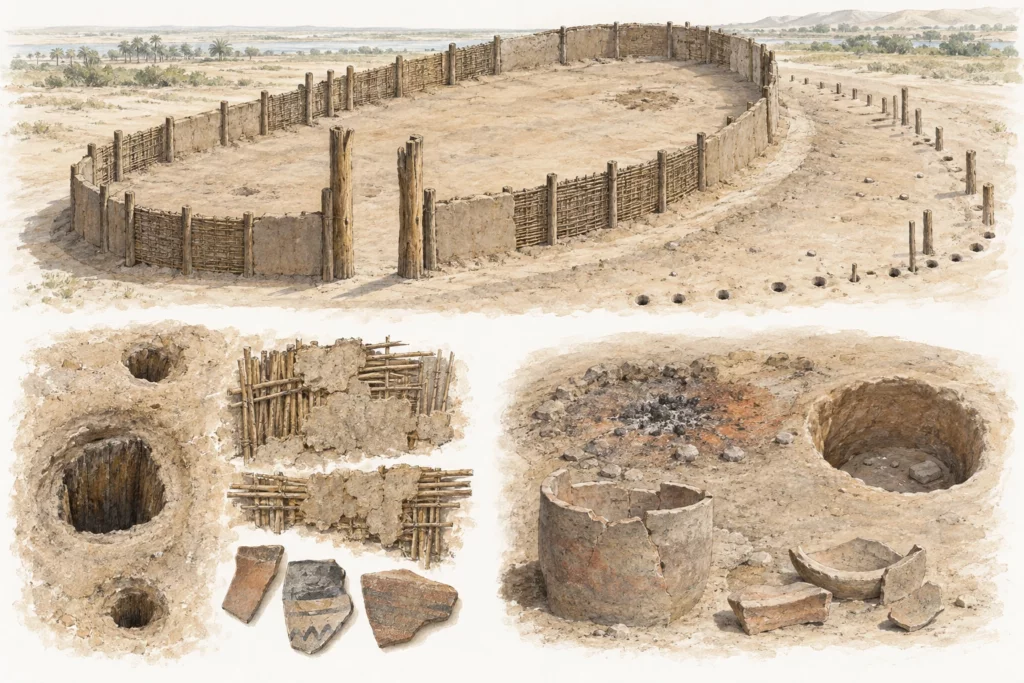
At HK11, on the south bank of the great wadi, houses and domestic activities are concentrated in the east; beer and pottery production occupy other sectors. Hearths, storage pits and the remains of mud-plastered fences give a material picture of the occupations. A stratified midden has preserved cereals, wild plants, bones and pottery, bearing witness to successive deposits. At HK29A, on the edge of the low desert, excavations have revealed a walled oval court of about 45 by 13 metres. Four large acacia posts and smaller posts belong, according to the current interpretation, to a monumental entrance. The neighbouring sector HK29B preserves the trace of a palisade of large posts followed over more than 50 metres. The total extent of the enclosed space and the exact relationships between its different elements remain to be clarified.
Chronology and building phases
The occupation of Hierakonpolis began before its peak in the 4th millennium. The levels of the HK11 midden fall mainly within the Naqada IC–IIA transition, roughly around 3800–3700 BC, according to their pottery. The great expansion of the settlement is placed around 3700–3500 BC. The centre at HK29A functioned for more than five centuries, from Naqada IIA to the 1st Dynasty, with several renovations: it would therefore be misleading to freeze it in a single appearance. Changes in climate and in human activity then contributed to altering the occupation of the low desert. The town mound and its sanctuaries continued their own history in the Dynastic periods. The dates given for the sectors are not interchangeable.
History and functions
The data from HK11 shed light on the economy of the inhabitants. Botanical analyses have identified emmer, barley, flax, cultivated or wild fruit and desert plants. They provide information on crops, gathering and environment, but some agricultural practices remain debated. The brewing installations and pottery workshops bear witness to organised production. At HK29A, the peripheral pits contained a great deal of pottery and several tens of thousands of bones of fish and of domestic and wild animals. The assemblage suggests slaughtering, communal meals and ceremonial acts. The strong presence of certain wild species supports a ritual interpretation; it does not allow a specific ceremony to be reconstructed. Calling the place a ceremonial and administrative centre describes a hypothesis based on all the evidence, not a function written on an ancient plan.
Excavations and the history of research
The first scholarly explorations at the end of the 19th century favoured large objects and tombs. The excavations of James Quibell and Frederick Green in the area of the Dynastic temple yielded the Narmer Palette in the Main Deposit. Attention to the localities of the low desert grew with modern research. Michael Hoffman explored HK29A between 1985 and 1989; new seasons in 2002 and then 2009 revised the reading of its structures. The four large posts had first been understood as the supports of a small shrine. Their examination and the new reading of the ground now link them to the entrance of the court; the wood has been identified as local acacia, not cedar. At HK11, the stratigraphy of the deposits and the studies of plants and fauna complement the study of the architecture. The mission’s publications set out the results and the successive revisions.
State of preservation and research questions
Perishable materials and later disturbance limit the reconstruction of the buildings. A vast area of settlement is known only through test pits and partial surfaces; the levels of the plain remain deeply buried. The plan of HK29A combines several phases whose simultaneous appearance is not fully established. The reconstruction of a shrine on the posts of its entrance was abandoned following the 2009 excavations. The bone pits establish deposits and slaughtering practices, but the exact staging of the rites remains a matter of interpretation. Likewise, the Narmer Palette and the other objects of the Main Deposit shed light on the political and religious history of Nekhen without serving as direct proof of each function attributed to HK29A. The visuals provided separately offer an evocation and a non-metric reading plate, without reproducing the exact state of an excavated sector.
Sources
Main sources: Hierakonpolis Expedition, ‘Predynastic Town Introduction’. https://www.hierakonpolis-online.org/index.php/explore-the-predynastic-settlement (consulted on 26 September 2026).
Hierakonpolis Expedition, ‘The Ceremonial Center (HK29A)’. https://www.hierakonpolis-online.org/index.php/explore-the-predynastic-settlement/hk29-the-ceremonial-center (consulted on 26 September 2026).
Hierakonpolis Expedition, ‘HK11 – Settlement features’. https://www.hierakonpolis-online.org/index.php/explore-the-predynastic-settlement/hk11-settlement-features (consulted on 26 September 2026).
Friedman, Renée F., ‘Hierakonpolis Locality HK29A: The Predynastic Ceremonial Center Revisited’, Journal of the American Research Center in Egypt 45, 2009, pp. 79–103.