Identification and location
Gabal al-Tayr lies in the governorate of Minya, in Middle Egypt. In June 2026, the Egyptian Ministry of Tourism and Antiquities announced that a mission of the Supreme Council of Antiquities had uncovered part of a Predynastic cemetery in this area. The announcement reports burials in a contracted position, remains of plant mats and, near some tombs, black-topped vessels attributed to the Naqada II and Naqada III phases. The same excavation revealed two tombs of the Early Dynastic period and burials of the Late Period. This article concerns the Predynastic burials. The precise extent of the cemetery and the full inventory of the tombs had not been published at the time of writing.
General presentation
The discovery adds a landmark to the study of Predynastic funerary practices in the middle Nile valley. It establishes at least that the area was used during Naqada II and III, before the burials of later periods. The presence of several phases on the same site can shed light on how its use changed, provided the excavated contexts are kept separate. The two built tombs that the announcement attributes to the Early Dynastic period do not define the form of the Predynastic tombs. Their preliminary comparison with the tomb of King Den at Abydos concerns another phase and makes it possible neither to date the earlier pits nor to identify their occupants. The importance of the site lies here in new documentation that is in the course of publication.
Monuments and remains
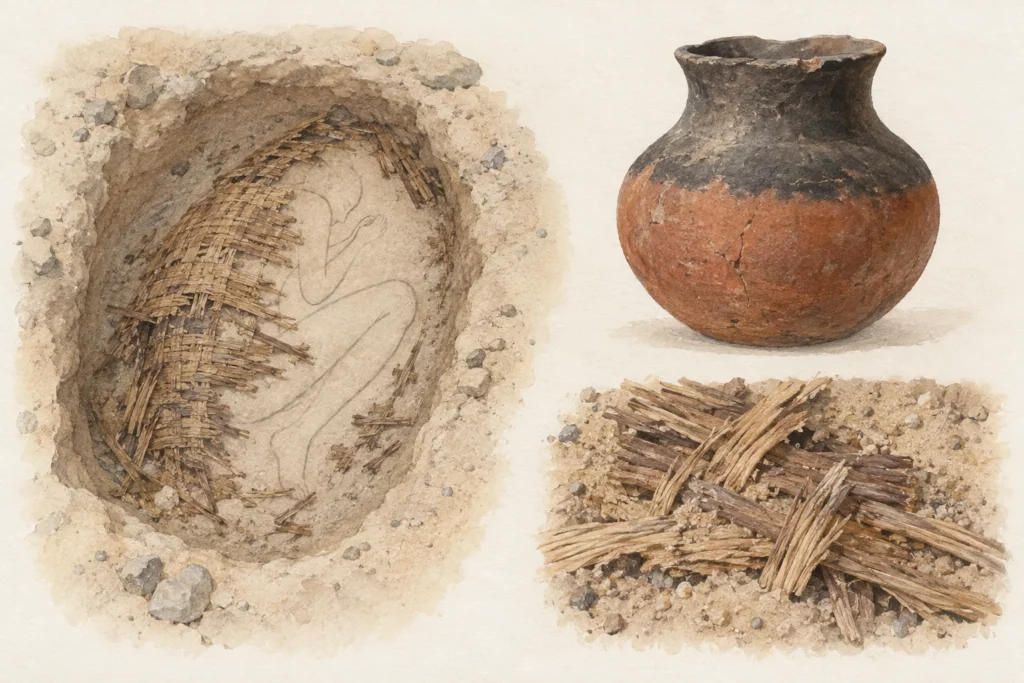
According to the mission’s public report, some of the Predynastic individuals lay in a flexed position. Traces of decomposed plant mats surrounded some deposits. These fragile remains indicate the use of organic materials in the funerary arrangements, but their original form and precise function require detailed field analysis. Black-topped vessels were found near some burials; an established stratigraphic association must be distinguished from mere proximity in space. The available publication gives no tomb-by-tomb plan, no dimensions and no catalogue of this pottery. The two large Early Dynastic tombs described by the mission have distinctive architectural features and must be studied in their own sequence. The late burials confirm later use of the area.
Chronology and building phases
The mission proposes for the Predynastic burials an attribution to Naqada II and III, resting in particular on the associated pottery. These phases cover the end of the 4th millennium BC, but the announcement gives no absolute date for each pit. The Early Dynastic tombs belong to the beginnings of dynastic Egypt; the other burials announced belong to the Late Period. This stratification rules out speaking of a single funerary complex built within one generation. Nor does it establish, at this stage, a continuous occupation of the ground between these periods. To clarify the sequence, field surveys, stratigraphy, pottery series and, if available, independent dating analyses will be needed.
History and functions
The published observations concern mainly the treatment of the dead and a few associated objects. The contracted position of a body is a descriptive fact; it tells us nothing directly about the beliefs of the people who buried it. The mats may have wrapped the dead person or formed part of the arrangement of the pit, but only their documented position would allow a decision case by case. A black-topped pot can be useful for relative chronology when it is securely associated with a tomb. The announcement does not yet make it possible to distinguish status groups, differences of age or sex, or exchange networks for this part of the cemetery. These questions are relevant for future research but should not be presented as established results.
Excavations and the history of research
The discovery was announced by the Egyptian Ministry of Tourism and Antiquities on 20 June 2026, from the work of an Egyptian mission of the Supreme Council of Antiquities directed in the field by Sami Dardiri. The announcement names the heads of the mission and describes the major finds of several periods. At the date of this article, the information available remains that of an institutional announcement: it does not replace a detailed excavation report. A scientific publication will need to specify the location of the tombs, their plans, the order of the deposits and the stratigraphic relationships with the Early Dynastic and late structures. It may also document the typology of the pottery, the study of the human remains and the state of preservation of the mats. New information will have to be added to the article when these data become available.
State of preservation and research questions
The scope of the conclusions must remain proportionate to the documentation. No total number of Predynastic burials and no complete survey is given in the announcement consulted. The attribution to Naqada II and III is an archaeological proposal announced by the excavators, with no published detail of the pottery series. The comparisons of the Early Dynastic tombs with Abydos and the hypotheses on the development towards the pyramids do not directly concern the Predynastic pits; they are preliminary and should not be turned into a demonstrated line of descent. The site also includes burials of the Late Period.
Sources
Main sources: Egyptian Ministry of Tourism and Antiquities, ‘Archaeological discovery at Gabal al-Tayr, Minya’ [press release in Arabic], 20 June 2026. https://mota.gov.eg/ar/الأخبار-2-1-1/كشف-أثري-بجبل-الطير-بالمنيا-يعيد-رسم-ملامح-العمارة-الجنائزية-في-مصر-القديمة/ (in Arabic) (consulted on 26 September 2026).
Egyptian State Information Service, ‘Ancient tomb discovery sheds light on early Egyptian funerary architecture’, 20 June 2026. https://sis.gov.eg/en/media-center/news/ancient-tomb-discovery-sheds-light-on-early-egyptian-funerary-architecture/ (consulted on 26 September 2026).