Identification and location
Medinet Madi, in the Faiyum, corresponds to the Middle Kingdom town of Dja, called Narmouthis in the Graeco-Roman period, a name meaning ‘the town of Renenutet’. The cobra goddess of the harvest had a temple there (temple A) founded by Amenemhat III at the same time as the town, under the 12th Dynasty. This sanctuary, decorated with reliefs showing Amenemhat III and his successor Amenemhat IV, comprises a hypostyle hall with two columns and a transverse hall opening onto three chapels. The Pisa mission presents it as the only Middle Kingdom cult temple known in Egypt to survive with its texts and its sculptures.
The Ptolemaic programme around the first temple
In the Ptolemaic period, probably under Ptolemy IX Soter II, the temple of Amenemhat was extended southwards by three courts and a vestibule, while a second temple (temple B, known as the north temple) was built against its north side. A long dromos lined with sphinxes passed through the great southern gate of the temenos and led to a kiosk. At the original entrance to this way, recent clearance uncovered a sacrificial altar, four statues of lions and a statue of a lioness, a group described as without parallel, as well as new Greek dedicatory inscriptions dated to 116 BC. The dromos can now be followed for 230 metres from south to north.
On the jambs of the gate of the first court are carved the four Greek hymns of Isidorus, discovered by Achille Vogliano. Composed after 96 BC, they are addressed to Isis-Renenutet (Isis-Hermouthis in Greek), to Sokonopis, to Anchoes and, under the name Porramanres, to Amenemhat III, the founder of the first temple. The author, a Hellenised Egyptian, thus honours in Greek, among the deities of the place, a king of the Middle Kingdom.
Temple C and its crocodile eggs
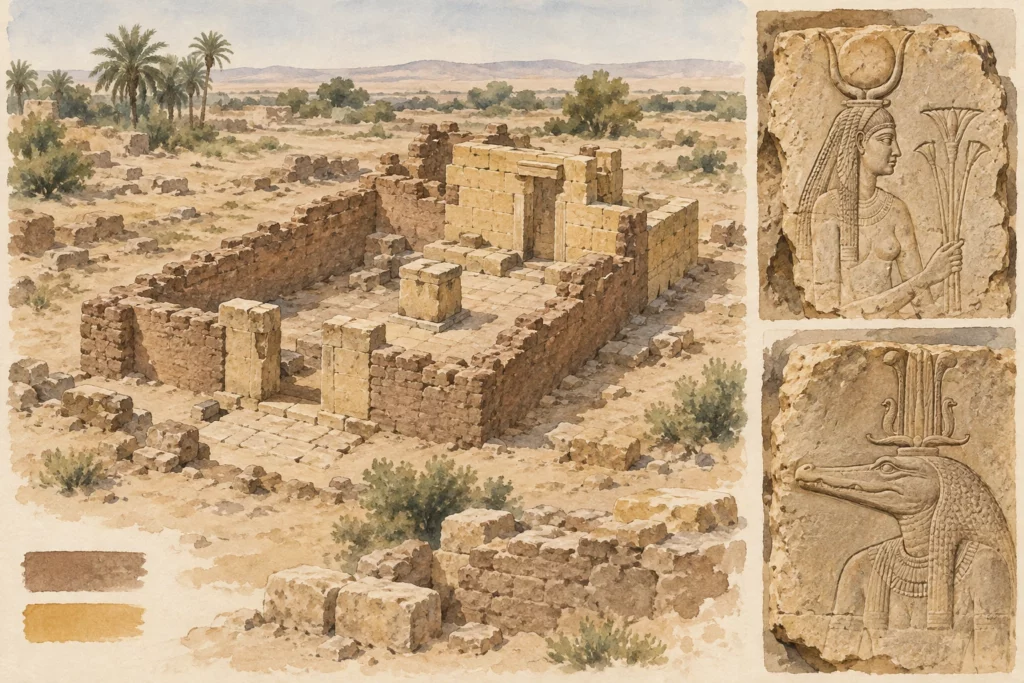
Excavated by the Pisa mission from 1997, temple C, of the Ptolemaic period, is dedicated to two divine crocodiles, perhaps Sokonopis and Soknopaios, or Soknebtynis. Built of mudbricks of Ptolemaic size (30 × 15 × 12 cm), it measures 16.50 metres long by about 12 metres wide, and its walls survive to a height of 4 to 4.20 metres. A vaulted structure attached to it was used to incubate crocodile eggs: one room contained more than thirty, and some sixty eggs in all were found in purpose-made cavities.
From the Roman stoa to the churches
Beyond the secondary northern gate, a large porticoed court (stoa) of about 50 × 30 metres was added in the Roman period. In 2006–2007, the mission identified the castrum Narmutheos of the time of Diocletian. It is a square fortress 50 metres on each side, with mudbrick walls 3.80 metres thick, flanked by four corner towers and a central circular tower. A vaulted cistern 3.35 metres square, cut into the rock, supplied it with water. The garrison was the cohors IV Numidarum. In the southern sector, ten churches of basilican plan from the 5th and 6th centuries attest the vitality of the town in the Christian period.
From Vogliano to the archaeological park
Achille Vogliano cleared temple A and its Graeco-Roman additions between 1935 and 1939. The University of Pisa, under the direction of Edda Bresciani and in collaboration with the University of Messina, resumed the exploration from 1978. The ISSEMM project was launched in 2008 with €3.5 million of funding from the Italian Ministry of Foreign Affairs. It cleared the sand from a strip 420 metres by 20, to an average depth of 4 metres, and consolidated the structures with about a million mudbricks. It also laid out a visitor route and a visitor centre.
Dating each addition
The detailed phasing of the Ptolemaic works remains the main question: the attribution of the courts and the vestibule to Ptolemy IX is put forward only as probable, and only the dedications of 116 BC and the hymns later than 96 BC provide dated reference points. The exact identity of the crocodiles of temple C also remains uncertain.
Sources
Main sources (consulted on 30 September 2026): Medinet Madi, University of Pisa excavations, Egyptology laboratory of the University of Pisa (in Italian); Medinet Madi (concluded excavations), University of Pisa; Alexandra von Lieven, ‘Some Observations on Multilingualism in Graeco-Roman Egypt’, Max Planck Research Library for the History and Development of Knowledge.