Identification and location
Luxor Temple, on the east bank of Thebes, was linked to the temple of Amun at Karnak by a processional avenue of sphinxes. Ramses II (Ramesses II) enlarged the building of Amenhotep III by constructing a vast court and a monumental pylon in front of it: it is these additions that now form the entrance to the temple.
Architecture and decoration
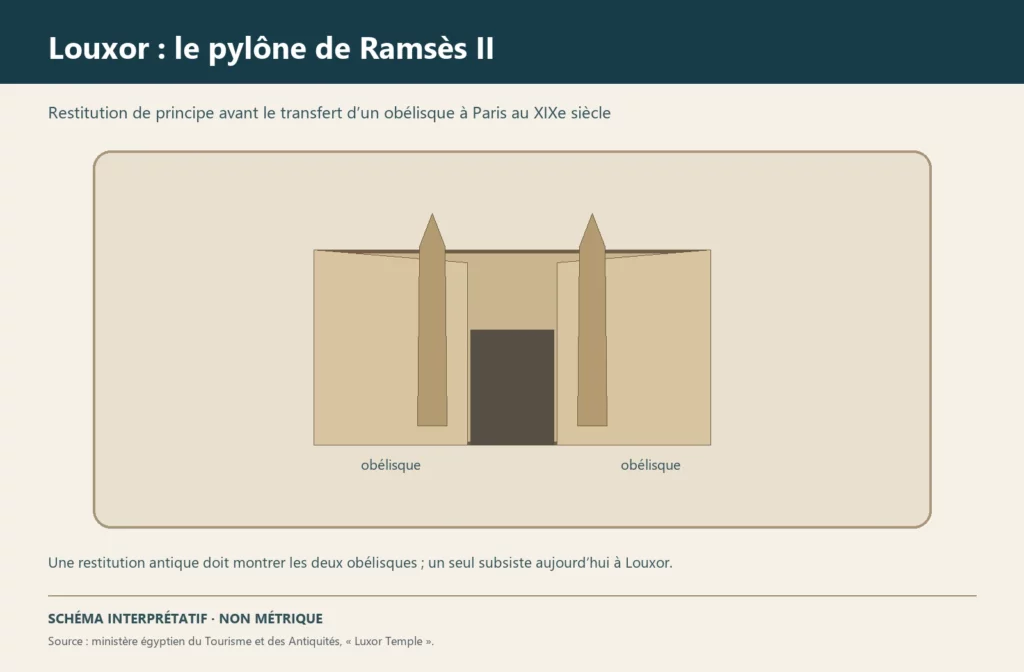
The pylon, about 65 m wide, bears reliefs of the battle of Qadesh on its two towers. In front of it stood two granite obelisks; one is still in place, the other was given to France and erected in the Place de la Concorde in Paris in 1836. Seated and standing colossi of the king framed the entrance.
The court, surrounded by a double row of papyriform columns, houses statues of the king between the columns on the south side. It is not exactly on the axis of the temple of Amenhotep III: its orientation adapts to that of the avenue coming from Karnak. An earlier barque shrine of the Theban triad was incorporated into the north-west corner of the court.
Chronology and functions
These buildings date from the first years of the reign of Ramses II. They gave monumental form to the approach to the temple during the Opet festival, when the statues of Amun, Mut and Khonsu came from Karnak. The reliefs of the court also show a procession of the king’s sons.
The following periods
The temple underwent many transformations: a Roman military camp, churches, then, in the 13th century, the mosque of Abu el-Haggag, built on the debris that filled the court. It is still in use, overlooking the court cleared in the 19th and 20th centuries.
State of preservation and research questions
Research focuses on the chronology of the Ramesside additions and on reuse: some statues in the court bear the name of Ramses II but may have been carved for an earlier king.
Sources
Main sources (consulted on 28 September 2026): Egyptian ministry, Luxor Temple; UNESCO, Ancient Thebes with its Necropolis.