In brief
Luxor Temple stands about three kilometres south of Karnak, in ancient Thebes. The Egyptian Ministry of Tourism and Antiquities attributes the core of the monument to Amenhotep III (c. 1390–1352 BC). The temple is oriented towards Karnak rather than along the usual east–west axis, because it received the procession of the Opet festival. Visitors entering through the pylon do not, however, see a monument of a single reign: this page focuses mainly on the project of Amenhotep III, without attributing to him all of today’s courts and façades.
What you discover
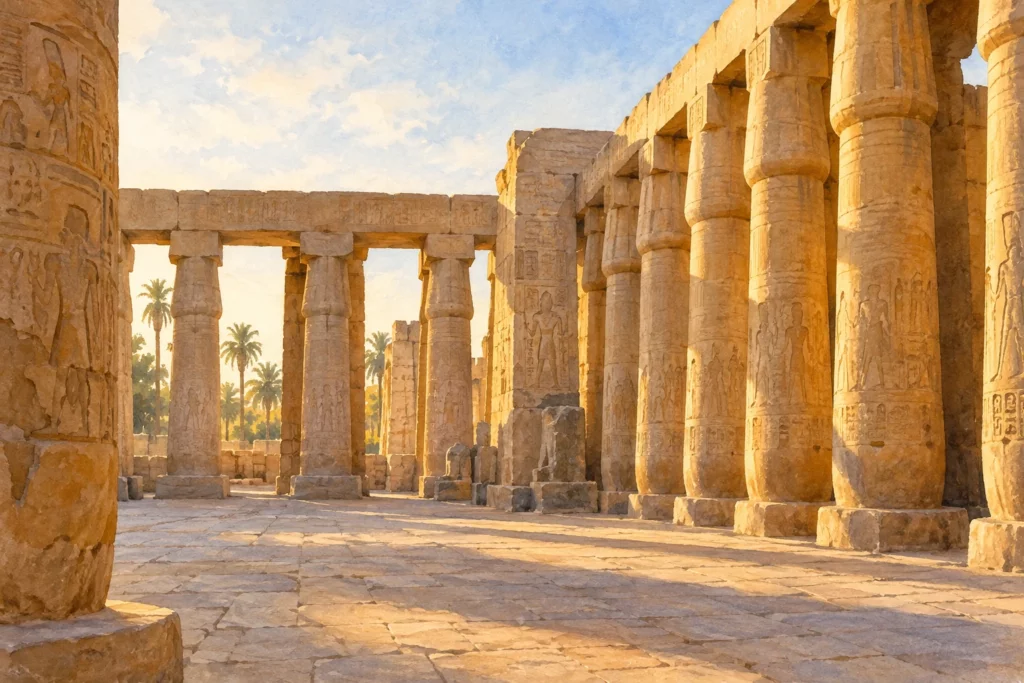
The programme of Amenhotep III comprises inner rooms, a court surrounded by columns and, in front, the Great Colonnade, formed of two rows of seven colossal columns. An inner sanctuary bears the scenes of the divine birth, in which the god Amun-Ra appears as the king’s father. Further north, in front of this core, Ramses II (Ramesses II), who reigned c. 1279–1213 BC, added a peristyle court, a monumental pylon and two obelisks 25 metres high. One of them still stands at Luxor, the other has been in Paris since 1836.
What to look at
The columns of the Great Colonnade, through their proportions, give the measure of the project of Amenhotep III: two rows of seven colossal shafts open the way to the sacred interior. Then look, in the innermost part, for the Roman decoration. At the end of the 3rd century AD, the temple was turned into a military installation. The sanctuary was then decorated in the Graeco-Roman style with a depiction of the emperor Diocletian (AD 284–305) and his three co-rulers. This painted decoration covers older surfaces: on the same wall, two states of the monument are superimposed.
The axis of the temple also deserves a look. It does not follow an east–west orientation but the link with Karnak, along which the procession of the divine images travelled.
Its history
Amenhotep III built the core of the temple and the colonnade. Ramses II then transformed the approach to the monument with his court, his pylon and his obelisks. At the end of the 3rd century AD, a Roman camp was set up around the sanctuary, which changed the access and the uses. The phase of each addition therefore cannot be guessed from the outside: the building accumulates successive states, and it must be read from the core towards the entrance so as not to invert its chronology.
Why this place matters
Luxor Temple shows the links between architecture and ceremony. Its position, its orientation and its colonnade accompanied a route coming from Karnak, during a festival in which divine statues were carried in procession. The divine birth scenes also show how the king presented his legitimacy. It is part of Ancient Thebes with its Necropolis, inscribed on the World Heritage List. Observing the later additions guards against a common mistake, that of confusing the programme of Amenhotep III with the whole history of the place.
Sources
Consulted on 30 September 2026: Luxor Temple, Egyptian Ministry of Tourism and Antiquities; Ancient Thebes with its Necropolis, UNESCO.