Luxor Temple developed at the heart of ancient Thebes. Its main part, linked to Amenhotep III, and the additions of Ramses II (Ramesses II) are presented in two separate articles. The ceremonies that linked Luxor to Karnak explain its importance without making the two sanctuaries a single monument.
In brief
The ancient Egyptians called the temple Ipet-resyt, ‘the southern sanctuary’. It was dedicated to Amun in the form of Amenemope and hosted the Opet festival: the cult statues of Amun, of his consort Mut and of their son, the lunar god Khonsu, were carried there in procession from Karnak. For UNESCO, which inscribed it on the World Heritage List with Thebes in 1979, it is a masterpiece of 14th-century BC architecture.
What you discover
The visible temple is the result of successive contributions. Hatshepsut built the oldest surviving sanctuary there. Amenhotep III built the heart of the temple and the great colonnade, formed of two rows of seven colossal columns. Tutankhamun and Horemheb completed the decoration. Ramses II finally added a peristyle court and a monumental pylon.
An avenue lined with sphinxes linked Luxor Temple with that of Karnak. The processions of the Opet festival travelled along it: this ritual relationship is essential to reading the city, but it does not make the plans or the histories of the two sites identical.
What to look at
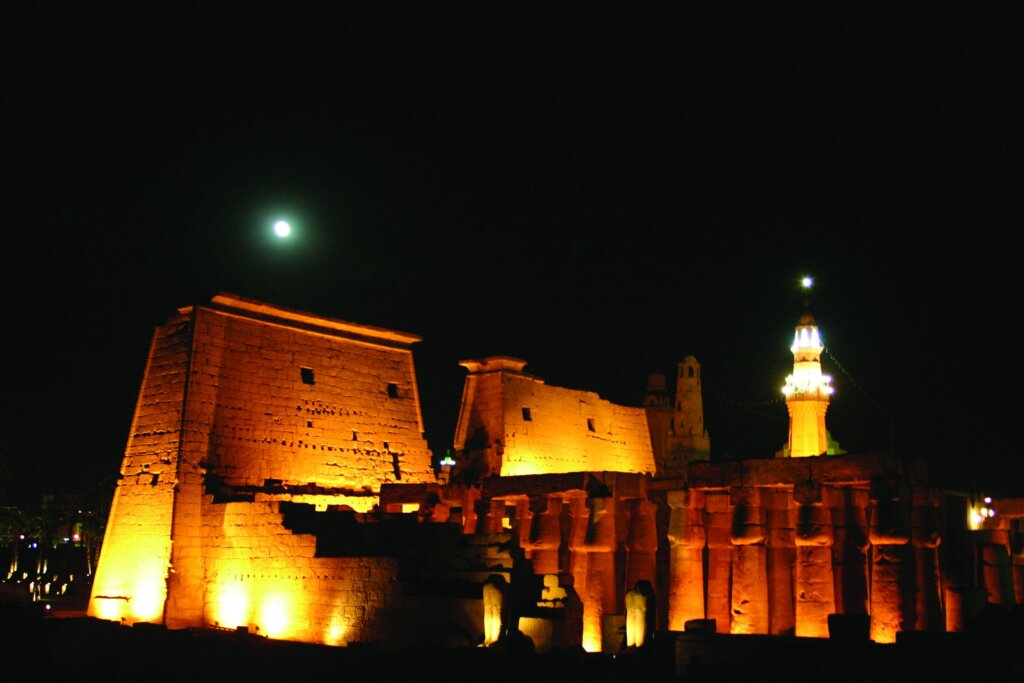
In front of the pylon of Ramses II stood two obelisks 25 m high. One is still in place; the other has adorned the Place de la Concorde in Paris since 1836. The photograph shows the pylon on a moonlit evening, with the minaret of the mosque of Abu el-Haggag rising above the temple: a single place thus carries more than three millennia of religious history.
Its history
The temple did not stand still after the pharaohs. At the end of the 3rd century AD, the Romans built a fort around it and added reliefs in the Graeco-Roman style. Between the sanctuary of Hatshepsut (c. 1473–1458 BC) and the pylon of Ramses II (c. 1279–1213 BC), more than two centuries of building works followed one another, and each reign left its mark in the inscriptions. Courts, columns, reliefs and later additions thus bear witness to very different functions and uses, from the cult of Amun to the daily life of Luxor.
How to explore the articles
The article on the construction of Amenhotep III describes the great programme of the 14th century BC. The article on the pylon and court of Ramses II presents the Ramesside additions. To follow the processional way of the Opet festival to its starting point, go on to the Karnak article and then to that on the domain of Amun-Ra.
Sources
Egyptian ministry, Luxor Temple: https://egymonuments.gov.eg/monuments/luxor-temple
UNESCO, Ancient Thebes with its Necropolis: https://whc.unesco.org/en/list/87