Identification and location
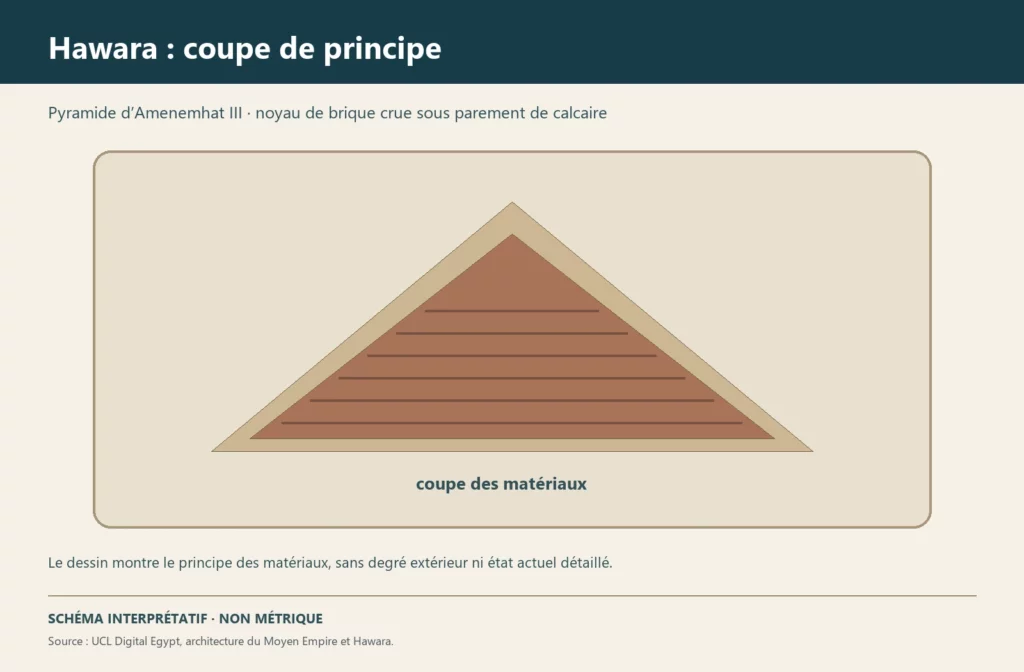
Hawara lies near the entrance to the Faiyum. The pyramid of Amenemhat III was built there after the king’s first project at Dahshur. UCL attributes the choice of Hawara, towards the end of the reign, to the problems encountered with the ground at Dahshur and regards Hawara as the royal burial place. The exact chronology of the decisions is still debated. This article concerns the pyramid and the Middle Kingdom cult complex; the surrounding necropolis also includes many much later occupations. The pyramid had a mudbrick core and a stone casing, largely lost. The present monument appears as an eroded hill that no longer shows its original regular profile. Its underground organisation belongs to the development of the pyramids of the 12th Dynasty, whose corridors, chambers and closing devices became complex. An explanatory section cannot deduce the whole layout from this. Studies of the site must compare the remains in place with old surveys and with the disturbances caused by later interventions.
General presentation
Near the pyramid stood a great cult building, generally regarded as the ‘Labyrinth’ praised by Greek authors. UCL presents this identification as probable. The travellers’ accounts are valuable for the history of the monument’s reception, but they are about a millennium later and do not replace the excavated foundations. Large parts of the architecture have disappeared. The number of courts or rooms sometimes repeated in the literature must not be treated as a reliable modern measurement.
Monuments and remains
The complex served as the place of the funerary cult of Amenemhat III. Its exceptional size expresses the royal importance of the Faiyum in this period. The fragments of sculpture and the blocks recovered in the excavations show that the architectural and figurative programme went beyond the pyramid alone. Yet the absence of complete walls limits the reconstruction of the ritual routes. A drawing of the associated temple must therefore distinguish what is attested on the ground from what is suggested to explain the possible functions of the spaces.
Chronology and building phases
Amenemhat III kept a lasting religious memory in the Faiyum. Late attestations of his cult come from Hawara and other sites. They do not prove that the forms of devotion of the Ptolemaic or Roman period exactly reproduced the ritual of the Middle Kingdom. At Hawara, burials followed one another from the Middle Kingdom to the Roman period. Their material proximity to the pyramid makes a systematic chronological distinction necessary in descriptions and images.
History and functions
The painted mummy portraits discovered in the Roman necropolis made Hawara famous. Petrie excavated there in particular a large group of encaustic portraits. They belong to burials of the Roman period and are neither portraits of Amenemhat III nor part of the decoration of his temple.
Excavations and the history of research
Petrie’s excavations in 1888–1889 and then in 1910–1911 provided much of the archaeological documentation. The material covers several periods: sculptures of the royal complex, Middle Kingdom tombs, late burials and Roman objects. Provenance and date must accompany each piece. Objects kept in the Petrie Museum or elsewhere must not be placed arbitrarily in a supposed court of the ‘Labyrinth’. The history of the excavations determines the precision a reconstruction can achieve.
What we still do not know about the Labyrinth of Hawara
The pyramid of Amenemhat III is now no more than an eroded hill whose stone casing has almost disappeared, and the great neighbouring cult building, which UCL presents as the probable ‘Labyrinth’ of the Greek authors, has lost large parts of its architecture. The plans and ritual routes therefore cannot be deduced from the surviving walls.
Several questions remain open: the exact chronology of the move from Dahshur to Hawara, the real number of courts and rooms in the complex, and the place of the recovered sculptures in a whole that is now incomplete. Petrie’s excavations, being old, require each piece to be re-read with its provenance and date, and the Middle Kingdom occupations to be distinguished from the late burials.
Sources
Main sources: UCL, Hawara, UCL Digital Egypt; ‘Amenemhat III’, https://www.ucl.ac.uk/museums-static/digitalegypt/chronology/amenemhatIII.html; ‘Hawara, the tomb chapels’, https://www.ucl.ac.uk/museums-static/digitalegypt/hawara1/roman/stelae.html; ‘Site index’, https://www.ucl.ac.uk/museums-static/digitalegypt/archaeology/sitesindex.html; ‘Evolution of Pyramids’, https://www.ucl.ac.uk/museums-static/digitalegypt/pyramids/shape.html (consulted on 27 September 2026).