In brief
On the Egyptian shore of the Gulf of Suez, Wadi al-Jarf preserves a port of the beginning of the 4th Dynasty. It was used under Sneferu and then under Cheops (Khufu) by teams sent to Sinai, in particular to obtain copper and turquoise. The site brings together a jetty, camps, anchors and galleries cut into the rock to store nautical equipment. Papyri found here take the reader into the daily organisation of a royal team.
What you discover
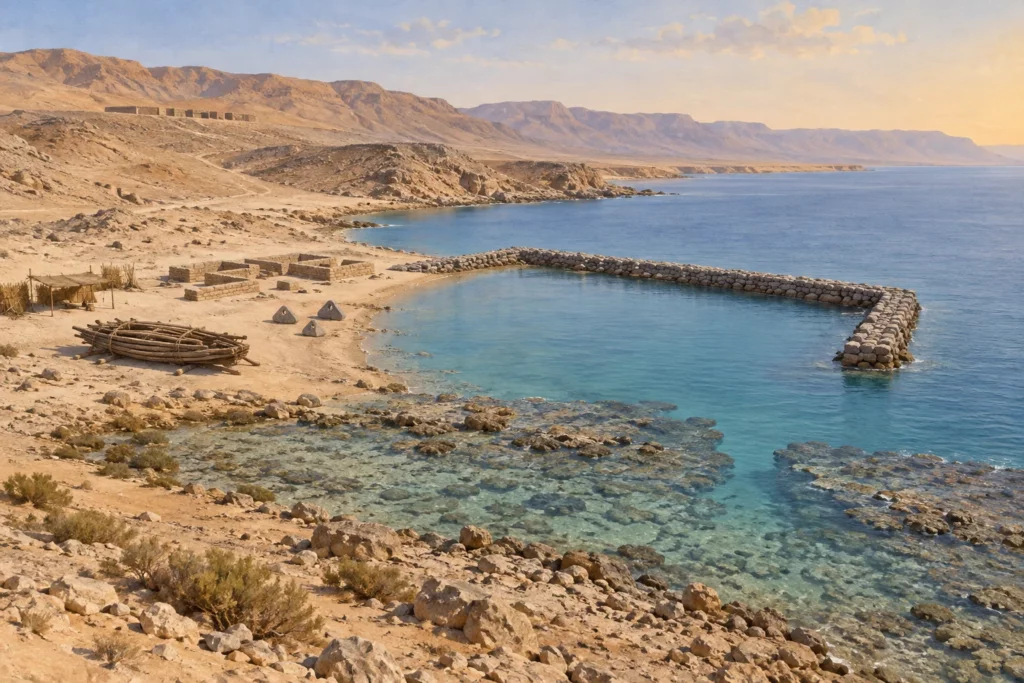
Near the coast, archaeologists have identified the remains of a large L-shaped jetty and buildings where expeditions stayed temporarily. More than a hundred stone anchors have been found stored together. About five kilometres from the sea, more than thirty storage galleries were cut into the rocky foothills; some were closed with large blocks. Fragments of boats, tools, pottery and sealings were recovered there. At the entrance to one gallery, hundreds of papyrus fragments were discovered in 2013.
Its history
The port was not a permanently occupied town: teams came there for missions. The papyri belonged to a group active at the end of the reign of Cheops. The journal of the inspector Merer tells in particular of the transport of limestone from Tura to the building site of the Great Pyramid at Giza. These journeys concerned navigation on the Nile, before the team’s stay on the shore of the Red Sea. It would therefore be wrong to say that the blocks from Tura reached Giza through this sea port.
Why this place matters
Wadi al-Jarf shows how the state organised sea expeditions, kept boats and equipment between two campaigns, and kept accounts. The papyri are also a rare testimony to the supply of the pyramid of Cheops, even though they were found far from Giza. Their presence at the port links mobile teams to several royal building sites. The two separate images of the feature are created compositions: they have no value as an exact survey and show no legible authentic papyrus text.