In brief
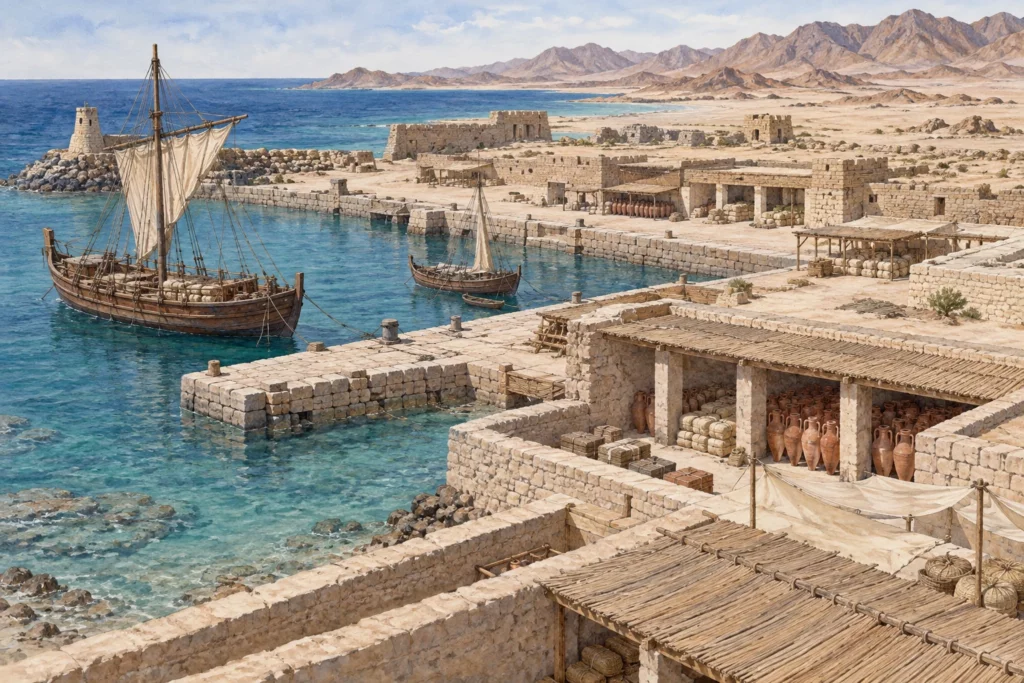
Berenike, which ancient authors called Trogodytika, occupies the Egyptian coast of the Red Sea, about 260 kilometres east of Aswan and some 825 kilometres south-south-east of Suez. Pliny the Elder attributes its foundation to Ptolemy II Philadelphus, who gave it his mother’s name; excavations have confirmed a settlement in the 3rd century BC. For about eight centuries, until the 6th century AD, the port linked the Nile Valley with South Arabia, East Africa and India.
What you discover
The ancient town can be read mainly through the areas opened by archaeologists. To the west, on the edge of the Wadi Mandit, stood the Ptolemaic fort, a vast complex of about 150 by 80 metres, organised around at least three courtyards. To the north, a rampart of about 180 metres, located by geomagnetic survey and then partly uncovered, protected the only approach by land. In the heart of the town rose the great temple of Isis and Serapis, built in the 1st century AD and in all likelihood ruined by earthquakes: it is the largest sanctuary of Berenike. Towards the south, in the harbour area, excavations have uncovered a workshop building, ship planks, ropes and mooring lines.
What to look at
The materials tell the story of the place first. The north-west tower of the first fort, about 5 metres square, had walls made of gypsum-anhydrite blocks and large pieces of coral: people built with the immediate resources of the shore. Close by, a V-shaped ditch was cut into the rock; it lacks the lime plaster that would have allowed it to hold water. Elephant molars were found nearby. The excavators see it as an enclosure where the animals landed from ships were penned, the first archaeological evidence of this traffic. Skull fragments of a young elephant, found elsewhere, confirm it.
The temple offers another striking detail: among many images of Serapis is a bust in teak wood, once gilded, which the archaeologists think was carved from a broken mast, since this wood was used for the ships of the Indian Ocean.
Its history
The port was born of a military project: the Ptolemies landed there the war elephants captured further south on the African coast. The fort went through several phases between about 275 and 200 BC and also housed workshops for working copper and lead. Under Rome, Berenike became a major trading centre: excavations have yielded 1st-century black pepper, teak from South India, cedar from Lebanon, pottery, textiles and beads of Indian manufacture. Buddhist sculptures, an inscription in Sanskrit and Meroitic statuary bear witness to the diversity of the people passing through, although no single imported object is enough to prove the lasting presence of a foreign community.
From the end of the 4th century AD, the Blemmyes, a nomadic people of the Eastern Desert, controlled the port; an inscription paid for by a certain Mochosak, interpreter of their king Isemne, records this. Berenike was abandoned before about 550 and never reoccupied. The geophysical plan shows that a large part of the town remains to be excavated, and the ancient shoreline and the exact location of all the quays remain uncertain.
Sources
Consulted on 30 September 2026: Berenike Archaeological Project, Polish Centre of Mediterranean Archaeology, University of Warsaw; Discoveries of the Polish Centre of Mediterranean Archaeology in Berenike, University of Warsaw, 2020; Marek A. Woźniak et al., ‘Ptolemaic Berenike: Resources, Logistics, and Daily Life in a Hellenistic Fortress on the Red Sea Coast of Egypt’, American Journal of Archaeology 125/2, 2021.