Identification and location
Wadi al-Jarf lies on the western coast of the Gulf of Suez, on the Red Sea. The site, used at the beginning of the 4th Dynasty under Sneferu and Cheops (Khufu), is not a single installation: its components extend from the sea to the foothills of the Gebel Galala, over about five kilometres. The jetty, the coastal camps, the anchor deposits and the storage galleries form an intermittent harbour system. The expeditions crossed the gulf to the south of the Sinai peninsula to exploit copper and turquoise in particular. The label port of the time of Cheops refers to the phase best documented by the archives found on the spot; it should not erase the evidence of occupation under Sneferu.
General presentation
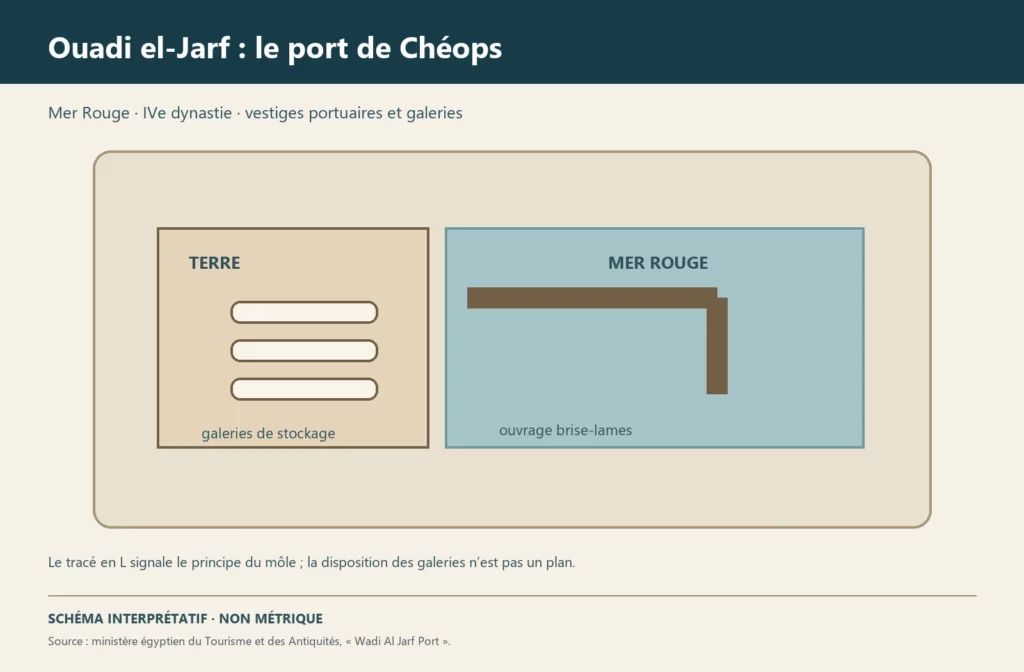
The interest of Wadi al-Jarf lies in the rare combination of a maritime infrastructure, rock-cut storerooms and written archives. The L-shaped jetty protected a coastal access opened in the reef. Buildings with small cells temporarily housed teams, and stone anchors were left grouped together awaiting reuse. The galleries away from the coast served to store boat parts and other equipment between two missions. The papyri discovered in 2013, at the entrance to a gallery, are accounts and logbooks. Some of them document the earlier activity of Merer’s team at the building site of the Great Pyramid. The history of the port and that of the transport of limestone to Giza therefore meet through the men and their archives, not through a route of blocks passing by the Red Sea.
Monuments and remains
On the shore, the mission has described a massive L-shaped jetty, about two hundred metres along each of its two main arms according to the synthesis of the Institut français d’archéologie orientale (IFAO, French Institute for Oriental Archaeology). It lies in front of a gap in the coral reef that made access to the shore easier. Compartmented buildings and a deposit of more than a hundred anchors are known in the coastal area. In the last foothills of the Gebel Galala, some five kilometres away, more than thirty galleries were cut into the rock; their length varies from about fifteen to more than thirty metres. Large blocks closed some entrances. The excavations have yielded pottery, tools, sealings and fragments of boats. Hundreds of pieces of papyrus, from several rolls, had been deposited near the entrance to a gallery. These components are not all next to one another on the ground.
Chronology and building phases
The sealings and other materials place the main occupations under the first two kings of the 4th Dynasty, Sneferu and Cheops. The installations were used during temporary expeditions; the exact frequency of these missions cannot be determined from each gallery. The archives found in 2013 belonged to a team that came to the coast towards the end of the reign of Cheops. Merer’s journals describe, for an earlier period, journeys carrying fine limestone from Tura to Akhet Khufu, the building site of the Great Pyramid, by the waterways of the Nile. Other fragments record accounts of foodstuffs, tools and equipment intended for the teams of the port. They make it possible to follow specific operations, not the whole economic policy of the reign. After the last significant phase of occupation, the equipment was left or stored, and papyri were abandoned at the entrance to the storerooms.
History and functions
The port served as a staging post for crossing the Gulf of Suez and reaching the resources of Sinai. The presence of a spring in the region, now near the Monastery of St Paul, was among the advantages of this location. The boats, transported in pieces from the Nile Valley, could be assembled on the coast, then dismantled again and kept in the galleries. The grouped anchors and the living spaces reflect the intermittent nature of the activity. The IFAO suggests that the copper obtained during these missions supplied, among other things, the tools of the builders of Giza; this economic relationship is plausible, but the route of each batch of metal is not documented. Merer’s journal attests more directly the transport of limestone on the Nile for the pyramid. Confusing these two flows, copper from Sinai and limestone from Tura, would blur the meaning of the archives.
Excavations and the history of research
Modern research has been carried out since 2011 by a mission bringing together the IFAO and its partners, under the scientific direction of Pierre Tallet with specialists in harbour architecture and topography. The seasons have documented the jetty, the camps, the anchors, the galleries and the inscriptions. In 2013, the discovery of the papyri at the entrance to a gallery transformed the understanding of the site and of the Giza building project. Their restoration and publication require the assembly of fragments that are sometimes very small. Merer’s journals have been edited by Pierre Tallet in the series of the Red Sea Papyri; other accounting texts and journals are the subject of separate volumes. The surveys of the port and the studies of the finds make it possible to compare the written documents with the physical organisation of the site, while respecting the difference between where the texts were found and the journeys they recount.
State of preservation and research questions
The installations are unevenly preserved: a low jetty, camp structures, galleries and objects moved by excavation. The papyri were found at Wadi al-Jarf, but several of them recount operations carried out earlier far from this coast. Calling it the oldest port needs to be qualified: the IFAO presents it as one of the oldest remains currently known of an artificial sea port, not as the first port ever designed. The written fragments are among the oldest inscribed papyri preserved, without being the first archives in all of human history. The discovery image accompanying the feature is a created illustration of the shore.
Sources
Main sources: IFAO, Wadi al-Jarf mission, https://www.ifao.egnet.net/recherche/archeologie/ouadi-el-jarf/ (in French); IFAO, field operation 17132, https://www.ifao.egnet.net/recherche/operations/op17132/ (in French); Tallet, Marouard and Laisney, ‘Un port de la IVe dynastie au ouadi el-Jarf’, BIFAO 112, 2012, https://www.ifao.egnet.net/bifao/112/24/ (in French); Tallet, Les papyrus de la mer Rouge I: Le journal de Merer, IFAO, 2017; Egyptian Ministry of Tourism and Antiquities, ‘Wadi Al Jarf Port’, https://egymonuments.gov.eg/sunken-monuments/wadi-al-jarf-port/.