Identification and location
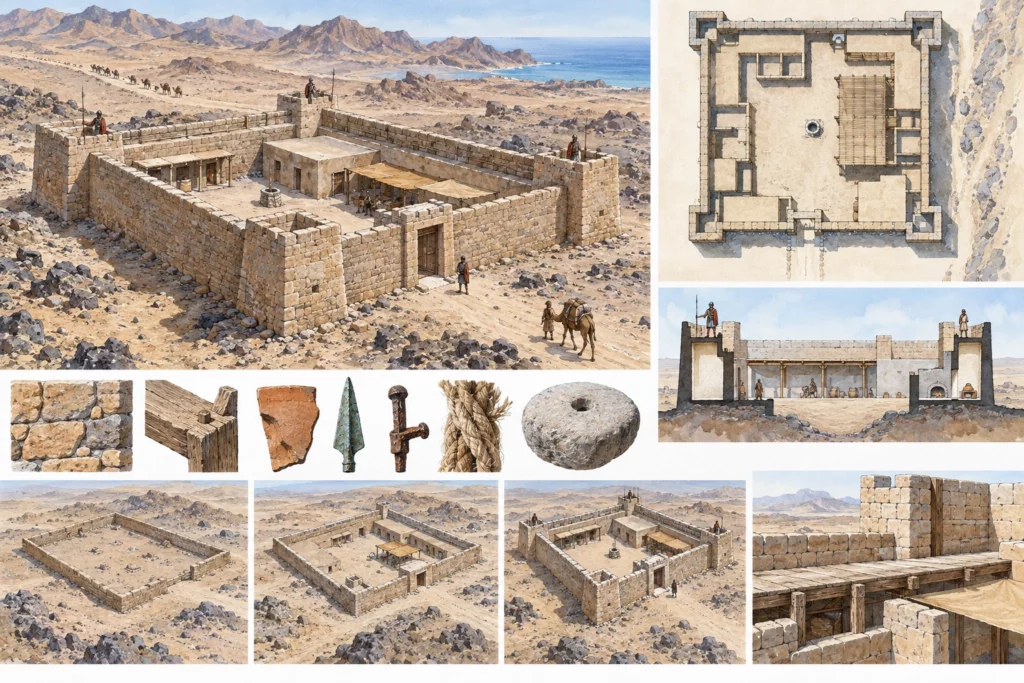
The Berenike road linked Coptos (Quft), on the Nile, to the port of Berenike on the Red Sea; between Coptos and Phoinikon (al-Laqita), it shared its course with that of Myos Hormos. The Romans had made this southern part of the Eastern Desert a military territory administered by a knight, the prefect (of the desert) of Berenike, who at certain times held the rank of procurator. The posts, or praesidia, are generally small forts or quadrangular fortified villages of dry stone, organised around a well (hydreuma). The mission of the Institut français d’archéologie orientale (IFAO, French Institute for Oriental Archaeology) has worked on four of them: Khashm al-Minayh (Didymoi), Abu Qurayya (Dios), Duwayq (possibly Phalakron) and Jirf (Xeron Pelagos, 24°55′40″ N, 34°15′50″ E), as well as at Bir Bayza. Their ancient names are handed down by the Antonine Itinerary, the Peutinger Table and the Cosmography of the Anonymous of Ravenna, which do not always agree with one another or with the ostraca.
From Ptolemaic stations to Flavian praesidia
Stations between Berenike and Edfu or Coptos have yielded traces of activity of the 3rd and 2nd centuries BC: the Roman network extends a Ptolemaic system. At the beginning of the province, Rome contented itself with widely spaced wells. A graffito of 4 BC, at the paneion of the Wadi Minayh, is the oldest date attesting the use of the road, whose stages Pliny the Elder (Natural History VI, 102–103) describes. Around AD 50, it supplanted that of Myos Hormos for trade. In 76/77, the prefect Iulius Ursus had new hydreumata dug, associated with forts; a dedication commemorating his passage has been found on three sites, including Didymoi. The increase in raids by barbaroi, reported by ostraca of Trajan and Hadrian, is the preferred explanation for this reinforcement.
Didymoi, a post dated by its ostraca
Didymoi, whose name refers to the Dioscuri, was founded in 76/77; a new cistern was dug there between 88 and 92, and the post was rebuilt around 176–177, under Marcus Aurelius, after the well collapsed. Water was drawn by a hydraulic machine with terracotta buckets; four cisterns succeeded one another. The rubbish dump, preserved up to three metres high, has eleven phases. It has yielded textiles, leather and a gazelle-hunting scene painted on a hide, probably from a parade shield. The last dated texts go back to 235–236, including the copy of a circular announcing the association of Maximus with the throne by Maximinus Thrax.
Dios, Bir Bayza and Xeron Pelagos
Dios, called Iovis in the Antonine Itinerary, was founded in 114/115, probably to replace Bir Bayza, 6 kilometres away, abandoned in the course of the 1st century and excavated in January 2008. Dios has yielded a bath house, an oracular chapel in steatite with inscriptions in Greek and Ge’ez, and the praetorium of the curator, decorated with chequerboard mosaics. Xeron Pelagos, a post of 44 × 33 metres, owes its enormous rubbish dump to the gypsum-rich mud from the clearing of the well; its ostraca of the early 3rd century mention Palmyrene, Emesene and Parthian soldiers.
Late garrisons and nomads
In the 3rd century, reduced garrisons let rubbish accumulate in the barracks. Ostraca show a modus vivendi with the nomads, led by a chief called a hypotyrannos, who came to collect rations of wine. The forts of the Myos Hormos road were abandoned at the end of the 2nd century; those of the Berenike road, around the middle of the 3rd.
A rescue programme
The Eastern Desert programme, launched in 1994 and directed by the papyrologist Hélène Cuvigny (CNRS, IRHT) with the support of the IFAO, explored the Myos Hormos road (1994–1997) and then that of Berenike from 1998. The sites suffer from off-road vehicle tours, illicit digging and the machinery of neighbouring mines, which threaten the rubbish dumps.
Sources
Main sources (consulted on 30 September 2026): The Roman praesidia of the Eastern Desert, Institut français d’archéologie orientale (in French); François Kayser, review of H. Cuvigny (ed.), Didymoi. Une garnison romaine dans le désert Oriental d’Égypte, Revue des études anciennes 114/2, 2012, Persée (in French); Marek A. Woźniak, Steven E. Sidebotham et al., ‘Ptolemaic Berenike: Resources, Logistics, and Daily Life in a Hellenistic Fortress on the Red Sea Coast of Egypt’, American Journal of Archaeology 125/2, 2021.