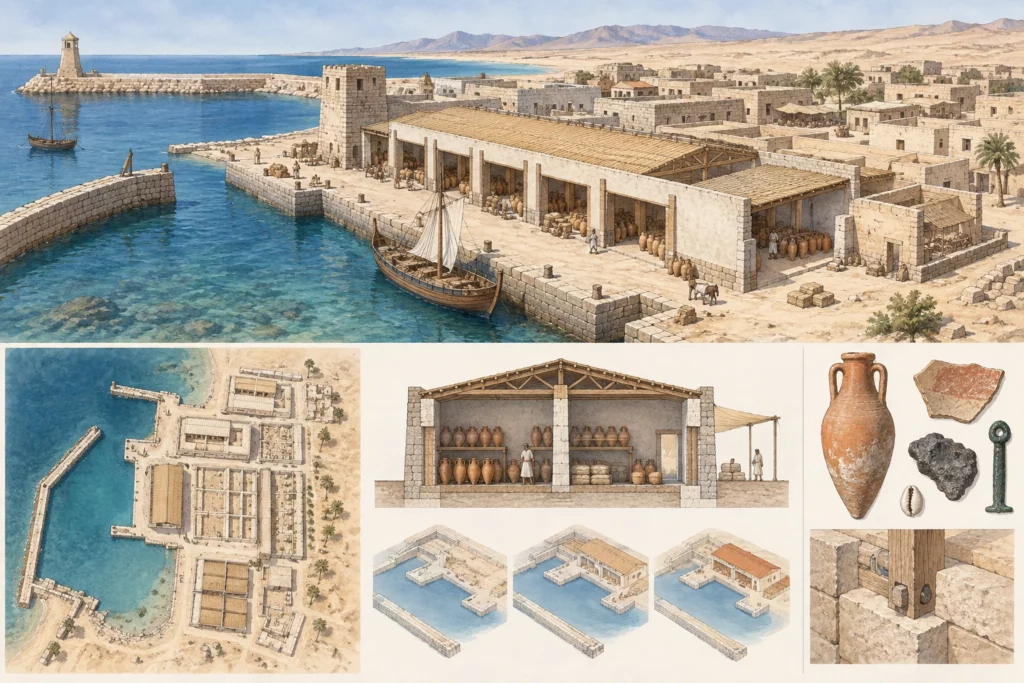
Identification and location
Berenike (Trogodytika) lies on the Egyptian coast of the Red Sea, about 260 kilometres east of Aswan and 825 kilometres south-south-east of Suez; the Wadi Mandit marks its western limit. Tracks across the Eastern Desert linked it to the Nile, at Coptos (Quft) and Apollonopolis Magna (Edfu). It is the only Hellenistic emporion of the Red Sea attested archaeologically, whereas the texts mention a dozen Ptolemaic foundations on the African coast.
A Ptolemaic fort for war elephants
Pliny the Elder (Natural History VI, 33, 168) attributes the foundation to Ptolemy II Philadelphus, who gave the port his mother’s name. The Ptolemaic fort, in the west of the site, measured about 150 metres from north to south by 80 from east to west and had at least three courtyards. Its north-west tower, about 5 × 5 metres, had walls 0.8 to 0.9 metres thick of gypsum-anhydrite blocks and large pieces of coral; slightly later walls use a sandstone quarried 300 to 500 metres north of the town. A V-shaped ditch cut into the rock, without hydraulic plaster, associated with elephant molars, is interpreted as an enclosure for the animals landed from the specialised ships (elephantegoi); skull fragments of a juvenile elephant were found in the area of the north rampart. The fort went through three phases in about 75 years (c. 275–200 BC) and housed the smelting and working of copper alloys and lead. A north rampart of about 180 metres, doubled to the north-west, closed the only land approach.
The Roman emporion of the Indian Ocean
In the Roman period, the port received the goods of South Arabia and India. Excavations have yielded nearly 8 kilograms of 1st-century AD black pepper (found in 1999), teak from South India, cedar from Lebanon, Indian pottery, textiles and beads, sapphires, as well as a pet cemetery. The temple of Isis and Serapis, of the 1st century AD, is the largest sanctuary of the town; probably destroyed by earthquakes, it has yielded marble heads imitating the art of Gandhara, a large statue of the Meroitic god Sebiumeker and a bust of Serapis in gilded teak, probably carved from a mast.
The Berenike of the Blemmyes
From the end of the 4th century AD, the Blemmyes controlled the port politically and economically. North of the town, a large building preceded by a courtyard and surrounded by chapels has yielded an inscription paid for by Mochosak, interpreter of the Blemmyan king Isemne. The site was abandoned before about 550, with no later reoccupation.
An international excavation since 1994
The excavations began in 1994 under the direction of Steven E. Sidebotham (University of Delaware), first with Leiden University (1994–2001), then with the University of California, Los Angeles (2001–2008), and since 2008 with the Polish Centre of Mediterranean Archaeology of the University of Warsaw (co-directed by Iwona Zych). The temple of Isis and Serapis is the subject of a programme led by Rodney Ast (Heidelberg), Olaf Kaper (Leiden) and Martin Hense (Berenike Foundation).
Shoreline, southern rampart and town plan
A rampart with square towers on the harbour side, suggested by geophysics, has not yet been confirmed by excavation, and the geophysical plan reveals vast unexplored areas. The precise date of foundation remains to be refined: the excavators place the first layers in the 3rd century BC, in agreement with Pliny.
Sources
Main sources (consulted on 30 September 2026): Marek A. Woźniak, Steven E. Sidebotham et al., ‘Ptolemaic Berenike: Resources, Logistics, and Daily Life in a Hellenistic Fortress on the Red Sea Coast of Egypt’, American Journal of Archaeology 125/2, 2021; Uncovering the secrets of Berenike, University of Delaware; Discoveries of the Polish Centre of Mediterranean Archaeology in Berenike, University of Warsaw, 2020.