In brief
Tell Basta, in the Sharqiya governorate, on the edge of Zagazig, preserves the ruins of Per-Bastet, ‘the house of Bastet’, which the Greeks called Bubastis. The cult of the goddess is attested there from the 2nd Dynasty, and the town was among the most important in the eastern Delta until the Roman period. Capital of the 18th nome of Lower Egypt in the New Kingdom, it became under the 22nd Dynasty, that of the kings of Libyan origin, the cradle of a royal line and one of the capitals of the country.
What you discover
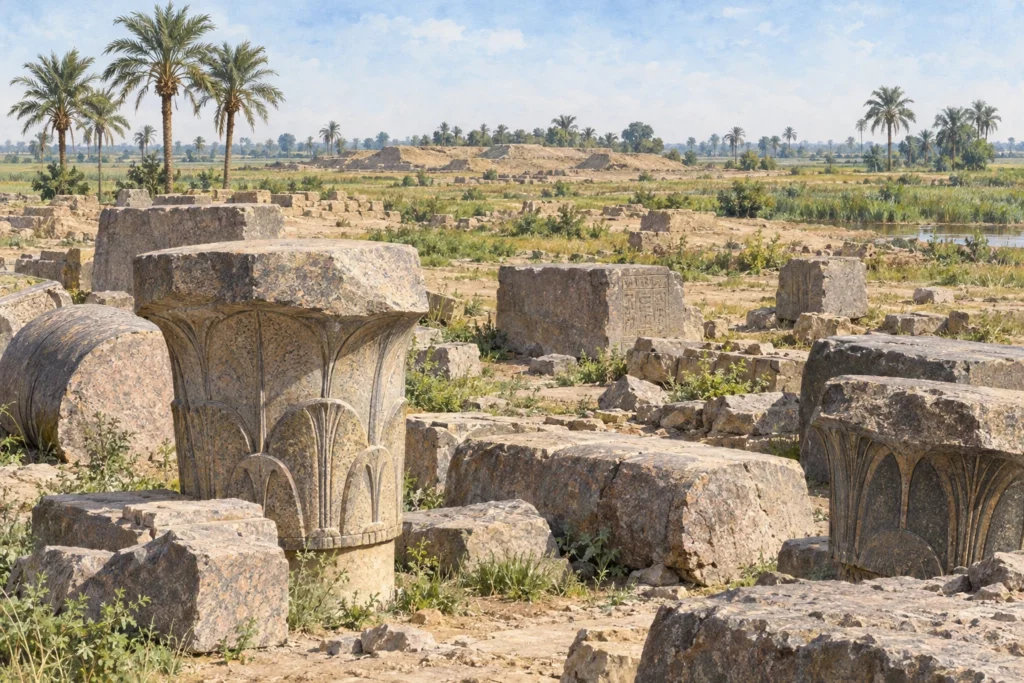
The visitor finds not a standing temple but a field of fallen blocks, in the middle of a modern town that has encroached on the tell. This chaos can nevertheless be read. The oldest stones, two red granite blocks in the names of Cheops (Khufu) and Chephren (Khafre), were reused in later enlargements. The kings of the 22nd Dynasty rebuilt the sanctuary with recovered materials: the name of Osorkon I recurs constantly at the entrance, while Osorkon II had a monumental gate built and a long colonnade opening onto a hypostyle hall with papyriform and Hathor columns. Nectanebo II, under the 30th Dynasty, finally rebuilt the holy of holies.
Around the temple, other remains recall the long life of the site: the pillars of the ka temple of Pepi I, on the western kom, the remains of a Middle Kingdom palace, a statue of Queen Meritamun, daughter and then wife of Ramses II (Ramesses II), and a Roman-period well.
What to look at
The most telling detail is the decoration of the gate of Osorkon II: its reliefs depict the sed festival, the jubilee by which the sovereign’s kingship was renewed. Édouard Naville, who uncovered them, devoted a whole volume to them as early as 1892; their study has since been taken up by the German mission working on the site.
Look also at what is missing. Herodotus, in the 5th century BC, described a temple almost entirely surrounded by water, between two canals from the Nile, about a hundred feet wide and shaded by trees. No excavation had found any trace of them. Cores and electrical resistivity measurements carried out in 2016 and 2018 north of the enclosure revealed clay deposits at least four metres thick and a buried trench 20 to 30 metres wide: the first material evidence of these sacred canals.
Its history
Depicted first as a lioness and then as a cat, Bastet protected the town. Mummified cats offered to the goddess, sometimes in bronze or wooden cases, were then buried in her sacred domain; Bubastis was, with Saqqara, one of the main centres of these offerings. Naville excavated the temple in 1887–1889, Labib Habachi discovered the temple of Pepi I in 1939, then several teams explored the Middle Kingdom palace. Since 2009, a project of the University of Würzburg directed by Eva Lange-Athinodorou, in cooperation with the Egyptian Ministry of Tourism and Antiquities, has been studying the dromos, the limestone-paved processional way that linked the eastern town to the temple. Christian tradition also links the place to the passage of the Holy Family.
Much remains uncertain: the festivals of Bastet described by Herodotus are a Greek testimony that no Egyptian inscription allows us to verify in detail, and the exact plan of the successive states of the temple still partly remains to be reconstructed.
Sources
Consulted on 30 September 2026: Tell Basta, Egyptian Ministry of Tourism and Antiquities; Eva Lange-Athinodorou et al., ‘The sacred canals of the Temple of Bastet at Bubastis (Egypt)’, Journal of Archaeological Science: Reports 26, 2019; Cat statuette intended to contain a mummified cat (56.16.1), Metropolitan Museum of Art.