In brief
Tell el-Dab’a lies in the eastern Delta, 8 kilometres north of Faqus, in the Sharqiya governorate. The Austrian Archaeological Institute (Austrian Academy of Sciences), which has excavated there since 1966, identifies it with certainty as Avaris, capital of the Hyksos kings of the 15th Dynasty (c. 1640–1530 BC), then as the southern part of Pi-Ramses, the residence of the Ramesside kings. The history of the place nevertheless begins before the Hyksos and continues after them: it should be seen as a long succession of towns, not a frozen city.
What you discover
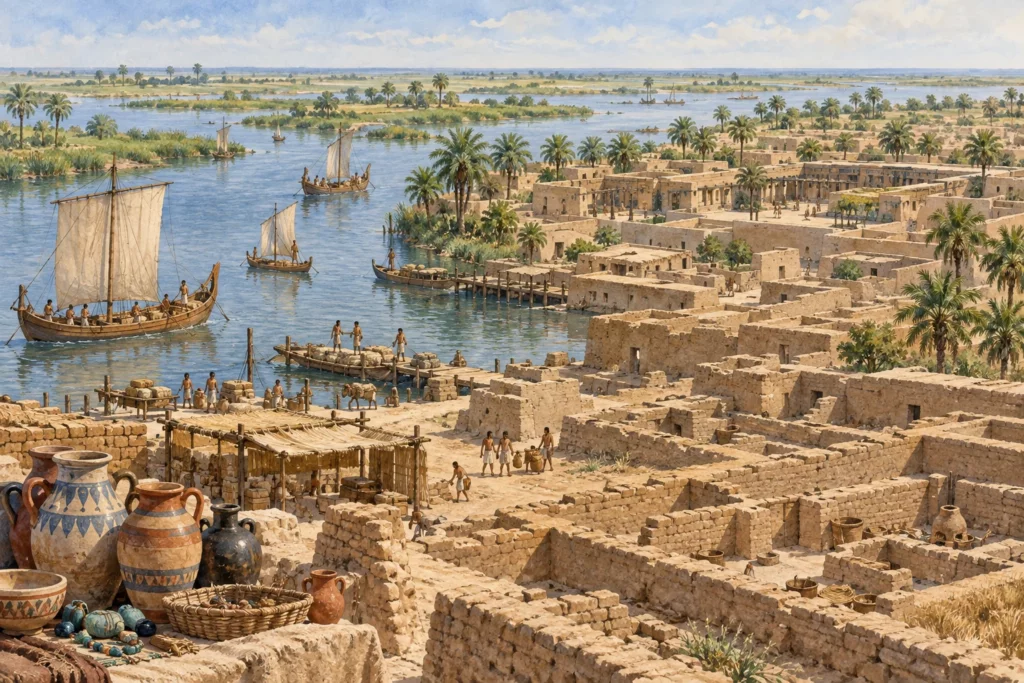
Avaris is not a site of monumental ruins: what we know of it comes from excavation and geophysical survey, which reconstruct the plan of a settlement now buried. Palaces, temples, tombs and harbour installations have been uncovered sector by sector. The town extended along the Pelusiac branch of the Nile and, by the end of the Middle Kingdom, had become an important port for seagoing ships, at the meeting point of the Nile Valley, the Sinai routes and the Mediterranean.
The layers of this period yield houses and tombs of inhabitants who came from the Levant. According to Alexander Ilin-Tomich, their analysis suggests that they were free people, some of whom acquired considerable wealth. The grave goods do not, however, allow a single origin to be assigned to each inhabitant.
What to look at
Two kinds of discovery sum up what makes Avaris unique. The first is funerary: in front of some tombs, equids and sheep or goats were sometimes buried according to a Levantine custom foreign to Egyptian practice.
The second is pictorial. At Ezbet Helmi, in sector H/VI, the excavators recovered fragments of Minoan-style wall paintings from two palatial complexes, dated to the first half of the reign of Thutmose III. They show scenes of bull-leaping and bull-wrestling, winged griffins, lions, leopards and maze-pattern backgrounds, close to the imagery of Knossos. The technique itself is Aegean: true fresco on lime plaster, until then unknown in Egypt, with lines marked out with a cord. Only 5 to 20% of these decorations survive.
Its history
A first phase is known at Ezbet Rushdi, where Shehata Adam uncovered in 1951–1954 remains of the 12th Dynasty and a temple linked to Amenemhat I. Under the 15th Dynasty, some kings of Avaris bore the title ‘ruler of foreign lands’, which many Egyptologists regard as the origin of the Greek word Hyksos. The only one of these kings well attested by contemporary documents is Apophis, whose 33rd regnal year appears in the Rhind papyrus. The city was taken by Ahmose, founder of the New Kingdom.
After the palaces of the Thutmosid period, the area became the southern part of Pi-Ramses, then was abandoned around 1100 BC, when the branch of the Nile silted up; occupation resumed from the Saite period to the beginning of the Ptolemaic period. Excavated by Édouard Naville in 1885, then by Labib Habachi in 1941–1942, the site has been explored by the Austrian team, directed by Manfred Bietak until 2009, then by Irene Forstner-Müller. The absolute dates of the 15th Dynasty remain debated.
Sources
Consulted on 30 September 2026: Tell el-Dabʿa, Austrian Archaeological Institute (Austrian Academy of Sciences); Tell el-Dabʿa, Late Minoan Wall Paintings, Austrian Archaeological Institute; Alexander Ilin-Tomich, ‘Second Intermediate Period’, UCLA Encyclopedia of Egyptology, 2016.