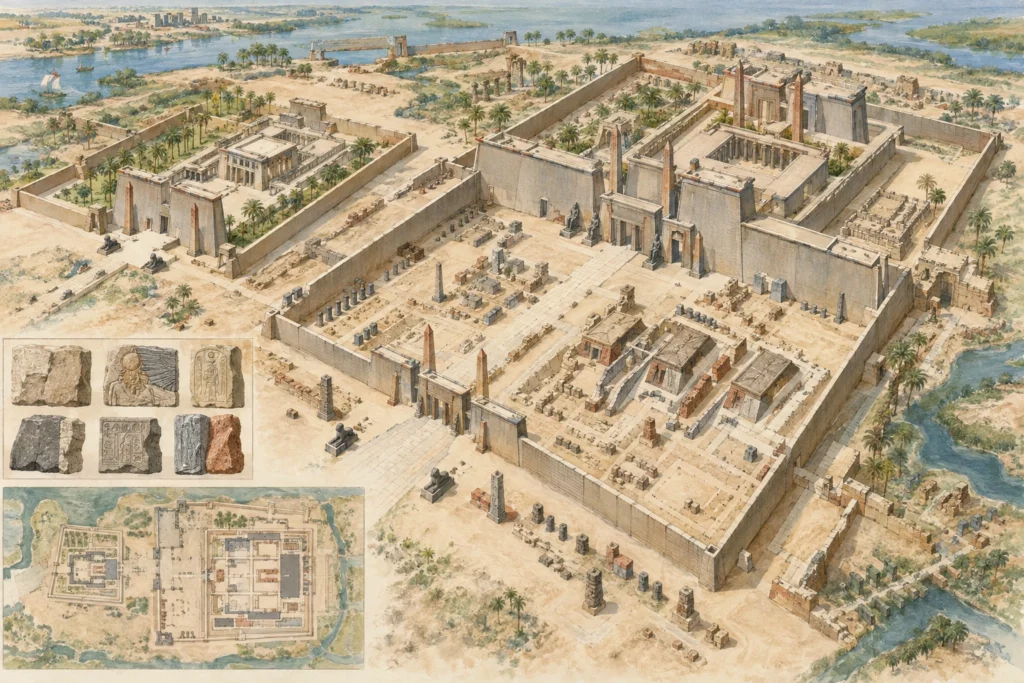
Identification and location
Tanis, Egyptian Djanet, corresponds to Tell San el-Hagar, in the north-east of the Delta, about 120 kilometres north-east of Cairo. The town stood on the Pelusiac branch of the Nile, some twenty kilometres from Pi-Ramses (Qantir). The ancient settlement exceeded 200 hectares; the sacred domains occupy its northern part.
A capital born of the abandonment of Pi-Ramses
Tanis was founded around the 11th century BC, at the turn of the New Kingdom and the Third Intermediate Period. It was the home of the 21st and 23rd Dynasties, the burial place of the sovereigns of the 21st and 22nd Dynasties and one of the main capitals of Egypt between the 11th and the 7th century BC. Its creation followed the change in the regime of the Pelusiac branch, which led to the abandonment of Pi-Ramses: the deserted Ramesside buildings provided a nearby source of blocks, statues and obelisks for the sanctuaries of the new capital. The monuments in the name of Ramses II (Ramesses II) found at Tanis belong to this reuse.
The temenos of Amun and the sanctuaries of the triad
A vast temenos, surrounded by an enormous mud-brick wall, some of whose bricks bear the stamp with the cartouche of Psusennes I, enclosed the temple of Amun. The sanctuaries of Amun, Mut and Khonsu reproduced the organisation of Karnak, while a temple of Amun of Opet, mirroring that of Luxor, occupied the southern end of the town. The temple of Mut, south of the domain of Amun, is dated to the Third Intermediate Period by foundation deposits in the name of Siamun found at its gate. Under the 30th Dynasty, the temple of Amun was remodelled. A colonnade, probably added to the court, reused columns of the Old Kingdom. The limestone enclosure was restored, as a foundation deposit of Nectanebo I attests. The temple of Khonsu was entirely rebuilt, and a sacred lake was dug nearby, with retaining walls of reused blocks. The cult of Horus of Mesen, the main deity of the eastern Delta, received a temple under the first Ptolemies.
Since late Antiquity, the limestone has largely disappeared into lime kilns. The hard stone elements (granite, quartzite), obelisks, colossi, columns and stelae, are the most visible remains and give a distorted image of an architecture entirely of hard stone.
The royal vaults at the foot of the first pylon
In 1939 and 1940, the mission of Pierre Montet cleared five tombs within the enclosure of the great temple, south-west of the first pylon: that of Osorkon II, an anonymous tomb, then those of Psusennes I, Amenemope and Shoshenq III. Montet published this list as early as 1945 in the Comptes rendus de l’Académie des inscriptions et belles-lettres. The tomb of Osorkon II, reached on 27 February 1939, had been robbed; it also held the burials of Takelot I and Prince Hornakht. The tomb of Psusennes I, by contrast, was intact: the king lay in a usurped pink granite sarcophagus bearing the name of Merneptah, with a silver coffin and a gold mask now in the Egyptian Museum in Cairo. The same tomb contained the burial of Shoshenq II, placed in two falcon-headed mummiform coffins with no known parallel. The vault of Shoshenq III is richly decorated with extracts from the Book of the Afterlife. The work, continued until 1946, uncovered more than fifteen royal and princely burials.
Two centuries of exploration at San el-Hagar
Visited by the French expedition to Egypt in 1798, Tanis was cleared by Auguste Mariette in 1860–1864 (the first major clearance of the temple of Amun), then excavated by William Flinders Petrie in 1884. Pierre Montet directed a French mission there from 1929 to 1956. The French Mission for the Excavation of Tanis, founded in 1964 by Jean Yoyotte and attached to the EPHE in 1966, was directed by François Leclère (2014–2023), then by Frédéric Payraudeau from 2024, in partnership with the Egyptian Ministry of Tourism and Antiquities, the Institut français d’archéologie orientale (IFAO, French Institute for Oriental Archaeology), the CNRS and the Louvre.
Reuse, attributions and open questions
The mission studies the spatial organisation and development of the urban fabric, the royal inscriptions, the tombs and the monumental gate of Shoshenq III; magnetic surveys complement the excavations, and the ANTa programme is digitising Montet’s archives. The attribution of the burials remains open. During a recent season of the mission, announced by the EPHE, 225 faience shabtis in the name of Shoshenq III were found in place, in a room of the tomb of Osorkon II, near an anonymous pink granite sarcophagus. This discovery points to this king as the owner of the sarcophagus.
Sources
Main sources (consulted on 30 September 2026): Tanis (Tell San el-Hagar), Institut français d’archéologie orientale (in French); Christiane Zivie-Coche, ‘Late Period Temples’, UCLA Encyclopedia of Egyptology, 2008; French Mission for the Excavation of Tanis, École pratique des hautes études (in French).