Identification and location
Bubastis, Egyptian Per-Bastet (‘the house of Bastet’), corresponds to Tell Basta, in the south-east of the Delta, on the edge of Zagazig (Sharqiya governorate). The town was one of the most important in Egypt from the end of the 4th millennium BC to the Roman period. It occupied a favourable position on the routes leading to Sinai.
From the 2nd Dynasty to the Libyan kings
The cult of Bastet, a goddess depicted as a lioness and then as a cat, is attested at Bubastis from the 2nd Dynasty (around 2800 BC). On the western kom, a provincial palace with columned courts had installations for the preparation and storage of food. It was used at least from the middle of the 4th Dynasty to the end of the 5th, then abandoned. At the beginning of the 6th Dynasty, the ka temple of Pepi I was built on its levelled remains. Old Kingdom cemeteries and a Middle Kingdom palace, attributed to Amenemhat III, complete this picture of the early periods. In the New Kingdom, the town was the capital of the 18th nome of Lower Egypt; a statue of Queen Meritamun, daughter and then wife of Ramses II (Ramesses II), comes from there. Under the 22nd Dynasty (c. 945–715 BC), known as the Bubastite Dynasty, it became a royal capital.
The great temple of Bastet
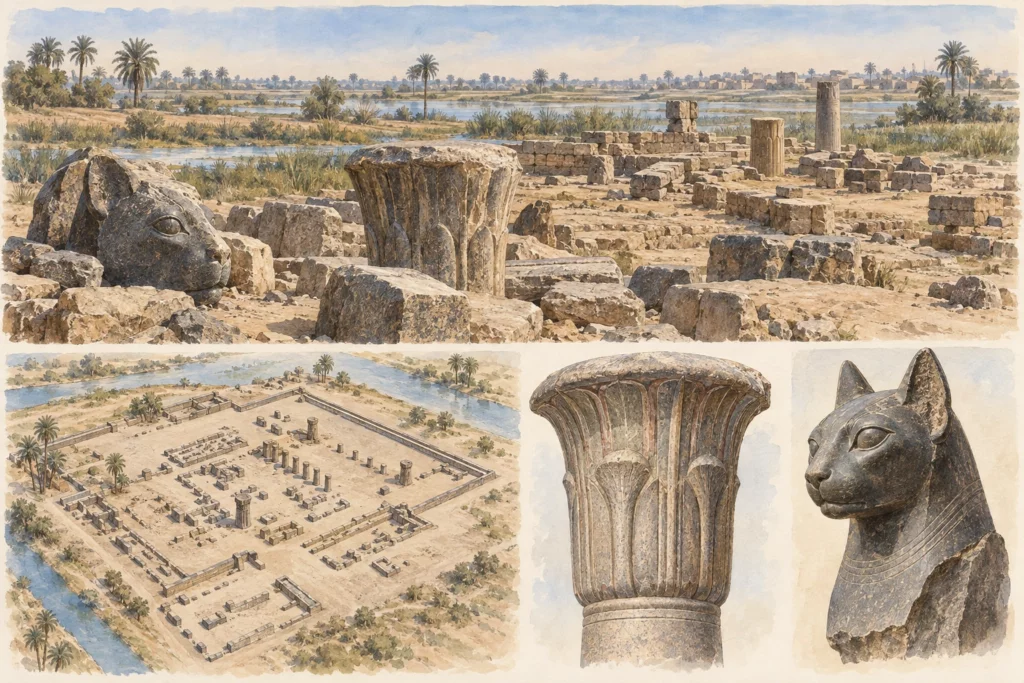
The temple, in the western part of the town, was linked to the eastern town by a limestone-paved dromos, described by Herodotus (II, 138). Two red granite blocks in the names of Cheops (Khufu) and Chephren (Khafre) were reused there. Under the 22nd Dynasty, the sanctuary was enlarged with recovered materials. Osorkon I intervened at the entrance, where his name is everywhere. Beyond the peristyle court, Osorkon II added a monumental gate decorated with scenes of the sed festival, then a colonnade and a hypostyle hall with papyriform and Hathor columns. Nectanebo II (360–343 BC) rebuilt the holy of holies. The jubilee reliefs of Osorkon II, published by Naville in 1892 (The Festival-Hall of Osorkon II in the Great Temple of Bubastis), were re-examined by Eva Lange in 2009.
The canals of Herodotus found again
Herodotus describes a sanctuary surrounded by water from two canals off the Nile, about a hundred feet wide and shaded by trees, which stopped at the entrance of the temple. No mission had reported any remains of them. The geomorphological and geophysical seasons of 2016 and 2018 (cores, electrical resistivity tomography) provided evidence. Near the northern enclosure, they identified clayey silt deposits at least four metres thick, below the floor level of the 1st-millennium temple. They also revealed a trench-like structure 20 to 30 metres wide, consistent with the dimensions given by the historian.
Offerings, cats and decrees
Bubastis was, with Saqqara, the main place of deposit of the mummified cats offered to Bastet, sometimes in bronze or wooden cases, and then buried in the goddess’s enclosure. The site has also yielded a new copy of the Canopus decree, published in 2005 by C. Tietze, Eva Lange and Klaus Hallof in the Archiv für Papyrusforschung.
From Naville to the Würzburg project
Édouard Naville excavated the temple from 1887 to 1889 for the Egypt Exploration Fund. Labib Habachi discovered the temple of Pepi I in 1939; the Middle Kingdom palace was explored by several teams between the 1960s and the 1980s. Since 2009, the Tell Basta Project, directed by Eva Lange-Athinodorou (University of Würzburg) in cooperation with the Egyptian Ministry of Tourism and Antiquities, has been excavating the area in front of the entrance of the temple. Towered and casemate buildings of the Late and Ptolemaic periods there were transformed, in the Roman period, into an open court adorned with a monumental column. The temple of Pepi I has been excavated since 2018. Open questions concern the topography of the temple, the successive states of the town and the reconstruction of the river landscape.
Sources
Main sources (consulted on 30 September 2026): Temple of Bastet, Egyptian Ministry of Tourism and Antiquities; Tell Basta/Bubastis Project, University of Würzburg; Eva Lange-Athinodorou et al., ‘The sacred canals of the Temple of Bastet at Bubastis (Egypt)’, Journal of Archaeological Science: Reports 26, 2019.