In brief
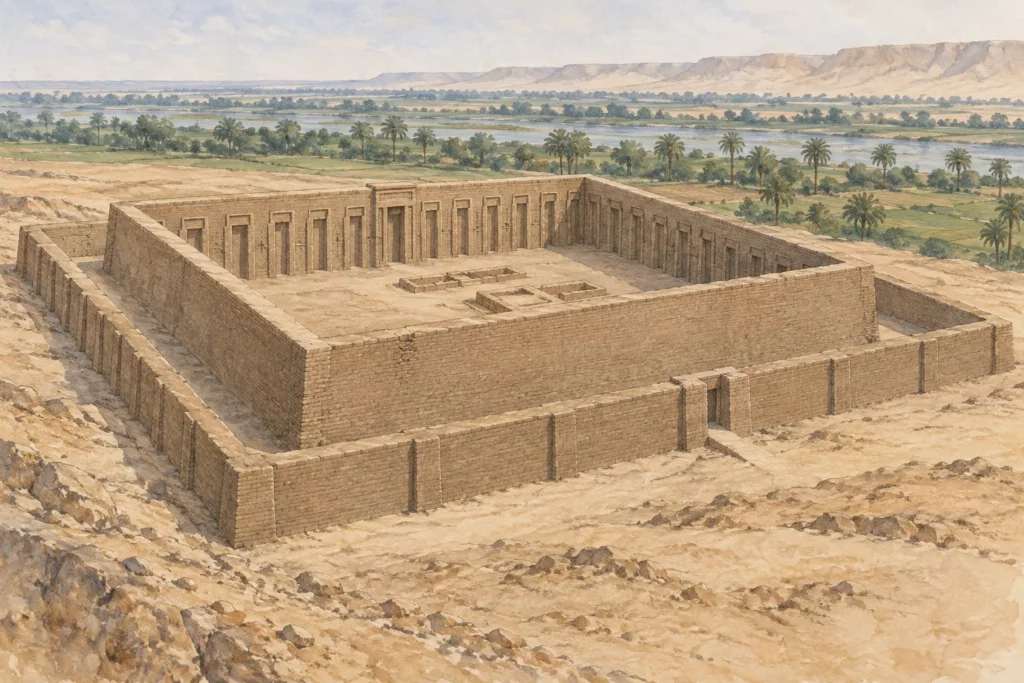
At Abydos, a huge mudbrick enclosure still stands on the edge of the desert. Known today as Shunet el-Zebib, it was built around 2700 BC for Khasekhemwy, the last king of the 2nd Dynasty. Its rectangular walls surrounded a vast open-air space. It is the only royal enclosure of this tradition still standing at Abydos. It is an impressive witness to monumental architecture before the Step Pyramid of Djoser.
What you discover
The complex comprises two concentric walls: the very massive inner wall still reaches about eleven metres in height in places, while the outer wall was lower. The mudbrick, the niches and the gateways created a royal façade visible from afar. The tomb of Khasekhemwy was not in the court: it lay at Umm el-Qaab, about 1.75 kilometres further south. The enclosure was the monumental and ceremonial part of a wider funerary landscape. The excavations found there heaps of jars, mostly connected with beer, as well as cattle remains, charcoal and broken seals.
Its history
These deposits point to offerings and rituals carried out in the king’s time, but they do not make it possible to describe a specific ceremony. Other, older royal enclosures existed at Abydos; most have been destroyed or dismantled. The survival of Shunet el-Zebib therefore does not mean that it was the only one. After the 2nd Dynasty, the place was reused, notably for burials of sacred animals in the 1st millennium BC and, much later, for a monastic community. These uses do not describe its original function.
Why this place matters
Shunet el-Zebib shows on what scale the first kings could build in mudbrick. It also helps us to understand the distinction between tomb and place of funerary cult. Its conservation demands considerable work: the walls, built nearly five thousand years ago, are weakened by erosion and by earlier interventions. The archaeological teams study them while stabilising them. The separate visuals are evocations and an interpretive plate; they do not replace the surveys of the monument.