Identification and location
Umm el-Qaab is a funerary area on the desert edge of Abydos, west of the Nile valley. Cemetery U preserves a long Predynastic sequence there; this article deals with the later royal burials, mainly those of Dynasties 0 and I and of the late 2nd Dynasty. The tombs of Narmer and Hor-Aha lie in sector B. The rulers of the 1st Dynasty, from Djer to Qaa, as well as Merneith, occupy different complexes of the necropolis. After a phase during which the kings of the 2nd Dynasty were buried further north, Peribsen and Khasekhemwy returned to Abydos. The overall dating runs from about 3100 to 2700 BC, with debates over the detailed chronology of individual reigns.
General presentation
This group of tombs is a major source for the history of early Egyptian kingship. Each complex reflects decisions about the main chamber, the deposits, the annexes and sometimes the subsidiary tombs. The succession of plans documents funerary experiments earlier than the pyramids. The necropolis is also linked to ceremonial enclosures built closer to the edge of the cultivated land; an underground tomb and its possible enclosure are distinct components of the landscape. The tombs of Cemetery U, including U-j, shed light on the earlier stages but should not be equated with the burials of the 1st Dynasty. The religious afterlife of Umm el-Qaab added further uses and meanings long after the original construction.
Monuments and remains
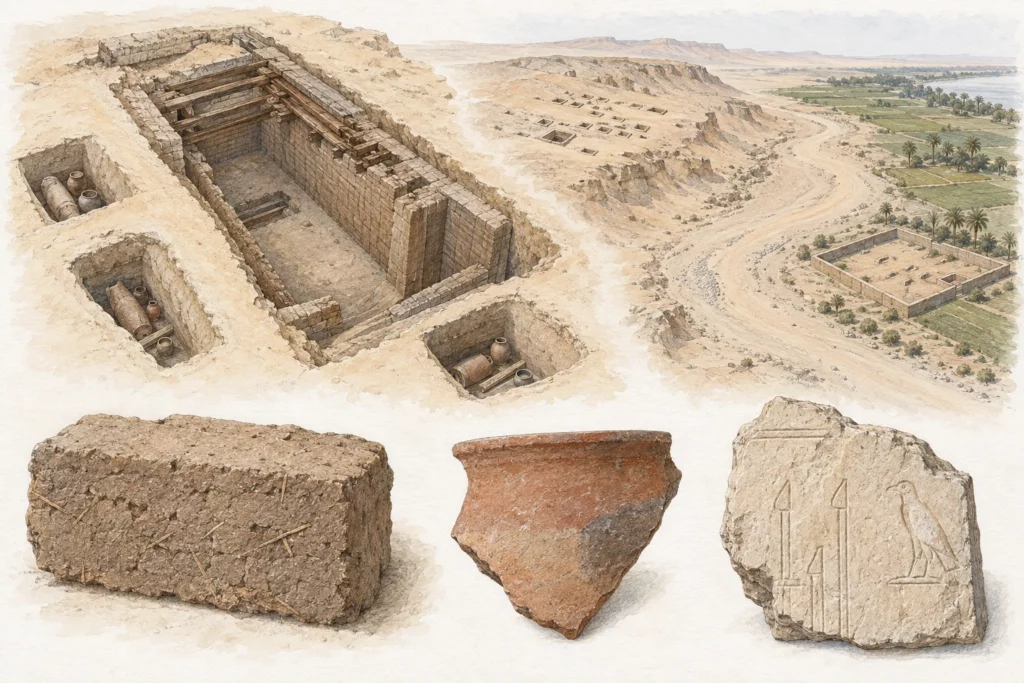
The royal burials are dug into the desert ground and built mainly of mudbrick, with elements of wood and, in some cases, stone floors. Central chambers and annexes housed the dead ruler and the funerary equipment. The upper parts were mounds of sand or low structures whose reconstruction varies from tomb to tomb. Several 1st Dynasty complexes are surrounded by rows of subsidiary burials. Research on the tomb of Djer has in particular documented new chambers and rows of annexes. Pottery, seals, fragments of objects and stelae contribute to the attribution and chronology of the complexes. The remains cannot, however, be read as a single plan: dimensions, layouts and states of preservation differ from one reign to another.
Chronology and building phases
The small complexes of sector B bear witness to the transition to the first dynasties. The tombs of the kings of the 1st Dynasty then occupy Umm el-Qaab for several generations down to Qaa, around the end of the 4th and the beginning of the 3rd millennium BC. A pause occurs for part of the 2nd Dynasty; the tombs of Peribsen and Khasekhemwy mark the return of the last rulers of that dynasty. After Khasekhemwy, Umm el-Qaab ceased to be a royal necropolis used for new kings. That does not amount to the abandonment of the place: deposits and ritual practices are attested afterwards. The veneration of Osiris, particularly important from the Middle Kingdom onwards, transformed the relationship with the site yet again. A single date therefore sums up neither its construction nor its long memory.
History and functions
The tombs bear witness to considerable resources mobilised for royal funerals: excavation, brickmaking, the setting of timber, the gathering of goods and the upkeep of the associated spaces. The subsidiary burials point to a close relationship between the court and the dead king. The exact circumstances of their creation and the status of each person buried must be assessed tomb by tomb; spatial proximity alone is not enough to describe a specific rite. Features that the mission has called ‘false exits’ seem to be oriented towards the wadi. Reading them as an evocation of a passage to the afterlife is an interpretation resting on topography and architecture, not on an explanatory text left by the builders. The funerary enclosures on the edge of the cultivated land complete this landscape, though not all their activities can be reconstructed.
Excavations and the history of research
The early excavations, in particular those of Flinders Petrie, revealed the royal tombs but left several questions of stratigraphy and grave goods open. The Deutsches Archäologisches Institut (DAI, German Archaeological Institute) has resumed the study of the site over the long term, to follow the development of the architecture from the Predynastic period to the end of the 2nd Dynasty and to inventory the objects. The campaigns of 2011–2013 re-examined the tomb of Djer and its annexes, with comparative test trenches in the complexes of Djet, Merneith and Adjib. Recent research has also classified the pottery from the tombs of Djer, Semerkhet and Khasekhemwy. Surveys, photographs and the analysis of the grave goods make it possible to distinguish building phases, disturbances and later deposits. Documenting the damage caused by looting is also part of the work of conservation and reinterpretation.
State of preservation and research questions
The tombs were looted from Antiquity onwards and exposed to removals and reuse. Their original elevation and the full arrangement of the deposits often remain uncertain. The rows of subsidiary burials and their exact relationship to the royal chamber are unevenly documented. The symbolic reading of the wadi and of the ‘false exits’ must continue to be presented as a proposed interpretation. The tomb of Djer was later identified as that of Osiris, which led to cult practices and accumulations of pottery with no direct connection to its 1st Dynasty funeral. The visuals accompanying this article offer a non-metric comparative landscape and plate; neither is an excavation survey or an exact reconstruction of the tomb of a named ruler.
Sources
Main sources: Deutsches Archäologisches Institut, ‘Abydos Umm el-Qaab’, research project. https://www.dainst.org/forschung/projekte/noslug/2522 (in German) (consulted on 26 September 2026).
Dreyer, Günter, ‘Abydos, Ägypten: Die Königsgräber der 1. und 2. Dynastie’, e-Forschungsberichte des DAI 2014/3, pp. 2–5. https://doi.org/10.34780/l6ma-3b97 (in German) (consulted on 26 September 2026).
Deutsches Archäologisches Institut, ‘Abydos – Umm el-Qa’ab’, Cairo Magazine 2014, pp. 24 ff. https://www.dainst.org/fileadmin/Media/Publikationen__PDFs_/DAI_Kairo_Magazin_DAI_Kairo_2014_englisch.pdf (consulted on 26 September 2026).
Deutsches Archäologisches Institut, ‘Die Geschichte des Osiriskultes in Abydos’. https://www.dainst.org/forschung/projekte/noslug/2734 (in German) (consulted on 26 September 2026).