Identification and location
Cemetery U at Umm el-Qaab occupies the desert edge of Abydos, in Upper Egypt. It belongs to a vast funerary landscape whose history extends from Predynastic communities to the first dynasties. The research of the Deutsches Archäologisches Institut (DAI, German Archaeological Institute) records about 650 pit tombs there. Occupation begins at the start of the 4th millennium BC and continues until around 3200. Tomb U-j, belonging to a late phase of the cemetery and dated to around 3250 BC, is a multi-chambered complex associated with abundant grave goods. It precedes the tombs attributed to the rulers of Dynasties 0 and I in Cemetery B. These neighbouring areas are linked in the history of Abydos, but their burials should not be confused.
General presentation
Cemetery U makes it possible to follow the transformation of a cemetery into a burial place for powerful elites. The first, relatively simple pits contrast with the larger and better-equipped tombs of the following phases. This development is evidence of social differentiation and of a concentration of resources. U-j is a major landmark of early Naqada III: its size, its compartmented plan and the scale of the funerary deposits suggest the tomb of a ruler. It nevertheless proves neither the name of its occupant nor the existence of an already complete territorial state. The value of the site also lies in the long series of other burials, without which U-j would appear isolated.
Monuments and remains
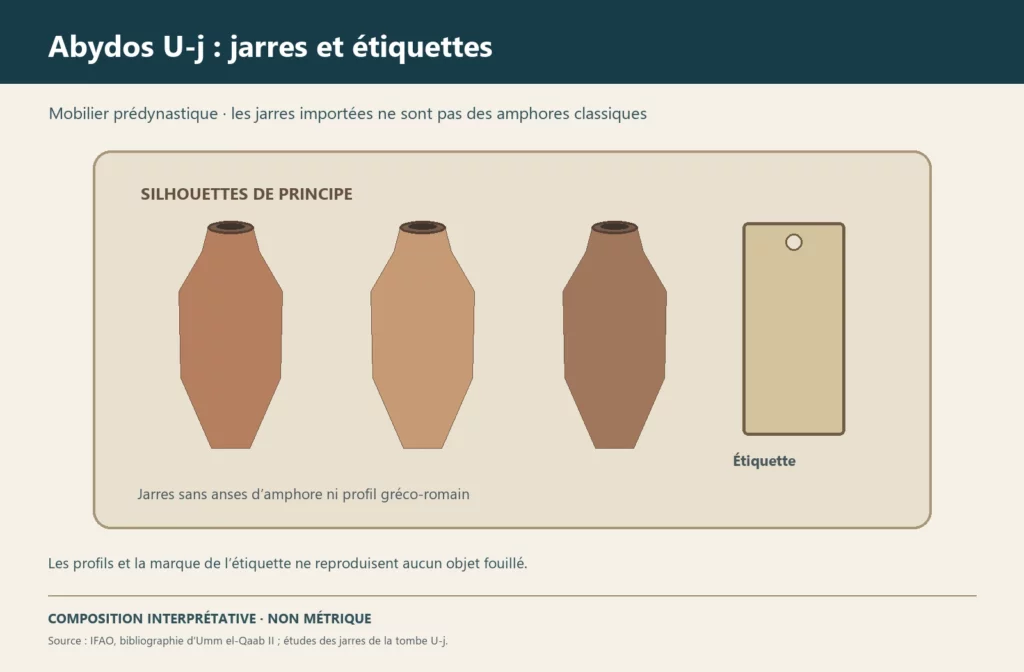
The oldest pits are dug into the desert sand. Later, some structures have mudbrick walls and several chambers reserved for the body and the goods deposited. U-j comprised more than twelve compartments. The remains of its equipment include hundreds of wine jars imported from the Levant and many locally made vessels, intended to hold oils, food and drink. Some pots bear ink inscriptions. Small labels of bone or ivory, sometimes pierced so that they could be attached to goods, bear graphic signs. The grave goods are known from the excavations and the inventories; an image of an entirely filled and intact tomb would be a reconstruction, not a directly observed state.
Chronology and building phases
The sequence of Cemetery U runs over much of the 4th millennium, from the first Naqada phases to early Naqada III. The roughly 650 pits are neither contemporary nor of the same status. The gradual enlargement of some tombs, the use of mudbrick and the multiplication of offerings accompany the rise of a local elite. The dating of U-j to around 3250 BC is an approximation resting on archaeological comparisons and the chronology of the assemblages. A few generations later, the neighbouring Cemetery B received burials attributed to rulers of the end of the Predynastic period and then of the 1st Dynasty, among them Narmer and Hor-Aha. The later cult uses of Umm el-Qaab, associated with Osiris from the Middle Kingdom onwards, belong to another era.
History and functions
The goods of U-j indicate an ability to gather varied products for a single burial. The Levantine jars attest long-distance exchange, although the exact route of each vessel cannot be reconstructed. The local and imported containers suggest the importance of provisions and their management. The labels and ink marks are often cited among the earliest evidence of Egyptian writing. Their function seems linked to the designation or organisation of goods, but the interpretation of each sign and the relationship with later writing systems are debated. These objects document an emerging administrative practice; they do not provide a single, definitive date for ‘the invention of writing’. Describing the occupant as a king remains an inference drawn from the wealth and organisation of the tomb.
Excavations and the history of research
The exploration of Abydos began long before recent research, but the DAI’s renewed excavations have transformed the reading of the Predynastic cemetery and the royal tombs. Günter Dreyer published in 1998 a monograph on U-j and its early written evidence. Rita Hartmann’s studies of the pottery and Ulrich Hartung’s of the imports place the objects in a wider sequence. The mission has also resumed the recording of the architecture and the inventories of the burials. This method makes it possible to compare the size, construction and grave goods of hundreds of tombs rather than commenting only on the most spectacular finds. The proximity of Cemeteries U and B helps in studying the transition to the first royal necropolises; it does not erase the differences of date and context between each tomb.
State of preservation and research questions
The burials have suffered ancient looting, displacement of objects and deterioration of materials. The precise provenance of an item and its original place in a chamber must therefore be established from the excavation record, not deduced from a composite image. The dates for the 4th millennium remain ranges. The number of chambers and the grave goods of U-j make it probable that it was the burial of a person of very high rank, but his personal identity remains unknown. The painted or incised signs are essential to the study of early writing, without always offering a secure reading. The tombs of Umm el-Qaab received, much later, a new religious meaning centred on Osiris: this memory does not describe the exact beliefs of their Predynastic builders.
Sources
Main sources: Deutsches Archäologisches Institut, ‘Abydos Umm el-Qaab’, Raum & Zeit section. https://www.dainst.org/forschung/projekte/noslug/2522 (in German) (consulted on 26 September 2026).
Dreyer, Günter, Umm el-Qaab I: Das prädynastische Königsgrab U-j und seine frühen Schriftzeugnisse, Archäologische Veröffentlichungen 86, Mainz, 1998.
Hartung, Ulrich, ‘Cemetery U at Umm el-Qaab and the funeral landscape of the Abydos region in the 4th millennium BC’, in Desert and the Nile, 2018, pp. 313–338. https://www.ifao.egnet.net/bases/beo/beo16383 (consulted on 26 September 2026).
Hartmann, Rita, Umm el-Qaab IV: Die Keramik der älteren und mittleren Naqadakultur aus dem prädynastischen Friedhof U in Abydos, Wiesbaden, 2016.