In brief
In the Western Desert, in the south of Egypt, Nabta Playa was once a basin where water collected after the rains. Human groups lived there at different times in the Neolithic. They left camps, wells, cattle burials and several groups of standing stones. This landscape tells a very ancient story, long before the pyramids: that of the communities who frequented a Sahara less arid than today.
What you discover
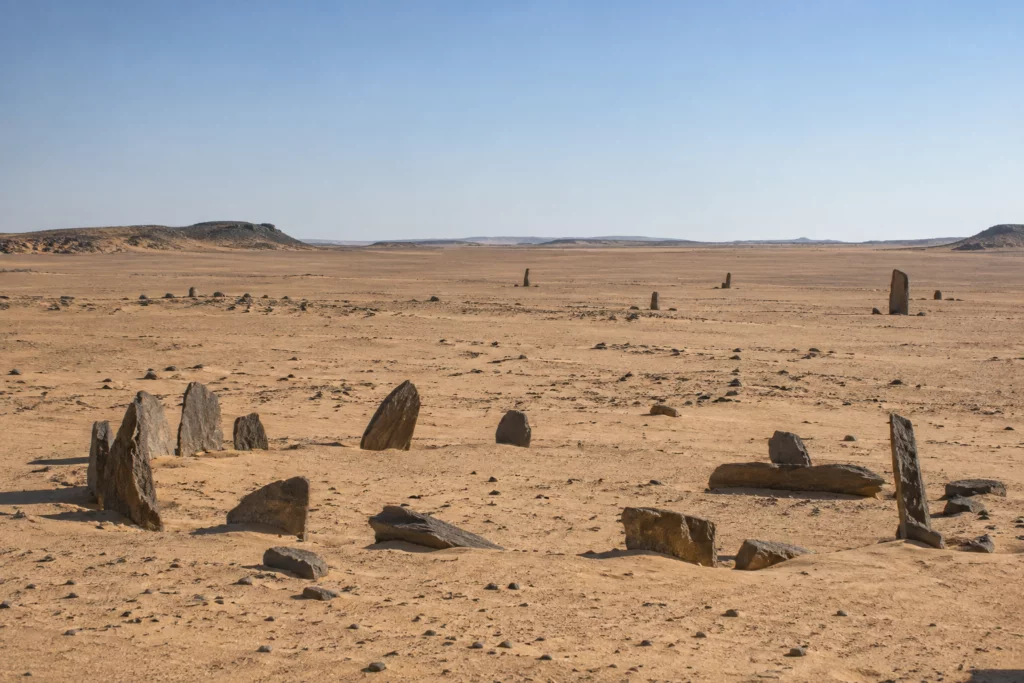
Nabta Playa is not a single temple. Over a vast area lie the traces of many places of life and ceremony. Archaeologists have recorded a small circle of slabs, alignments of larger stones and mounds covering cattle burials. The objects and hearths found around the basin also tell us about daily life. Visitors should, however, distinguish the remains left in the desert from some stones moved to be protected and displayed in the Nubian Museum at Aswan. An image showing all these elements side by side is a synthesis: they did not form a single compact monument.
Its history
The first occupations go back to the beginning of the Holocene, when seasonal rains made this area habitable. The basin attracted groups who used its resources and, later, dug wells. The ceremonial groups belong mainly to the later Neolithic phases; they therefore do not all date from the first camps. Excavations carried out by the Combined Prehistoric Expedition from the 1970s revealed this long history. With the gradual return of severe aridity, occupation of the desert declined. Research continues to refine the chronology of each group of monuments.
Why this place matters
Nabta Playa shows that the history of Egypt does not begin only in the Nile Valley. Its inhabitants shaped a landscape of gatherings, practices linked to cattle and stone monuments. An alignment of the small circle has been linked to the direction of the sun at the summer solstice, but its exact function remains debated: calling it a certain calendar would be going too far. Likewise, a direct link between these monuments and the religion of the pharaohs remains a hypothesis. The interest of the site lies as much in its remains as in the questions they open.