In brief
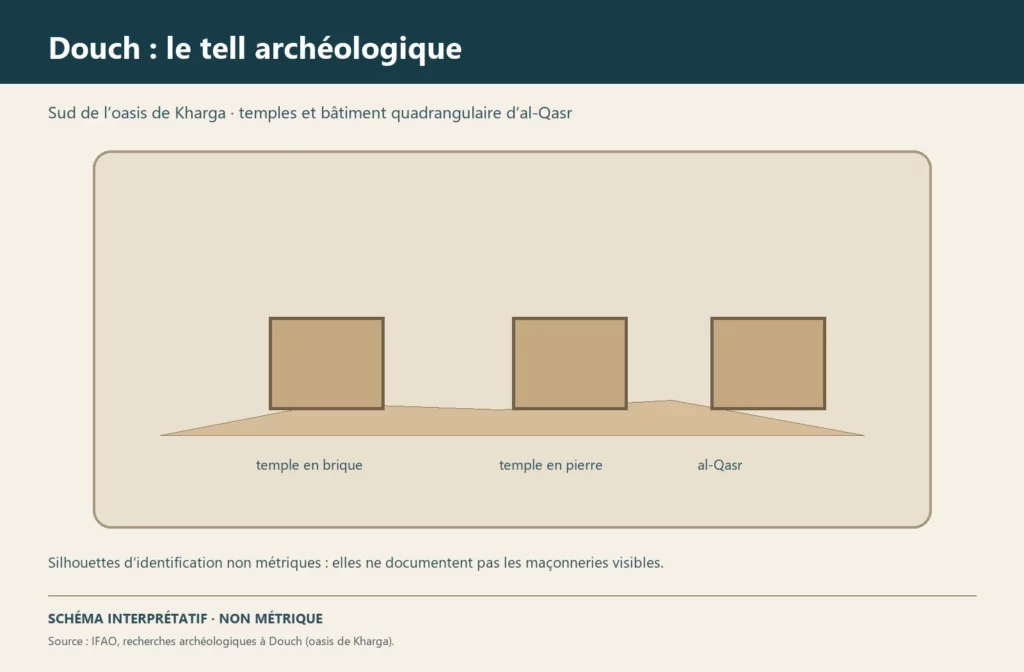
Dush, which Egyptian texts call Kesh and Greek texts Kysis, stands at the southern end of the Kharga Oasis, in the Western Desert. On a sandstone mound, a Roman-period stone temple, dedicated to Osiris-iu and Isis, leans against an imposing mud-brick building known as the fortress. Around it extend the remains of a village of about nine to ten hectares, its necropolises and an irrigated farmland, whose plots are exceptionally well preserved.
What you discover
On the mound, the mass of mud brick is what strikes first, and it readily suggests a frontier fort. The sandstone temple is set against it. Its plan is that of a classic Egyptian sanctuary: a vestibule, a hypostyle hall with four columns, then two rooms in a row roofed with vaults and flanked by two chapels. The temple was built under Domitian and completed under Trajan and Hadrian.
The word fortress needs qualifying. The excavations have shown that this large building first housed the storerooms of the sanctuary; it was turned into barracks only at the end of the Roman Empire. According to Michel Reddé, who directed the excavations, soldiers settled there towards the end of the 4th century AD, in temporary detachments from the Nile Valley, and their role was fiscal, customs and police control rather than the defence of the oasis.
What to look at
Two very different inscriptions tell the story of the temple. On the lintel of the first pylon, a Greek dedication is dated 26 April AD 116, under Trajan: it fixes a stage of the work precisely. At the back of the temple, on the outer face of the rear wall, the two deities of the place are shown in relief. The god is a local form of Osiris, Osiris-iu, whose name is often translated as ‘Osiris the welcome one’; the Egyptologist Michel Chauveau proposes instead ‘Osiris has come’. The Greeks identified him with Sarapis.
The eye can then turn to the cultivated ground around the mound. Artesian wells and underground drainage galleries, the qanats, fed the fields; without water, neither the temple nor the village would have existed.
Its history
Occupation of the place goes back much further than Rome. The surveys of the Institut français d’archéologie orientale (IFAO, French Institute for Oriental Archaeology) have recorded 84 prehistoric sites in the region, including a hunter-gatherer camp of the 7th millennium BC. A few kilometres away, at Ayn Manawir, a mud-brick temple dedicated to the same Osiris-iu was already functioning in the Persian period (5th–4th century BC); it should not be confused with that of Dush. At Kysis itself, the stratigraphy places the settlement at the beginning of the Ptolemaic period, and the village lived on until around the middle of the 5th century AD.
In March 1989, the IFAO mission, present since 1976, uncovered a group of gold objects from the treasury of the temple of Isis and Sarapis, including a crown ornament showing Sarapis enthroned; it is kept in the Egyptian Museum in Cairo. The end of the site remains poorly understood: no destruction is attested, and the exhaustion of the water table, perhaps aggravated by a climatic oscillation, is being considered.
Sources
Consulted on 30 September 2026: Dush (Kesh / Kysis), Institut français d’archéologie orientale (in French); Michel Reddé, ‘Un village dans les oasis d’Égypte: Douch’, Ausonius Éditions (in French); Michel Reddé, ‘L’occupation militaire tardive dans les oasis d’Égypte’, Ausonius Éditions (in French).