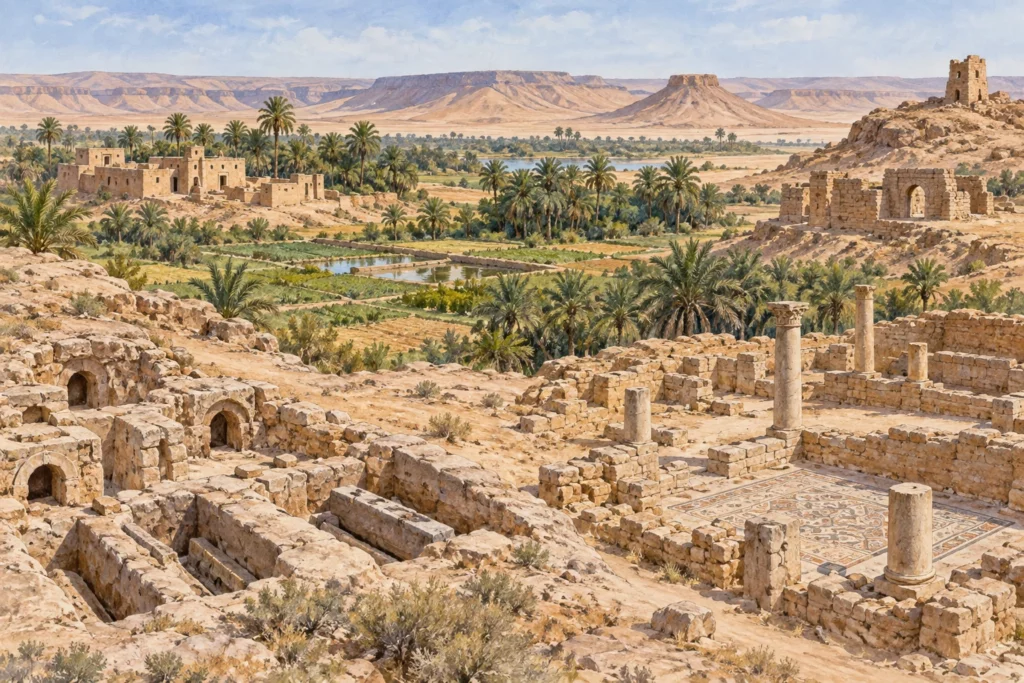
In brief
The Dakhla Oasis, in the Western Desert, has not one single Roman town but a constellation of villages, temples and necropolises occupied under the Empire. Two groups help to grasp this landscape: the monumental necropolis of Ezbet Bashendi, on the northern edge of the present village of the same name, and Amheida, ancient Trimithis, in the north-west of the oasis. Further east, Ismant el-Kharab, ancient Kellis, completes the picture. Each site has its own chronology, which should not be merged into a single story.
What you discover
At Ezbet Bashendi, six stone tombs have been uncovered so far. Four of them align their façades on a single east–west line, facing north, and form a row some forty metres long, preceded by small courts as if along a processional way. The best known, that of Kitynos, follows the plan of a small funerary temple about 8 metres square; its architecture and decoration are in pharaonic style, and the epigraphy places it in the 1st or 2nd century AD. Over another tomb now rises the mud-brick dome sheltering the burial of Sheikh Bashendi, the village saint, built in the Ottoman period on top of the ancient monument.
At Amheida, two silhouettes stand out first: a mud-brick pyramid and a tower-shaped tomb, both of the Roman period and consolidated by the mission. Near the entrance to the site, a 4th-century house has been rebuilt full size, with copies of its paintings, to serve as a future visitor centre.
What to look at
At Ezbet Bashendi, the decisive detail is a break in style within a single row. The first two tombs, with flat roofs, belong to the Egyptian tradition. The next three, almost identical, adopt a classical vocabulary: pilasters with Attic bases, a main niche in an apse framed by colonnettes with capitals derived from the Corinthian, and above all a stone dome on pendentives, rising 5.35 metres above a room about 5.50 metres square. Its voussoirs are cut to interlock. According to Sayed Yamani, who published the group, no other Roman tomb with a stone dome was then known in Egypt.
At Amheida, look at the walls of the house attributed to a town councillor named Serenos. Its paintings, dated to the second quarter of the 4th century, combine geometric motifs and Greek mythological scenes, such as Perseus and Andromeda, as well as a banquet accompanied by a player of the double aulos. Too fragile, the originals were reburied after documentation; what can be seen on the spot is a reconstruction.
Its history
The tomb of Kitynos, uncovered by Ahmed Fakhry, was cleaned by Anthony Mills’s Dakhleh Oasis Project and then opened to visitors. In 1985, the antiquities inspectorate of Dakhla cleared the necropolis, covered by more than three metres of sand and partly by modern houses, and the monuments were surveyed in December 2000 with the Institut français d’archéologie orientale (IFAO, French Institute for Oriental Archaeology). At Amheida, the painted room, located as early as 1979, has been excavated since 2004 as part of a mission launched in 2001 by Columbia University and run since 2008 by New York University.
Much remains uncertain. No burial in place and no object directly dates the tombs of Ezbet Bashendi: their chronology is relative, based on how one monument abuts another, and the domed tombs would be no later than the end of the 2nd century. The names of their owners are lost, and it is not known whether their main niche held a statue or a painting.
Sources
Consulted on 30 September 2026: Sayed Yamani, ‘Roman monumental tombs in Ezbet Bashendi’, BIFAO 101, 2001, Institut français d’archéologie orientale; Excavations at Amheida, Institute for the Study of the Ancient World, New York University; Dorothea Schulz, ‘Colours in the oasis: the Villa of Serenos’, Egyptian Archaeology 46, 2015.