In brief
Ain al-Sabil lies in the Dakhla Oasis, in the New Valley governorate, in the heart of the Western Desert. An Egyptian mission of the Supreme Council of Antiquities has uncovered there a fortified settlement of late Antiquity, occupied mainly in the 4th and 5th centuries AD. The discovery, announced by the Supreme Council of Antiquities at the beginning of July 2026, has not yet been the subject of a detailed scientific publication: what we know of it rests on the excavators’ press releases and their coverage in the archaeological press.
What you discover
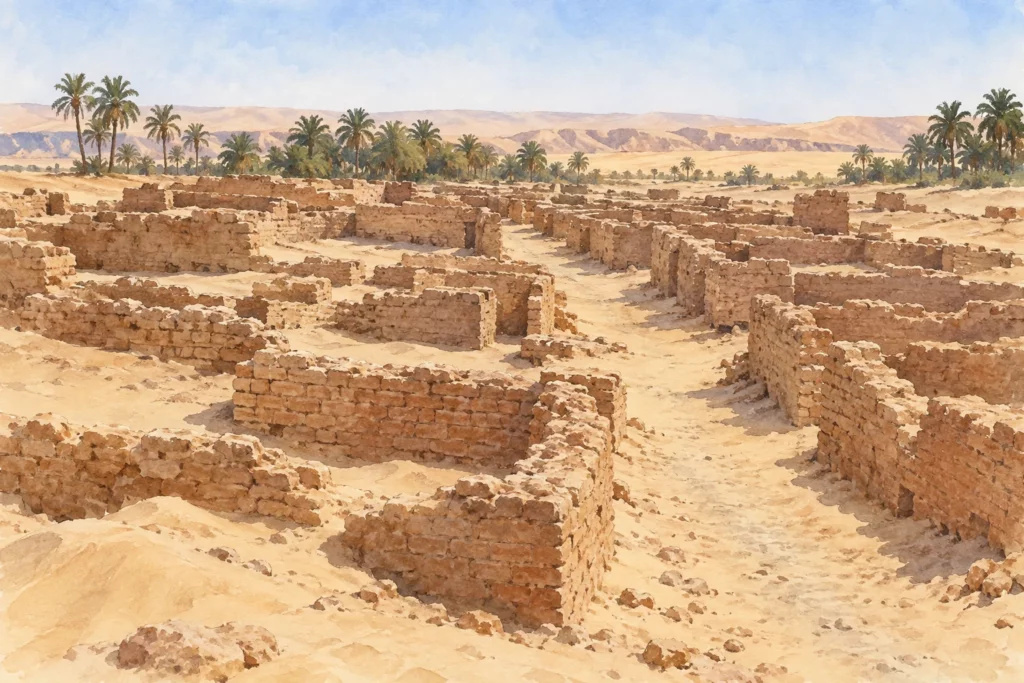
The first striking feature is the plan. The main streets, running north–south, are crossed by east–west roads; at their intersections open squares and open spaces. This regular grid implies a settlement planned as a whole rather than a mere cluster of houses. In the centre, along one of the main streets, stands a basilica-type church, dated to the middle of the 4th century and uncovered in earlier seasons. On the outskirts, two watchtowers and a thick-walled building complete the arrangement.
The mud-brick houses combine large reception rooms, vaulted roofs, kitchens and bread ovens. The finds reported are those of ordinary life: cooking and storage vessels, flasks, oil lamps, grindstones.
What to look at
Two houses stand out because they bear a name. The first, attributed to a certain Tabibos and dated to the beginning of the 4th century, is thought to have served as a place of worship before the basilica was built. The second belonged to Tisous, a deacon of the Church, who lived there in the second half of the same century. Between the two, on the scale of a district, one can read the passage from a Christian community gathered in a private house to a church built for it.
The other detail concerns writing. Some two hundred ostraca, potsherds used as a writing surface, bear texts in Coptic and Greek: sales, correspondence, everyday business. Bronze coins bearing the images of emperors and gold coins of the reign of Constantius II (337–361) provide dating points.
Its history
Ain al-Sabil is not an isolated case. Dakhla has several settlements of the same period, such as Amheida, ancient Trimithis, where New York University has notably uncovered a 4th-century funerary church. The new site thus belongs to an oasis already well documented for late Antiquity, and comparison between these settlements may shed light on the Christianisation of the Western Desert.
Much remains to be established. The exact function of the house of Tabibos, the relationship between the fortified enclosure and the residential districts, the real length of occupation and the precise content of the ostraca await the publication of the excavations. The presence of towers is not enough to make the inhabitants a garrison. Finally, mud brick exposed to the air deteriorates quickly, and the conservation of the uncovered walls is an immediate challenge.
Sources
Consulted on 30 September 2026: ‘Byzantine City Uncovered in Egypt’s Dakhleh Oasis’, Archaeology, Archaeological Institute of America, 7 July 2026; ‘Byzantine city discovered in Egyptian oasis’, Current World Archaeology (The Past); Excavations at Amheida, Institute for the Study of the Ancient World, New York University.