In brief
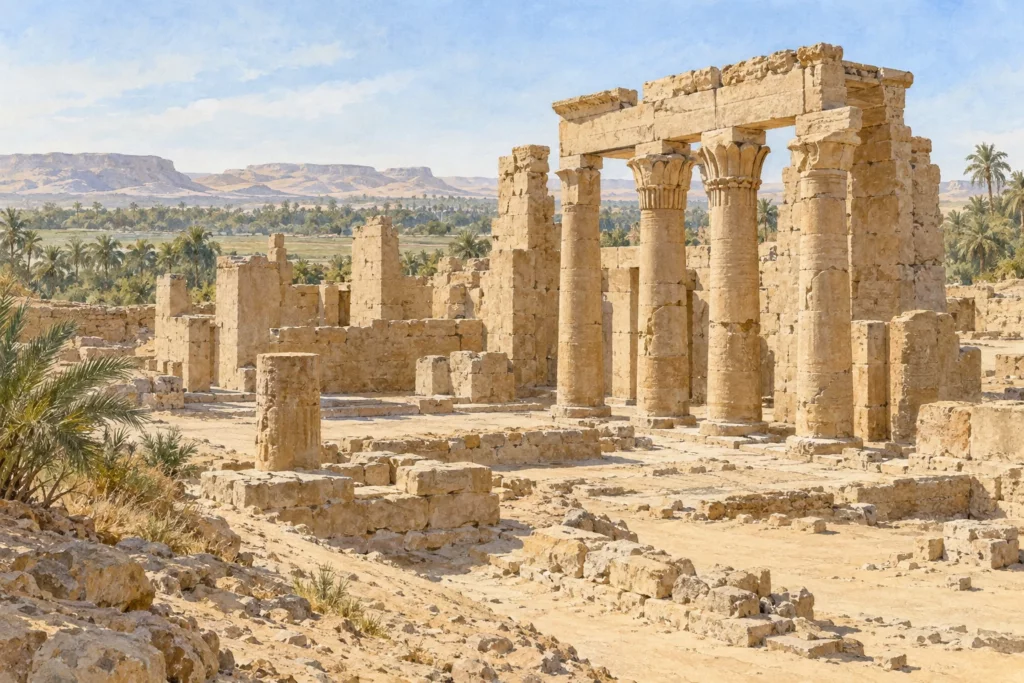
Deir el-Hagar, the ‘stone monastery’ in Arabic, is a small sandstone temple at the western end of the Dakhla Oasis, in the Western Desert. Its main god was Amun-Ra, and Thoth was also worshipped there. Work probably began under Nero, in the 1st century AD, and the decoration was continued under Vespasian, Titus and Domitian; the temple remained in use at least until the 3rd century.
What you discover
The temple is oriented east–west, in the middle of a mud-brick enclosure entered through a stone gateway facing the entrance. The first European to describe it in detail was the British traveller Sir Archibald Edmonstone, who came in February 1819. He measured its plan: a building of about 15.6 metres by 7.5, preceded by a columned portico. Then come a hall with four pillars, then an almost bare room, adorned only with a winged disc above the door. Three small parallel rooms close the whole; the central one formed the sanctuary. He noted walls blackened by the smoke of the cult lamps.
The monument had suffered from sand and from the digging of treasure hunters. Between 1992 and 1995, the Dakhleh Oasis Project cleared and consolidated it with the Egyptian Supreme Council of Antiquities, to safeguard it and make it easier to visit. The present presentation results from this work.
What to look at
Inside the pronaos, in the south room, modern graffiti bear the names of the members of Gerhard Rohlfs’s German expedition, who came in 1874. This team, which included the photographer P. Remelé, had the sanctuary and the offering room cleared in four days: it was the first excavation in the oasis.
More discreet are the traces left by ancient worshippers. The clearance of 1992–1995 revealed a secondary gateway, just south of the main gate of the enclosure. Its jambs kept their lime plaster, covered with painted inscriptions, or dipinti, among them prayers in Greek, names of musicians, drawings of gods and sacred animals. One shows, for example, a ram wearing a lunar crescent, animal of Amun-Ra, facing a baboon, animal of Thoth. Most date from the 2nd century AD. Some were lost in 1998, when one of the jambs deteriorated.
Its history
The temple is one of at least seven stone temples of the Ptolemaic and Roman periods preserved in the Dakhla Oasis. The imperial cartouches are not evidence that the emperors came to the oasis: following the tradition of Egyptian temples, the reigning sovereign, however distant, appears as the officiant of the rites. Two dipinti dated to the month of Tybi, compared with a stela of the reign of Vespasian bearing the same date, suggest that a great festival of Amun-Ra was held at the end of December; its nature remains unknown. The astronomical ceiling of one room, fragments of which were found in 1992–1993, has been dated to the 2nd century AD by comparison.
Sources
Consulted on 30 September 2026: Olaf E. Kaper and Klaas A. Worp, ‘Dipinti on the temenos wall at Deir el-Haggar (Dakhla Oasis)’, BIFAO 99, Institut français d’archéologie orientale; Anna Lucille Boozer, ‘Archaeology on Egypt’s Edge: Archaeological Research in the Dakhleh Oasis, 1819–1977’, Ancient West & East 12, 2013, Institute for the Study of the Ancient World (NYU); The Dakhleh Oasis Project, Netherlands Institute for the Near East, Leiden University.