Identification and location
The Dakhla Oasis, in the Egyptian Western Desert, preserves many settlements and necropolises of the Roman period. This feature selects three of them: the monumental necropolis of Ezbet Bashendi, on the northern edge of the modern village; Amheida, ancient Trimithis, in the north-west of the oasis; and Ismant el-Kharab, ancient Kellis. These sites have neither the same chronology nor the same function, and bringing them together is a convenience of presentation.
Ezbet Bashendi, a row of mausoleums
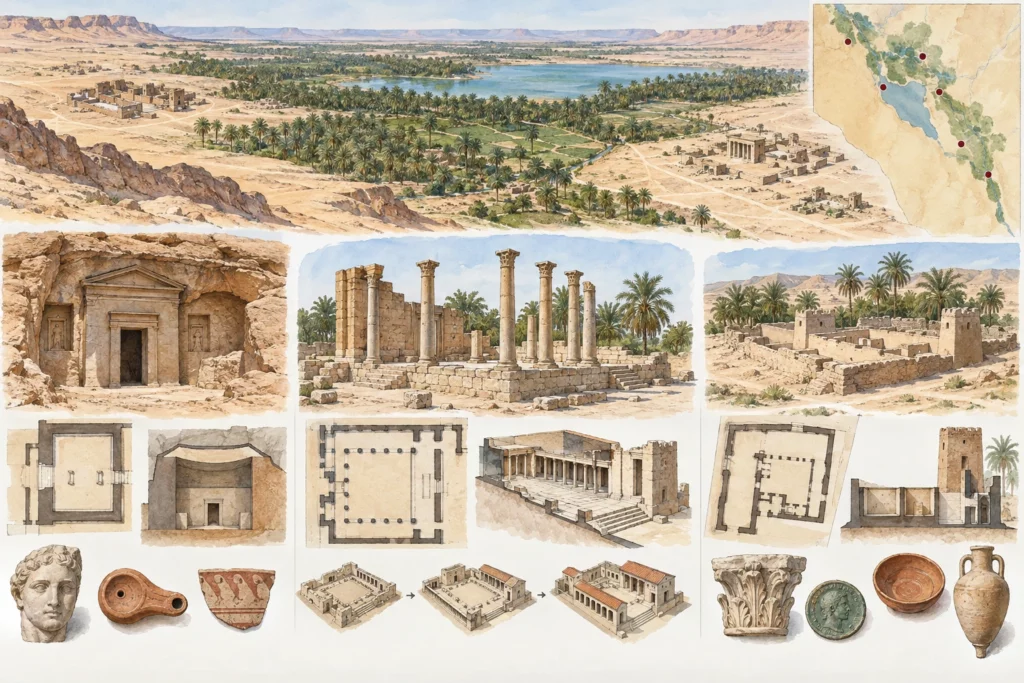
The necropolis has, at the present stage of clearance, six stone tombs. The tomb of Kitynos (tomb 1) follows the plan of a small funerary temple of 8.25 × 8.45 m, opening to the east, with an antechamber, an axial chapel and side rooms; architecture and decoration are in pharaonic style, and J. Osing dated it by palaeography to the 1st or 2nd century AD. Tomb 2 (8.50 × 6.68 m), built against the first, kept beneath its floor two anthropoid limestone sarcophagi, the sign of a family burial. Tombs 3, 4 and 5, of almost identical size (about 7.5 m square), form a group in classical style. They have pilasters with Attic bases and a main niche 2.20 m wide, roofed by an apse. A stone dome on pendentives, 5.35 m high, with interlocking voussoirs, covers the whole. In tomb 3, two pits lined with sandstone slabs, planned from the time of construction for wooden coffins, open beneath the small side niches. Tomb 4 carries the Ottoman qubba of Sheikh Bashendi, which rises six metres above the ancient dome. Tomb 6, isolated and set at 45° off the axis, is known only from its foundations.
The chronology rests on the successive abutments of the masonry: tomb 1, tomb 2, then tombs 3 to 5, which Sayed Yamani considers earlier than the end of the 2nd century. The domed tombs would, in his view, have no documented equivalent for the Roman period in Egypt.
Trimithis, a town of three millennia
Amheida yields remains spanning nearly three millennia. Excavations have concentrated on four areas. The first brings together an aristocratic 4th-century house with wall paintings, an adjoining school and underlying Roman baths. The second is a more modest 3rd-century house. The third is the temple hill, with the remains of a temple of Thoth built in the 1st century AD. The last is a 4th-century funerary church. The house, attributed by ostraca to a councillor named Serenos, was enlarged several times and then abandoned at the end of the 4th century; its paintings, of the second quarter of that century, show subjects from Greek mythology. A mud-brick pyramid and a Roman-period tower tomb have been consolidated.
Kellis and its archives
At Ismant el-Kharab, House 3, cleared in January and February 1991, yielded 4th-century documents in Greek, Coptic and Syriac, including two codices made of wooden tablets bearing Manichaean hymns and psalms. These texts shed light on the life of a Manichaean community in the oasis and on the techniques used to translate its writings.
Missions and publications
The Dakhleh Oasis Project, directed by Anthony J. Mills, cleaned the tomb of Kitynos, discovered by Ahmed Fakhry; the excavations of Kellis, led by Colin Hope, also belong to this project. The antiquities inspectorate of Dakhla excavated Ezbet Bashendi in 1985, under the responsibility of Sayed Yamani; the surveys of December 2000 involved Georges Soukiassian (Institut français d’archéologie orientale, IFAO, French Institute for Oriental Archaeology). At Amheida, the mission opened in 2001 by Columbia University has been run since 2008 by the Institute for the Study of the Ancient World (New York University); directed by Roger Bagnall and Paola Davoli until 2022, it has since been led by David M. Ratzan and Nicola Aravecchia. The American Research Center in Egypt funded the shelter for the decorated blocks of the temple.
What the excavations leave open
At Ezbet Bashendi, the absence of burials in place and of inscriptions rules out an absolute date; the content of the niches (statue or painting) remains hypothetical, and the floor of tomb 4, still sacred, has not been excavated. At Amheida, the destroyed temple of Thoth is now known only from remains and decorated blocks, now sheltered on the spot. The whole rules out reducing the oasis to a typical Roman village.
Sources
Main sources (consulted on 30 September 2026): Sayed Yamani, ‘Roman monumental tombs in Ezbet Bashendi’, BIFAO 101, 2001, Institut français d’archéologie orientale; Excavations at Amheida, Institute for the Study of the Ancient World, New York University; Aloïs van Tongerloo, ‘Coptic Manichean texts’, Encyclopædia Iranica.