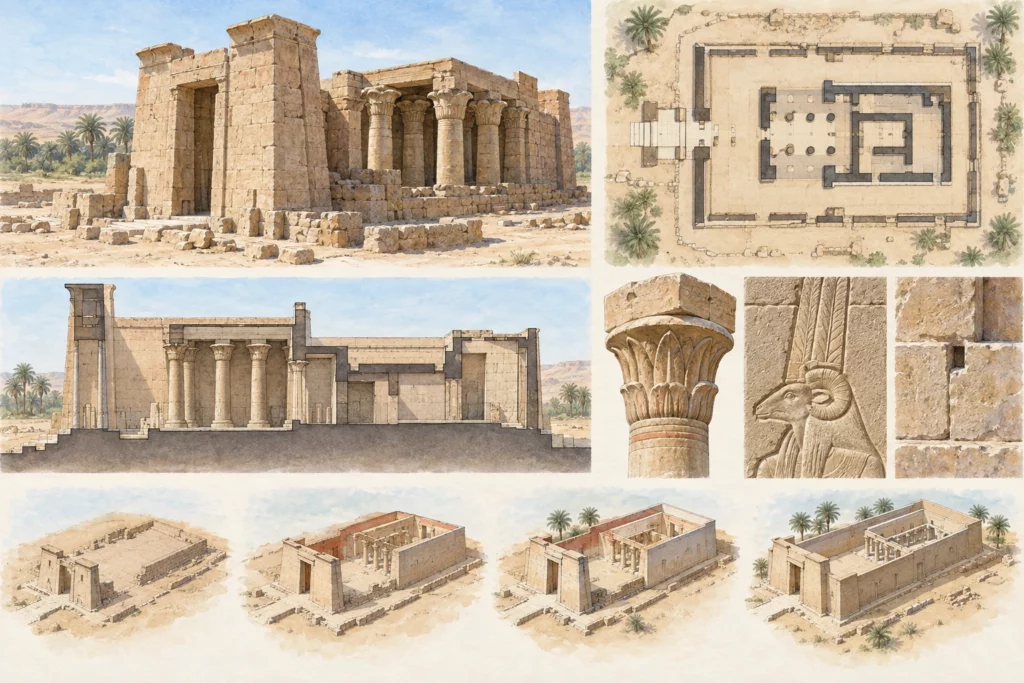
Identification and location
The temple of Deir el-Hagar lies at the western end of the Dakhla Oasis, in the Egyptian Western Desert; it bears the number 33/390-F9-1 in the inventory of the Dakhleh Oasis Project. To the west, the table mountain that Gerhard Rohlfs named Gebel Edmonstone closes the horizon; to the east, the necropolis of El-Muzawwaqa has yielded burials of rams of several species. The monument, a sandstone temple surrounded by a mud-brick enclosure, was dedicated to Amun-Ra, the main god of the place, and Thoth was also worshipped there.
From Nero to Hadrian: an imperial building project
The cartouches make it possible to follow the work reign by reign. The back wall of the sanctuary room was decorated in the name of Nero, which places the beginning of construction in his reign (AD 54–68). The sanctuary room was completed in the name of Vespasian, whose cartouches appear on the south wall. Under Titus, the façade of the temple, which later became the rear wall of the pronaos, received four offering scenes on the lintel of its door and a band of inscription to the north. Under Domitian, the pronaos was completed, with reliefs on the outer walls and cornices, and decoration was added to several inner doors as well as to the gate of the enclosure. Finally, a sandstone barque stand bearing a large cartouche of Hadrian was found during the recent clearance. A bilingual votive stela, in Greek and Egyptian, of the reign of Vespasian (Egyptian Museum, Cairo, JE 51943) is said to come from the back of the temple. A fragmentary Greek dedication of the 3rd century stood along the dromos, inside the main gate of the enclosure. Ahmed Fakhry had discovered it; eight fragments have since completed it.
Plan and astronomical ceiling
The first precise description is that of Sir Archibald Edmonstone, in February 1819. The building, oriented east–west, measured according to him 51 feet 4 inches by 24 feet 8 inches (about 15.6 × 7.5 m). On the façade was a portico of eight columns, only three of which were still standing; then a hall supported by four pillars, a room of the same width, bare except for a winged disc above the door, and three parallel rooms, the central one forming the adyton, still roofed and blackened by the lamps. A mud-brick enclosure, some twenty metres away, opened through a stone gateway on the axis of the entrance.
The astronomical ceiling, new fragments of which were found in 1992–1993, has been entirely reconstructed by Olaf E. Kaper in the Journal of Egyptian Archaeology (vol. 81, 1995). It is dated by comparison to the 2nd century AD; it highlights the opposition of the sun and the moon and presents a local version of the twelve gods of the lunar months.
A festival of Amun-Ra in the month of Tybi
The clearance revealed, just south of the main gate of the enclosure, a secondary gateway whose jambs kept a plaster covered with dipinti, recorded by Kaper in 1993: Greek proskynemata, signatures of an aulos player and a syrinx player and of a pastophoros of Isis, divine figures. One drawing merges Amun-Ra and Thoth into a pantheistic Sarapis; another sets the ram of Amun-Ra against the baboon of Thoth. Two texts are dated to Tybi, one of them to year 5 or 6 (or 15 or 16) of Antoninus Pius; since the stela of Vespasian also bears the date 1 Tybi, Kaper and Worp see in this a great festival of Amun-Ra at the beginning of that month, unknown from the papyri.
Travellers, excavators and restorers
After Edmonstone, Bernardino Drovetti and Frédéric Cailliaud passed through Dakhla in 1819–1820. In February 1874, Gerhard Rohlfs’s expedition had P. Remelé clear the sanctuary and the offering room in four days with fifty workers, the first excavation in the oasis; Lepsius transcribed and described the inscriptions and reliefs uncovered, and the names of the team remain carved in the pronaos. Herbert E. Winlock, who came in 1908, published the decoration in 1936. Ahmed Fakhry excavated in front of the pronaos in 1972–1973, and the Dakhleh Oasis Project surveyed the surroundings in 1978. From 1992 to 1995, this project, with the Supreme Council of Antiquities, cleared and consolidated the temple. In spring 1998, part of the dipinti was lost.
Sources
Main sources (consulted on 30 September 2026): Olaf E. Kaper and Klaas A. Worp, ‘Dipinti on the temenos wall at Deir el-Haggar (Dakhla Oasis)’, BIFAO 99, Institut français d’archéologie orientale; Anna Lucille Boozer, ‘Archaeology on Egypt’s Edge: Archaeological Research in the Dakhleh Oasis, 1819–1977’, Ancient West & East 12, 2013, Institute for the Study of the Ancient World (NYU); Olaf E. Kaper, ‘Emperor Names in Dakhleh Oasis’, 2012 (author’s offprint).