Identification and location
Ain al-Sabil lies in the Dakhla Oasis, in the New Valley governorate, in the heart of the Western Desert. An Egyptian mission of the Supreme Council of Antiquities has uncovered there a town of the Byzantine period, whose discovery was announced in July 2026. The site adds to the many ancient settlements of the oasis, such as Amheida or Kellis, and documents a Christian community of the 4th century.
A planned town
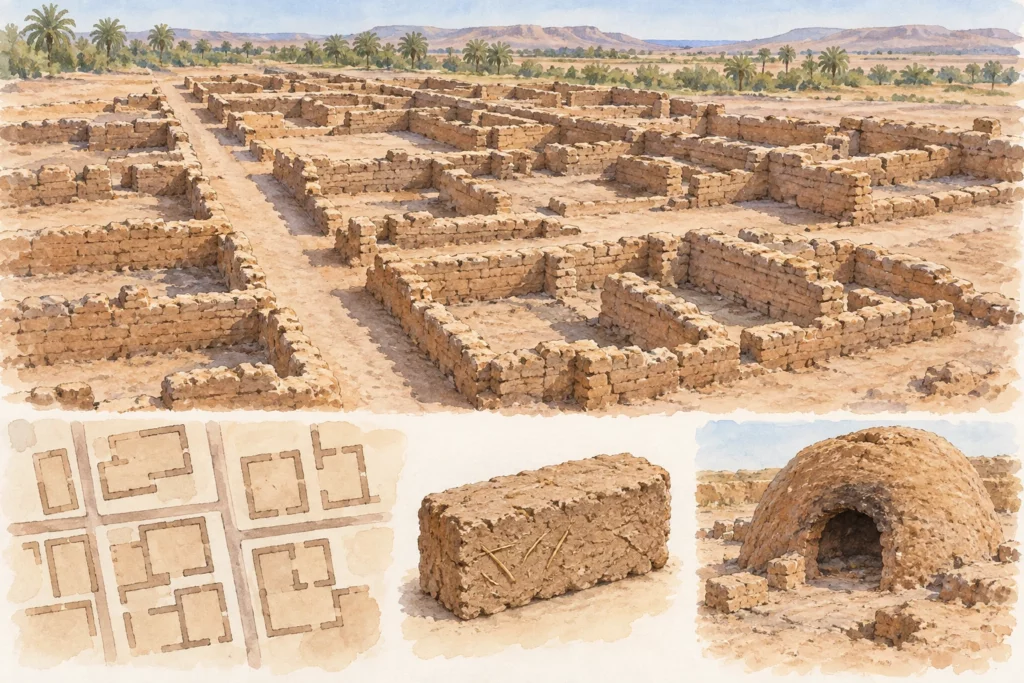
The town has a regular plan: wide streets running north–south are crossed by narrower streets running east–west, which open up squares and open spaces. This network bears witness to a deliberate organisation, going beyond a mere spontaneous cluster of houses. A thick-walled fortress and two watchtowers, on the outskirts, ensured the surveillance and defence of the settlement, in a region exposed to raids from the desert.
The basilica
At the centre of the urban network, along one of the main streets, rises a basilica-type church, built in the middle of the 4th century AD. Its central position shows the place Christianity already held in the life of the community. An older building, attributed to a certain Tabibos and dated to the beginning of the 4th century, is thought to have served as a Christian meeting place, a house church, before the basilica was built.
The houses
The dwellings, of mud brick, have large reception rooms, vaulted roofs, bread ovens and kitchens. One of them has been identified as the house of a deacon named Tisous, built in the second half of the 4th century. The finds include cooking and storage pottery, oil and perfume flasks, lamps and grindstones for milling grain, which shed light on domestic life.
Written documents and coins
Some 200 ostraca, inscribed potsherds, bear texts in Coptic and Greek: sales, purchases, commercial agreements, personal letters and other documents of daily life. They show the coexistence of the two languages in the administration and trade of the oasis. Bronze coins bearing the images of emperors and Christian symbols, as well as gold coins of Constantius II (337–361), place the main occupation in the 4th and 5th centuries.
Significance and research questions
Ain al-Sabil offers the image of a small Christian town of the oasis at the moment when Christianity was becoming the dominant religion of the Empire. The study of the ostraca, the basilica and the town plan will help us to better understand the organisation of a community of the Western Desert, its economic activities and its links with the Nile Valley.
Sources
Main sources (consulted on 28 September 2026): Archaeology Magazine, the Byzantine town of Ain al-Sabil (July 2026).